TUBIN/TUBSAT-27 Re-Entry

Hi everyone,

we now expect the next re-entry of a TU Berlin satellite, this time of TUBIN (project website). The latest prediction by GSSAC is around 2025-12-16 10:09:02 (UTC) ± 30 h, (but we recently entered a low-drag mode, so could be a bit later). Following the great success we had with the BEESAT re-entries (see respective posts: BEESAT-2, BEESAT-4, and BEESAT-9) we will try to repeat it with this bigger and more capable satellite.

Orbit Determination

For orbit determination we will rely both on GNSS data and UHF STRF measurements conducted with our Berlin ground station (SLR could be another very precise measurements, but OD has to be already quite good to hit with the laser and most likely this is not the case in the last days). Any TLEs we create we will publish here, the SatNOGS DB and our public TLE GitLab repository (be aware this could include multiple TLEs with different NORAD IDs as we want to have the ability to shift between those live in a pass). But of course we are also appreciating any TLEs generated by the SatNOGS community, only through them we were able to follow BEESAT-9 up to an altitude of ~100 km.

Communication

TUBIN will utilize the same communication bands as throughout its lifetime with the addition of an UHF beacon as described below.

UHF Communication

  • Frequency: 435.95 MHz
  • Modulation: GMSK BT=0.3 with 4800 bd
  • Framing: MobiTUB, details see answer #42

We just conducted the final software update for TUBIN, which implements a telemetry beacon similar to the one on the BEESATs. This will allow us to automatically transmit telemetry also outside of our ground station contacts (Berlin, Germany and Longyearbyen, Svalbard, Norway). If you are interested in decoding the UHF telemetry, @kerel recently wrote a functional MobiTUB decoder for gr-satellites with GNUradio 3.10 which is now also included in the 2.1 release of the SatNOGS client.

The auto send feature is now enabled until the end. Currently we are transmitting every 20 seconds one beacon, but that will be soon increased to every 10 seconds. The content of the beacons is described in answer #37.

S band Communication

  • Frequency: 2263 MHz and 2266 MHz (two independent transmitters)
  • Modulation: DQPSK with BPSK preamble
  • Framing: Custom, see decoder and example IQ file in answer #17
  • Recommended IQ recording settings for both bands:
    • Sample rate: 6 Msps
    • Center frequency: 2264.5 MHz

TUBIN also transmits telemetry and payload images in the S band. When I asked earlier this year how recordings of this high data band could be achieved we came to the conclusion that transmitting IQ files to us, we decode them and sent the telemetry back is not very feasible due to the file size of 5-15 GB/pass. Luckily our colleague PistonMiner recently developed a HiSPiCO modem in GNUradio/Rust. A preliminary version was published recently, for more information see answer #17.

As the opening angle of the HiSPiCO transmitters is around 45° (half-angle) and the ADCS system is more powerful than on the CubeSats we are quite confident that the satellite will be able to conduct attitude control and to transmit data. Our biggest concern currently is the pointing of our ground station antenna as its opening angle is only a few degrees. To mitigate the risk of misalignment we will also have support from some other S band ground stations (AFUTUB, TU Graz, maybe something with ESOC) which then can use different TLEs. But any further support from the SatNOGS community is of course very much appreciated.

X band Communication

To our knowledge there are no SatNOGS ground station suitable for X band and as this band is limited to payload data, this is less of a focus of the End of Life campaign.

Telemetry forwarding

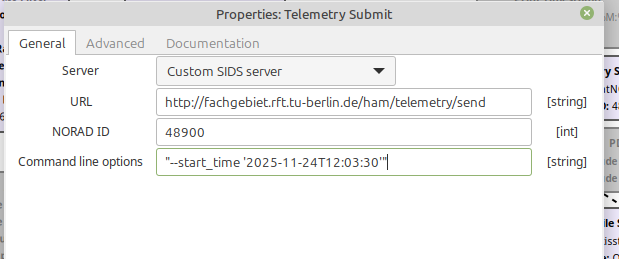
You can forward telemetry to us via our SiDS server:

Also we have prepared specialized TUBIN re-entry QSL cards, just reach out to us via this thread or PM if you want one.

That is it for now, if you have any questions feel free to reach out :slight_smile:

Julian for the TUBIN Ops Team

Change Log:
2025-12-11 01:14: Updated outdated information, added links to relevant answers in this thread and other sites and added information about modulation of signals.

9 Likes

just waiting its released for satnogs client docker version. thank you!

I’ve updated my gr_satellites installation as well as GNUradio to 3.10.12.0.
However, where now decoded frames should appear, there is only a constant flow of lines like this

correlate_access_code_tag_bb :debug: writing tag at sample <number>

Since this seems to have something to do with my installation and not with the decoder itself, I’ll have to stay with UZ7HO’s SoundModem.

trying pull satnogs-client:master-unstable

the gr_satellites is latest version. greatz


satnogs-client@470c36cecee2:/$ gr_satellites --version
gr_satellites v5.8.0

Copyright 2016-2025 Daniel Estevez

License GPL-3.0-or-later: GNU GPL version 3 or later
<https://gnu.org/licenses/gpl.html>.
This is free software: you are free to change and redistribute it.
There is NO WARRANTY, to the extent permitted by law.
1 Like

Are you trying to say that the satnogs-client has gr_satellites already on board?

There seem to be a SatNOGS version/release with gr-satellites onboard, but I am lost on what release/source and how to install activate.

Maybe @bali can point us in the right direction.

Jan | PE0SAT

With some trial and error I got a docker compose up and running, this is far from complete.

For example I don’t know how gr_satellites is integrated with this SatNOGS client and how to call and configure its operation.

services:

  rigctld:
    container_name: satnogs-client-rigctld
    image: 'librespace/hamlib:4.5.4'
    user: '999'
    read_only: true
    environment:
      MODEL: '1'
    restart: 'unless-stopped'
    command: 'rigctld'

  satnogs_client:
    container_name: satnogs-client
    image: 'librespace/satnogs-client:master-unstable'
    user: '500:500'
    read_only: true
    device_cgroup_rules:
      - 'c 189:* rwm'
    environment:
      SATNOGS_API_TOKEN: 'your api token'
      SATNOGS_LOG_LEVEL: 'INFO'
      SATNOGS_SOAPY_RX_DEVICE: 'driver=rtlsdr'
      SATNOGS_PPM_ERROR: '0'
      SATNOGS_RF_GAIN: '32.8'
      SATNOGS_ANTENNA: 'RX'
      SATNOGS_RX_SAMP_RATE: '2.048e6'
      SATNOGS_STATION_ELEV: 'your height'
      SATNOGS_STATION_ID: 'your id'
      SATNOGS_STATION_LAT: 'your lat'
      SATNOGS_STATION_LON: 'your long'
      SATNOGS_RIG_IP: 'rigctld'
      SATNOGS_RIG_IP: 'rigctld'
      GR_SATELLITES_ENABLED: 'true'
      GR_SATELLITES_APP: 'gr_satellites'
      GR_SATELLITES_KEEPLOGS: 'true'
      # GR_SATELLITES_ZMQ_PORT: 'tcp://127.0.0.1:5555'
      UDP_DUMP_HOST: '127.0.0.1'
      UDP_DUMP_PORT: '51696'
    command: 'satnogs-client'
    volumes:
      - type: 'tmpfs'
        target: '/tmp'
      - type: 'volume'
        target: '/var/lib/satnogs-client'
        source: 'satnogs-client'
      - '/dev/bus/usb:/dev/bus/usb'
    restart: 'unless-stopped'

volumes:
  satnogs-client:

It does seem to have a recent gr-satellites version.

satnogs-client@83f911b040ec:/$ gr_satellites --version
gr_satellites v5.8.0

Copyright 2016-2025 Daniel Estevez

License GPL-3.0-or-later: GNU GPL version 3 or later
<https://gnu.org/licenses/gpl.html>.
This is free software: you are free to change and redistribute it.
There is NO WARRANTY, to the extent permitted by law.

d.d. 11-11-2025 18:30 UTC updated the docker compose with the gr-satellites environment and the correct image.

This isn’t ready for production but should work and gives you the opportunity to do some R&D.

SatNOGS ground station 1696 is running this configuration.

Jan | PE0SAT

4 Likes

i just want say the image: librespace/satnogs-client:master-unstable have a recent gr-satellites version. before have an old version.

1 Like

no signal on Mode U

I guess you are referencing to the 8 observations on your 4451 station between Monday, 2025-11-10 21:38:43 and today? That is expected as the auto-send test only run until Monday 18:00 UTC and the satellite otherwise is only active in reach of our ground stations in Berlin, Germany, and Svalbard, Norway. But there will be more tests with auto-send soon, we will let you know.

2 Likes

Next Auto Send test will be active on Monday, 24.11., between 12 and 17 UTC with an interval of 10 seconds. We will also activate every attitude control system to stress test power budget while continuously transmitting with a short interval. The following source packets will be included in every frame:

  • 87: TmGps
  • 102: ObcTemperatures_TB
  • 131: TmAocsStateEstimationA
  • 143: TmAocsStateControl
  • 169: SolarPanel_TB
  • 177: Pcu_v2
  • 178: Battery_v2
  • 181: TmAocsVecTemperature
2 Likes

Hi Julian,

Will the UHF down-link be activated during this upcoming test? If so, the prediction is for an almost overhead pass here in EM12jw (Near Ft. Worth) with an AOS of 1207Z.

Thanks,

Bob

N6RFM/5

Hi Bob,
Yes, similar to the last test two weeks ago the satellite will transmit on UHF regularly. For example see SatNOGS Network - Observation 12705580 for what to expect. The only difference will be that the interval will be reduced from a frame every 30 seconds to one every 10 seconds.

The term “Auto Send” is used by us to state that the satellite is transmitting telemetry independently from from a ground station contact and at a regular interval. For now the feature is only active during certain tests, but it will run consistently in last days before re-entry. This will help us to generate fresh TLEs from Doppler shift measurements, but also the telemetry is relevant, see the BEESAT-9 Re-Entry thread.

Best Julian / DH4RJU

Hi Julian,

Thank You! Looking forward to receiving Tubin here.

Bob

N6RFM/5

2 Likes

Also tried to send frames to this server, but appears offline. Does the team prefer we only use the Satnogs server for data uploads?

Thanks!

Bob

N6RFM

3 Likes

Hi Bob,
great that you were able to receive it! The server is indeed offline after a recent server migration, but @PE0SAT already asked for that and we were bring it back online later this week. Will let you know here when this is done.

Best Julian

2 Likes

Great news our colleague PistonMiner has published their HiSPiCO modem that can be used to decode the TUBIN S band transmitters.

See their post on Mastodon here:

The GitHub repository (it also shows how to decode IR images :smiley:):
PistonMiner/hispico-receiver: Software receiver for the HiSPiCO transmitter

You can find an IQ recording from our ground station here:
iq_recording_2025-11-07T18-32-11Z.raw

Settings:

  • Center Frequency: 2264.5 MHz
  • Sample Rate: 6 Msps
  • Format: iShort / int16

TUBIN’s S band transmitters at 2263 MHz and 2266 MHz are active for every pass over 10° elevation at our Berlin ground station. It should transmit empty frames if nothing is scheduled, but for most passes we schedule a downlink. Telemetry is mostly transmitted during the weekday afternoon/evening passes and images for the night/morning passes and on weekends.

If you are not within Europe let us know and we will try to sent something during a pass over your ground station.

6 Likes

@PE0SAT @N6RFM The SIDS server is back online and now reachable under the following URL. Let us know if there are any further problems.

http://radio.space.tu-berlin.de/telemetry/send

2 Likes

This server only for TUBIN?

Yes it is, but when we where checking if it was accessible it didn’t except connections, so lets wait for some confirmation if it is open for business

gr_satellites has the option to configure a separate SIDS receiver, here an example with the old SIDS receiver.

name: TUBIN
norad: 48900
telemetry_servers:
  - SIDS http://fachgebiet.rft.tu-berlin.de/ham/telemetry/send
data:
  &tlm Telemetry:
    telemetry: tubix20
transmitters:
  4k8 FSK downlink:
    frequency: 435.950e+6
    modulation: FSK
    baudrate: 4800
    deviation: 1200
    framing: Mobitex-NX
    callsign: DP0TBN
    data:
    - *tlm

Jan | PE0SAT