We will be very happy to send the QSL card and a mission patch to anyone who receives telemetry on CW or LoRA. For the moment if you want you can send it to lw2dtz@gmail.com
3 Likes
HADES-L Telemetry
Begin 2026-10-03 20:44:30 UTC
Replay audio file.
Real Time UTC = Local Time - 5:49:08
HADES-L_20261003_204430Z_DATA.zip (43.8 KB)
2 Likes
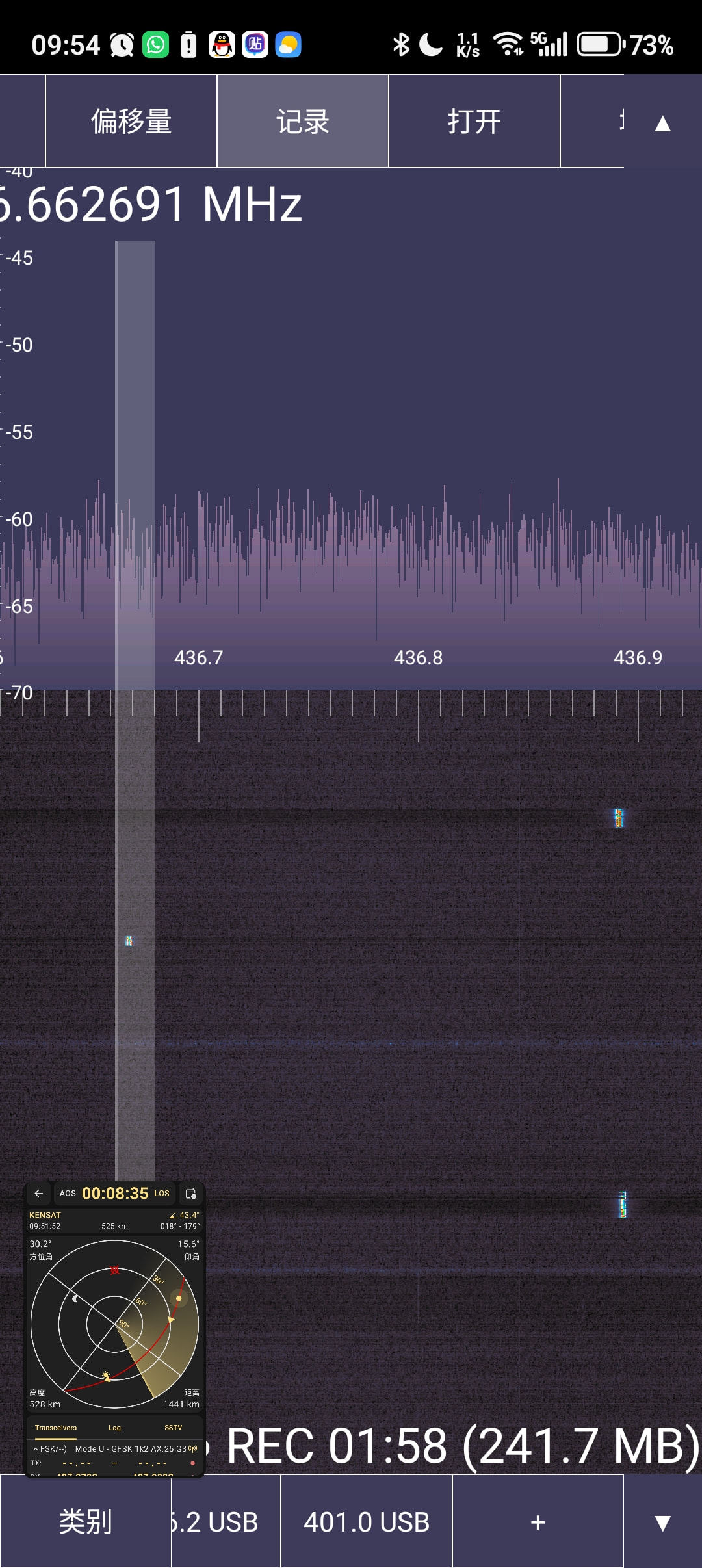
HADES-L over Brazil  ~01:13UTC !!
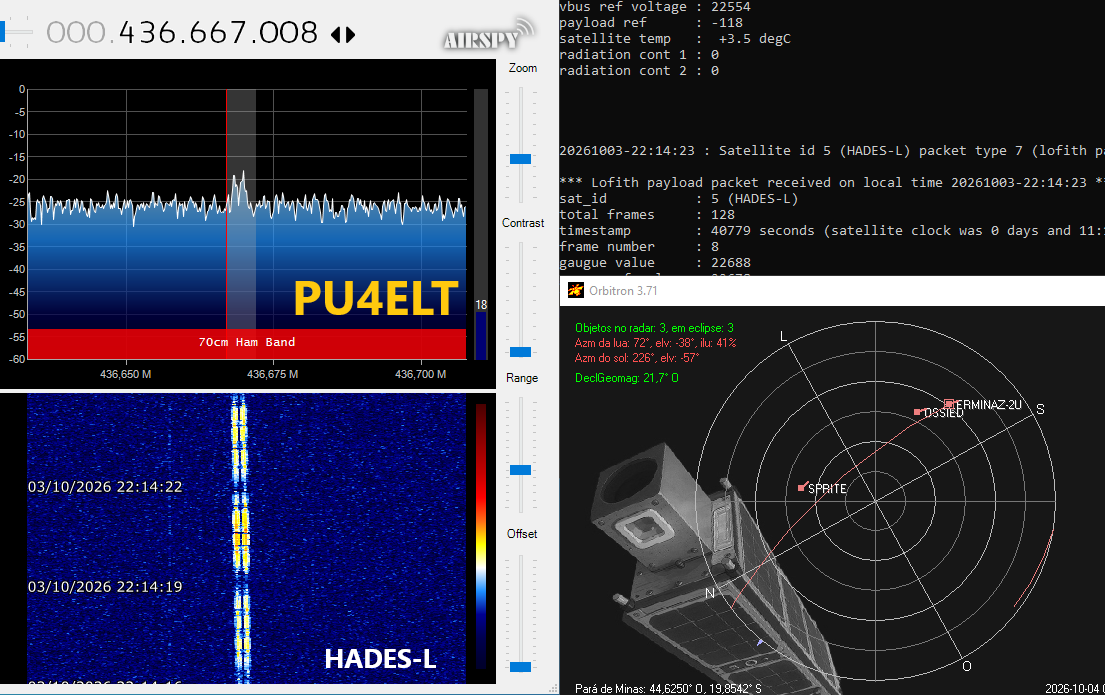
ERMINAZ-2U over Brazil ~01:13UTC !!

- HI HI DE DP0PQA ! +
UNNE-1B It’s still at 800 bps as @dl7ndr had already noted !!
4 Likes
Lots of activity between 436.6 - 436.9 on the last past over Argentina.
For anyone interested you can find baseband file on this shared folder: Seafile SENyT
2 Likes
0331UTC PN27
Confirm HADES-L start transmit long signal,But i dont know for information
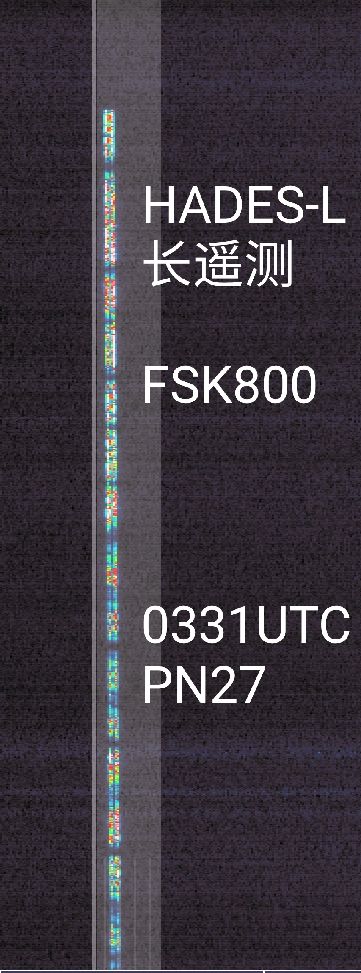
i not got my laptop to my home…
1 Like
Hi everyone, I’m back online, it looks like UARX didn’t followed the expected at-least-one-week-after-launch deployment and had already deployed all the satellites.
In the next couple of hours I’m going to add them in DB (most of them have already suggestions, thank you for that), post TLE with the temporary NORAD IDs here and do some re-scheduling in the Network to include all of them.
Congrats and good luck to all the teams!
5 Likes
Thank you in advance for all the work on the new sats.
By chance can you shed any light on this SIDLOC project? It’s been mentioned as active on some of the T-18 sats. If it’s easier to direct us to an online resource, of course that’s fine, too. I’ve reviewed the GitLab repository but that only helps but so much on the first day you become aware of a project. Thanks!
I’ll write a more detailed post later.
Quickly, at 401.5 MHz there will be transmitted spread-spectrum signals (expected under the noise floor) in a range of 1MHz (400.5 MHz - 402.5 MHz), so we need IQ, non-doppler corrected, with at least 2Msps that covers that range following for now TLE (passes) of OSSIE-D posted in previous post.
These IQ files will be analyzed and will be used for calculating orbit from doppler. You can check the previous experiment on Ariane 6 https://2025.smallsateurope.com/download/4493/?tmstv=1791089964.
There are 4 pocketqubes that transmit on this frequency and the goal is after the analysis to have data from all of them.
PS If you catch an IQ and you don’t have a way to share it, please contact me and I’ll give you some instructions where to upload the file.
2 Likes
Thanks very much - will setup for that on future T-18 passes!
1 Like
@LW2DTZ In IARU Sat Coordinator it says 436.650 MHz which one is the correct?
Also what about the GFSK transmission that is written in the same coordination page?
EDIT: I found somewhere else 436.850 MHz, so I’m going to use this for now, but please let me know if this is a typo in IARU page or something else.
EDIT 2: It looks like 436.650 is outside the range described in ITU entry
EDIT 3: I think I’m getting it but not sure if I’m right, so any confirmation of my understanding is more than appreciated. UTNH is not coordinated yet and transmits at 436.850 MHz and Sanosat-2 (SAJILO) is coordinated and transmits at 436.650 MHz
Hola Gustavo,
Just a small suggestion that might help with collaboration: when sharing IQ files, following a naming scheme like the one gqrx uses makes things a lot easier and sticking to UTC avoids any time zone confusion.
Also, it’s super helpful to explicitly mention the data format (e.g., float32, int16) or what tool was used to record it. And if anyone is planning to run Doppler analysis down the road, sharing an approximate location (and, naturally, keeping the raw recording without any applied Doppler correction) is key!
Hope that this message sounds as constructive as I intended.
Saludos!
3 Likes
Hello!
All that information should be available on the metadata of the file since it was recorded as WAV. If I recall correctly it was uint8 at 2MHz sampling rate. The center frequency is on the filename.
The recording was made in La Plata, Argentina on 4 October 2026 at 02:32.
I’ll take a look at gqrx naming convention for next uploads. Thank you for your suggestion!
Abrazo
1 Like
@LW2DTZ I’m doing this as a separate post just to point it out.
I’ve just finished reviewing and adding in DB all the UARX sats.
A quick break and next step to create TLE sets and add them in DB, in order to be able to schedule them in Network.
If I missed any of the satellites please let me know, the added ones are:
| Satellite | Temporary NORAD ID |
|---|---|
| SANOSAT-2 | 98385 |
| NIS-PQ | 98225 |
| EDUSAT-2 | 98214 |
| EDUSAT-3 | 98213 |
| USAT-I | 98212 |
| UTNH-SAT | 98211 |
| ETNS | 98210 |
| ERMINAZ-2X | 98209 |
| ERMINAZ-2V | 98208 |
| ERMINAZ-2U | 98207 |
| HADES-L | 98206 |
| UNNE-1B | 98205 |
| SIDLOC PQ-03 | 98204 |
| SIDLOC PQ-04 | 98203 |
| SIDLOC PQ-05 | 98202 |
| SIDLOC PQ-06 | 98201 |
6 Likes
Based on three passes over Europe, I have the following ERMINAZ-2U TLE set.
ERMINAZ-2U
1 98207U 26227BL  26276.93389170  .00000000  00000-0 -12652-2 0    00
2 98207  97.4462 346.2582 0003041 135.4993 275.4471 15.16473401    04
# 20261003.80-20261003.94, 18 measurements, 0.061 kHz rms
(I used the signal edges and that is the reason it is showing 435.905 MHz)
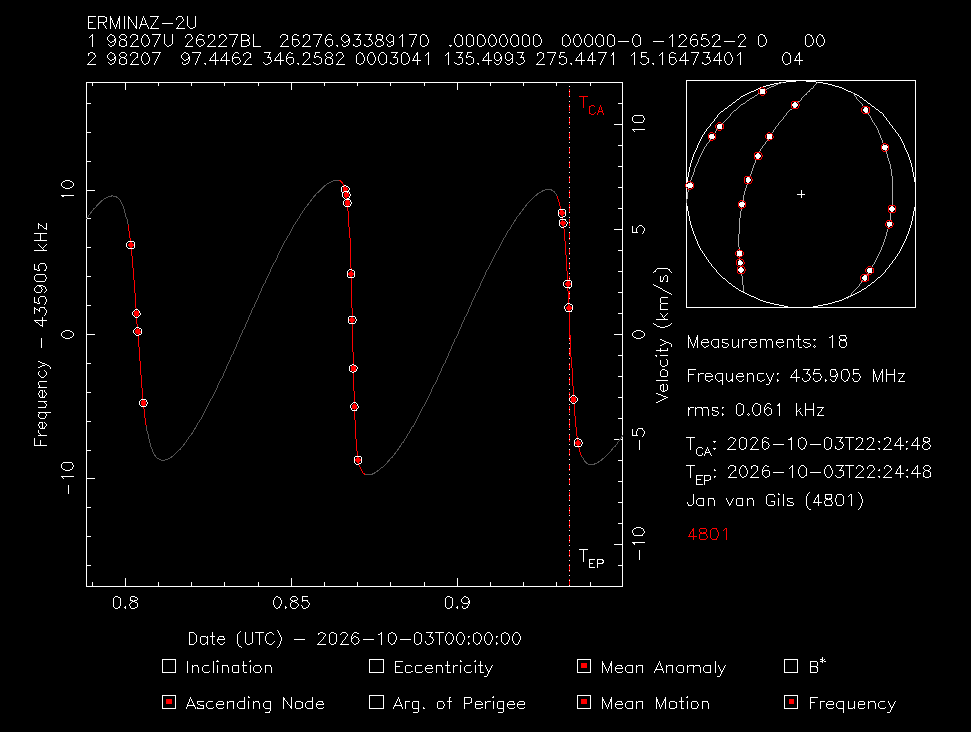
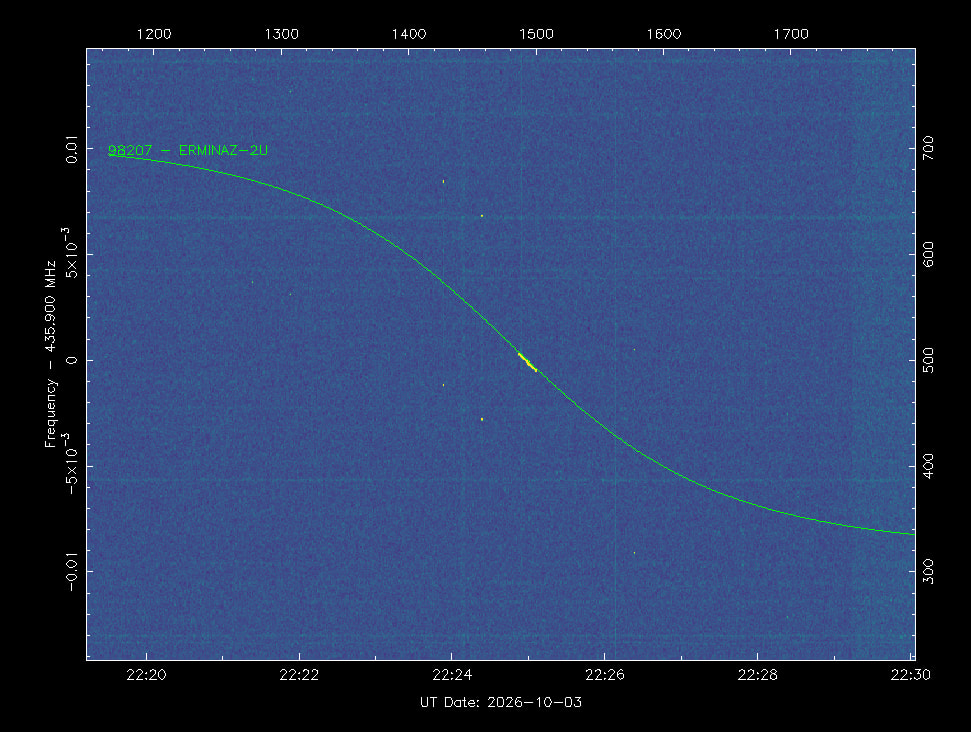
Jan | PE0SAT
4 Likes
Hello sorry for the late reply but as fredy said some things got activated sooner than expected so i have not managed to find all the necessary information to share with the community. Start with what fredy provided and when new information is available we are gonna share it with the community.
1 Like
Here are the TLE for the TLE for the satellites deployed by UARX, I used two different TLEs, for the ones that were part of PICOBUSv2 deployment, I used the TLE @PE0SAT generated for ERMINAZ-2U, as more or less all of them have the same mass and shape, for the rest I used the celestrak’s post launch TLE for OSSIED. The difference is about 1min between the two TLE sets, so even if we use the “wrong” ones for any of the satellites, we should be able to see something in our observations:
SANOSAT-2
1 98385C 26227BL  26274.81462064 -.00012609  00000-0 -12652-2 0  9992
2 98385  97.4462 344.3315 0003041 135.4993 228.5794 15.17406584    11
USAT-I
1 98212C 26227BL  26274.81462064 -.00012609  00000-0 -12652-2 0  9991
2 98212  97.4462 344.3315 0003041 135.4993 228.5794 15.17406584    10
UTNH-SAT
1 98211C 26227BL  26274.81462064 -.00012609  00000-0 -12652-2 0  9990
2 98211  97.4462 344.3315 0003041 135.4993 228.5794 15.17406584    19
ETNS
1 98210C 26227BL  26274.81462064 -.00012609  00000-0 -12652-2 0  9999
2 98210  97.4462 344.3315 0003041 135.4993 228.5794 15.17406584    18
HADES-L
1 98206C 26227BL  26274.81462064 -.00012609  00000-0 -12652-2 0  9994
2 98206  97.4462 344.3315 0003041 135.4993 228.5794 15.17406584    13
UNNE-1B
1 98205C 26227BL  26274.81462064 -.00012609  00000-0 -12652-2 0  9993
2 98205  97.4462 344.3315 0003041 135.4993 228.5794 15.17406584    12
NIS-PQ
1 98225U 26227BL  26276.93389170  .00000000  00000-0 -12652-2 0    00
2 98225  97.4462 346.2582 0003041 135.4993 275.4471 15.16473401    04
ERMINAZ-2X
1 98209U 26227BL  26276.93389170  .00000000  00000-0 -12652-2 0    02
2 98209  97.4462 346.2582 0003041 135.4993 275.4471 15.16473401    06
ERMINAZ-2V
1 98208U 26227BL  26276.93389170  .00000000  00000-0 -12652-2 0    01
2 98208  97.4462 346.2582 0003041 135.4993 275.4471 15.16473401    05
ERMINAZ-2U
1 98207U 26227BL  26276.93389170  .00000000  00000-0 -12652-2 0    00
2 98207  97.4462 346.2582 0003041 135.4993 275.4471 15.16473401    04
SIDLOC PQ-03
1 98204U 26227BL  26276.93389170  .00000000  00000-0 -12652-2 0    07
2 98204  97.4462 346.2582 0003041 135.4993 275.4471 15.16473401    01
SIDLOC PQ-04
1 98203U 26227BL  26276.93389170  .00000000  00000-0 -12652-2 0    06
2 98203  97.4462 346.2582 0003041 135.4993 275.4471 15.16473401    00
SIDLOC PQ-05
1 98202U 26227BL  26276.93389170  .00000000  00000-0 -12652-2 0    05
2 98202  97.4462 346.2582 0003041 135.4993 275.4471 15.16473401    09
SIDLOC PQ-06
1 98201U 26227BL  26276.93389170  .00000000  00000-0 -12652-2 0    04
2 98201  97.4462 346.2582 0003041 135.4993 275.4471 15.16473401    08
Next step, open slots in Network for scheduling observations, in other words re-scheduling for the launch.
5 Likes
First post have been updated with the UARX deployed satellites frequencies.
4 Likes
Booklets for two of the three ION Deployers:
ION SCV Empowering Ekaterina → The Sky Isn’t the Limit (no deployable satellites, only four payloads)
ION SCV Alluring Alexander → Into the Quiet Dark (deployable satellites: OSIRIS-C to -F (4x3U), MOI-1A (6U) and two payloads)
source: Missions | D-Orbit
Into the Quiet Dark Mission Booklet.pdf (1.5 MB)
The Sky Isn’t the Limit Mission Booklet.pdf (2.3 MB)