Here are some of the identifications/current fits more to come later or tomorrow, special thanks to @PE0SAT and @pe2bz for their help to perform and verify identifications:
We’ve checked the TLE for 68474 (Object BL) with BLACK KITE 2(we believe it’s 88092). The parameters are match. We can confirm that 68474 is BLACK KITE 2.
Hi Bali, thanks a lot for your interest and for sharing the reception results.
Unfortunately, we’re not able to share the decoding/conversion script, as it involves a proprietary format used by the module vendor. Sorry about that.
We really appreciate your continued interest in our satellites and the reception reports you’ve been sharing. We’ve noticed your observations and truly appreciate your support.
Unfortunately due to an urgent issue, I’ll not be able to check today the rest of the satellites, if you have any suggestions, please post them here and I’ll make sure to add them in DB.
PARUS-6U1 is active and we have good signals received. Can you share information on the data that is being send.
I have been trying to decode the data but unable to get some frames.
Hi @fredy,
We have found an updated TLE for VEGAFLY-1 from satellitemap.space.
Could you please help verify and update it in the SatNOGS database?
Link: Find Vegafly-1 — Live Satellite Tracking
As you will see in Jonathan’s catalog the Vegafly-1 entry, next to 68420, in the Satcat column has the value NNA which from the documentation of the catalog means that the satellite isn’t identified but just random assignment/placeholder.
I guess that this is done by Jonathan to check if all the objects of this launch have an object in space-track.org/NORAD catalog or if we miss something or have more than expected objects.
As we have kind of mitigated yesterday’s issue, I’ll try today and tomorrow to continue the analysis to identify the rest satellites of this launch that the Network or strf observations from our contributors have received. In case that weren’t received I’m going to assign a random object to follow based on some other criteria.
Of course our good friend Vlad was on the mark, but the plot thickens! A deeper dive using Claude.AI, confirmed Endurosat framing but with a twist.
For the IQ sample I collected, there is “5× 0xAA preamble, then 0x7E 0x7E sync word, then 84 9C 60 A8 92 A8 — which is BN0TIT in AX.25 left-shifted encoding! And bit offset 49 shows it even more clearly: 424e30544954 = BN0TIT in plain ASCII!”
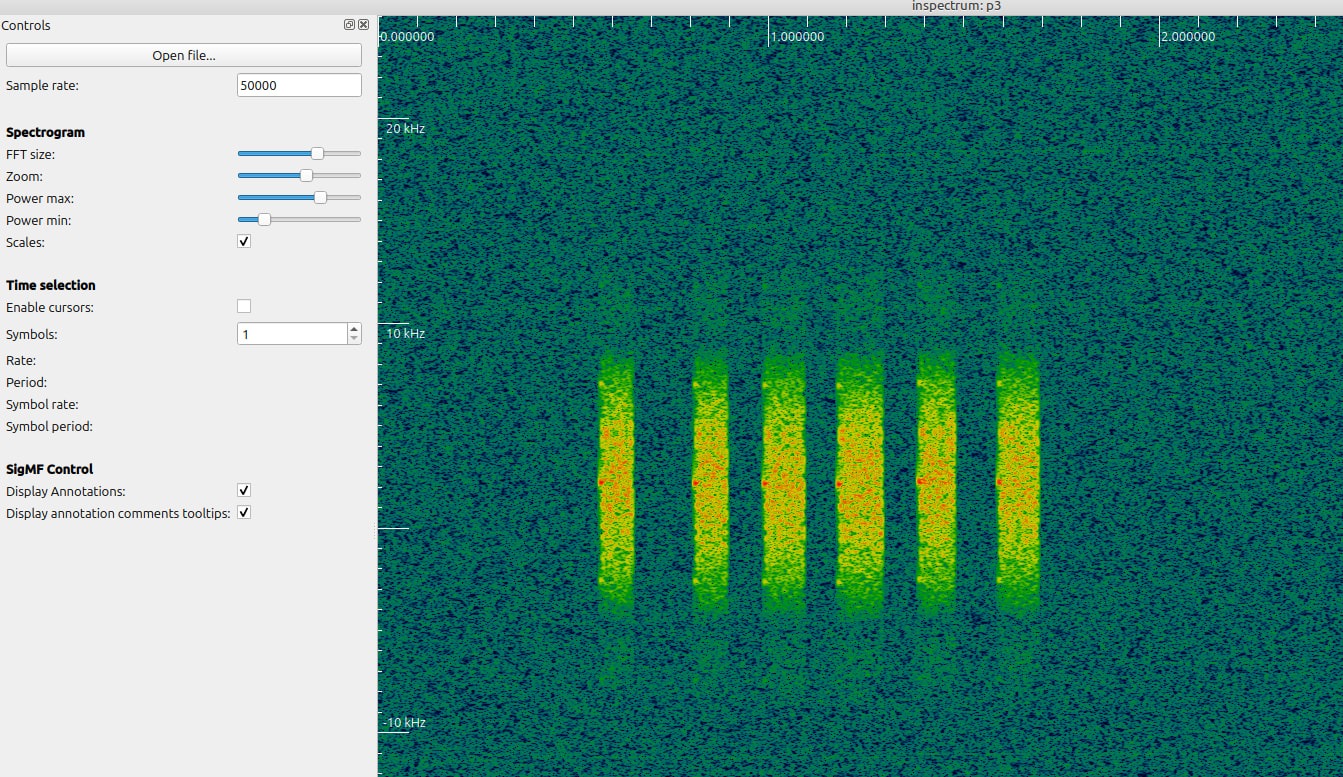
The zip file attached which includes a test decoder in python, a test iq file called p1.iq and an output.txt file. Results below are from the frames shown above using Inspectrum. Sample- 50000SPS_437194000Hz_2026_04_18_T08-24-00Z over Bristol_RI, FN41iq. Note that the python script will need to be edited if you want to try this.
Example partially decoded frame. Source still scrambled but BN0TIT-15 destination. tada!
[PARUS-6U1 Frame #3]
Dest: BN0TIT-15
Src: ??�1%1-10 (G3RUH scrambled)
Len: 112 bytes
Hex: 849c60a892a87e7e7e34624a62b4820ffdcfc8df211c4c3580d7b53e4c83acc18b7f0f1fe4bd16f04e4ecb19ab3997b7d7af693f2e272eeb2908b10bd365fb43ad924fdc5b05e00a6ef58865495db0401c730971468d5892946df0dd3f4605ba3d902fdd1275a0cebc60612861d1967f
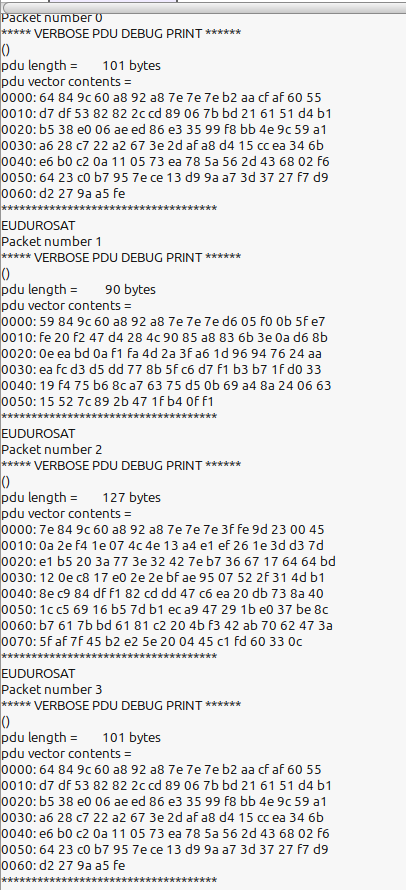
message_debug :info: The print_pdu port is deprecated and will be removed; forwarding to print.
***** VERBOSE PDU DEBUG PRINT ******
((crc_ok . #t) (src . ??�1%1-10 (scrambled)) (dest . BN0TIT-15))
pdu length = 112 bytes
pdu vector contents =
0000: 84 9c 60 a8 92 a8 7e 7e 7e 34 62 4a 62 b4 82 0f
0010: fd cf c8 df 21 1c 4c 35 80 d7 b5 3e 4c 83 ac c1
0020: 8b 7f 0f 1f e4 bd 16 f0 4e 4e cb 19 ab 39 97 b7
0030: d7 af 69 3f 2e 27 2e eb 29 08 b1 0b d3 65 fb 43
0040: ad 92 4f dc 5b 05 e0 0a 6e f5 88 65 49 5d b0 40
0050: 1c 73 09 71 46 8d 58 92 94 6d f0 dd 3f 46 05 ba
0060: 3d 90 2f dd 12 75 a0 ce bc 60 61 28 61 d1 96 7f
I am a member of the PARUS-6U1 team. Thank you so much for tracking our satellite and sharing the received data! It is incredibly exciting for us to see that the amateur radio community is receiving our signals with such good strength.
I noticed you mentioned that the frames look random after the initial callsign. You are absolutely right! The reason for this is that we are using the EnduroSat UHF “Pipe Mode”, but we implemented a custom software protocol inside the payload, which includes G3RUH scrambling, a custom CRC, and additional Reed-Solomon Forward Error Correction (FEC).
Based on the hex dumps you provided, here is the exact breakdown of our packet structure. (Note: The first byte in your dump is the EnduroSat Payload Length L):
Byte 0: Payload Length L
Bytes 1 to 9 (Unscrambled Header):84 9c 60 a8 92 a8 7e 7e 7e. This is our callsign BN0TIT (AX.25 format, shifted left by 1 bit) followed by three 0x7E flags. We kept this part unscrambled so the frames are easily identifiable.
Bytes 10 to (L - 18) (Telemetry Payload): This section contains a 9-byte internal header (which includes a Function ID) followed by the actual sensor data structure. This entire section is G3RUH scrambled.
Bytes (L - 17) to (L - 16) (Software CRC): A 16-bit software CRC calculated over the unscrambled telemetry payload. This is also G3RUH scrambled.
Last 16 Bytes, Bytes (L - 15) to L (RS Parity): Reed-Solomon Parity (16 bytes) calculated over the scrambled payload. This is appended at the very end of the packet for forward error correction.
To read the actual data, you need to strip the 16-byte RS parity at the end, descramble the payload and the CRC using a standard G3RUH descrambler, and then parse the internal structure.
Currently, we are only planning to release the data structure for our Power/Battery telemetry. When the Function ID inside the descrambled payload equals 0, the data following the internal header is our EPS (Electrical Power System) telemetry, containing our battery voltages, currents, and power generation status.
We are finalizing a standalone decoder/parser for the EPS telemetry. We will publish this parser on our GitHub repository in a few days so that the amateur radio community can easily decode and monitor our satellite’s power status. I will share the GitHub link in this thread as soon as it is ready!
Thank you again for your amazing support and for keeping an eye on PARUS-6U1!
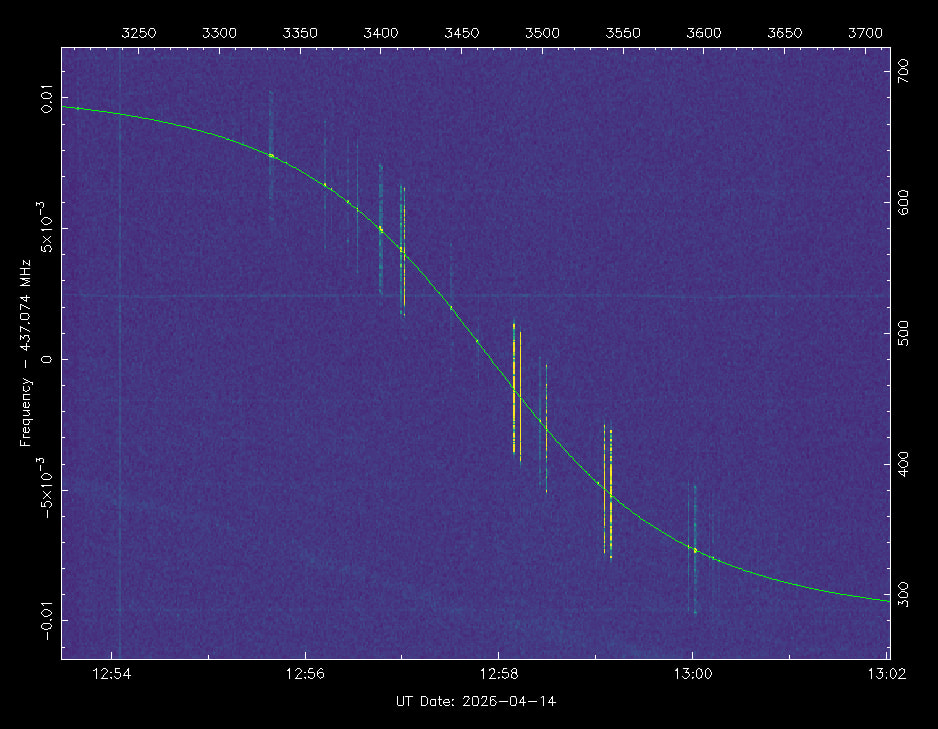
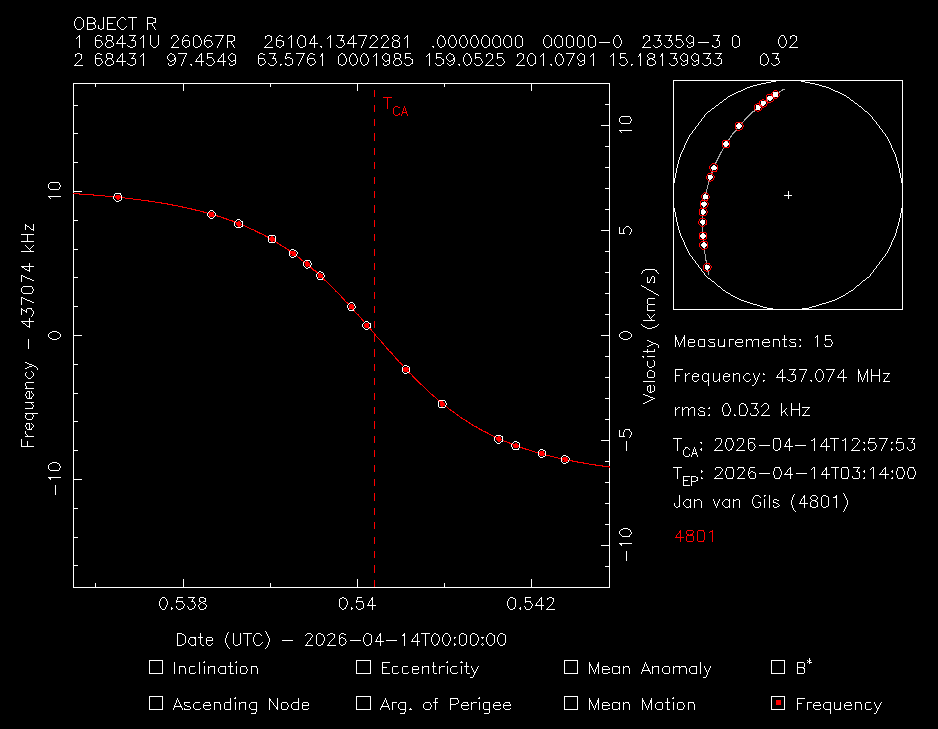
 400.500 MHz


