great bali
1 Like
Will do. Somebody from SilverSat will post here whenever we upload a command schedule to the satellite.
4 Likes
Hi all!
Another SilverSat mentor here, to provide you with some more information on the amazing SSDV transmissions you’ve been receiving and unpacking from SilverSat!
We are using the ssdv software from https://codeload.github.com/fsphil/ssdv to encode (and for testing, to decode) the SSDV packets, using the following command:
% ssdv -e -n -c CALLSIGN -i PHOTOINDEX -q 4 -l 195
on a “thumbnail” of the original photo (640x480 → 320x240). The satellites photos are sequentially numbered from 1 and this is the PHOTOINDEX shown above.
The SSDV image is transmitted one packet per second in a round robin for 300 seconds (parameters as launched).
For reassembly, the ssdv binary above requires the packets in order without duplicates.
For my test-script, which read KISS-encoded SSDV packets from the serial port, I waited multiple round robin cycles to see if I could get correct (length and CRC) packets for each packet number, only writing out the packets in order when I had a complete set or the transmission seemed to be done (empty packets).
You might find it useful to add the CRC check to your scripts, so that you can ignore bad-packets, and find a good one on the next cycle. Last packet is marked in the SSDV format so you (eventually) know a) whether you’ve seen the last packet number, and b) therefore, whether you’ve seen all the packets, and c) whether you have a good packet for all valid packet numbers.
And, yes, as Dave indicated, as long as they represent the same PHOTOINDEX, SSDV packets from transmissions at different times are identical, and it should be possible to create a complete set of good packets from merged partial sets (The SSDV packets are created once, when the photo is taken).
So glad Dave pushed to get SSDV implemented before launch - the pictures are awesome!
Cheers!
Nathan
5 Likes
Thanks, Edward, for your detailed information. I never imagined that with a regular omnidirectional RHCP turnstyle antenna and SDRSharp, I’d be able to decode the signal into a beautiful JPEG of our Earth this afternoon in Belgium. My sincere thanks to all the amateurs involved and staff at Silversat, and the students in the city silver spring Maryland usa . 73 de on7ndr
1 Like
UMKA-1 can also be easily received w/ an omni antenna if you want another target to monitor. While it does not downlink images 24x7, it has been very active over the past year or so.
For example:
2 Likes
Please can someone share a link to the SSDV.exe for windows or tell me where this program can be found for decoding the images?
If I have to use lynx based system what is the best way to decode the images as I see there are many options & different scripts. I have redberry pi 4 running hamclock and could try to use this to run rx.py to decode if this is a better option?
Many thanks in advance
The SSDV app is at:
https://github.com/fsphil/ssdv
EDIT: Sorry - you said for Windows!
1 Like
Yes for window, if possible
1 Like
I use this fork for Windows and it run as ssdv.exe
2 Likes
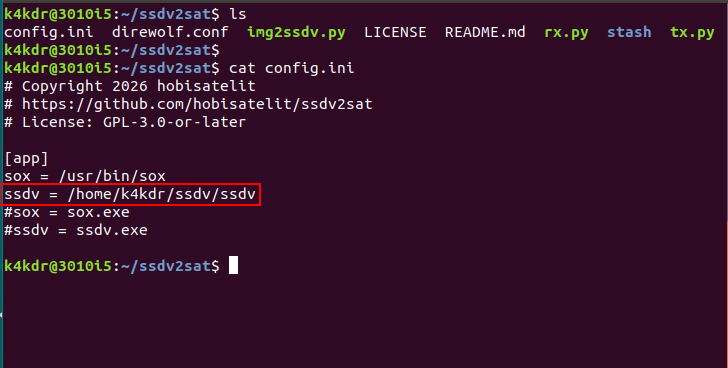
Please note the config.ini file where you can specify where the ssdv app is installed on your system. There are also example Windows entries (commented out) that illustrate how to specify the location of an ssdv.exe program on your computer.
3 Likes
Nice job Nico.
Keep in mind the beauty of SSDV is that *.bin files from different passes sending the same picture can be merged to create a more complete image, or even the full image.
In case you want to try, here’s a bin file to test with. Remove .pdf at end.
deeb796c_1A_1959local.bin.pdf (5.9 KB)
see NG-23 / SilverSat - #56 by K4KDR
73,
Bob
N6RFM
3 Likes
Looking for SSDV schedule in VU Region (South Asian Region)
2 Likes
@dvdiyen - We can include this on our next command load to the spacecraft. Can you send me a maidenhead locator designation or an approximate latitude/longitude?
I am hoping we can get the next set of commands uplinked this weekend, but this is weather-permitting.
2 Likes
MK82sx is my grid location (VU Region)

And that looks like we were pointed at the Sun. Next satellite, I want reaction wheels 
2 Likes
Is there no attitude-control at all now? Magnetotorquers … ?
We’re using passive magnetic stabilization along the camera boresight, so that the camera follows the magnetic field. We have hysteresis damping material in the other axes. Its why we nominally only take pictures in the northern hemisphere. What we are seeing though suggests that the spacecraft attitude is not stable.
2 Likes
Maybe I am wrong, but from the RSSI on the tracked LHCP yagi, there seems to be a 60second periode, at least on one axis. green=minimum, red =maximum
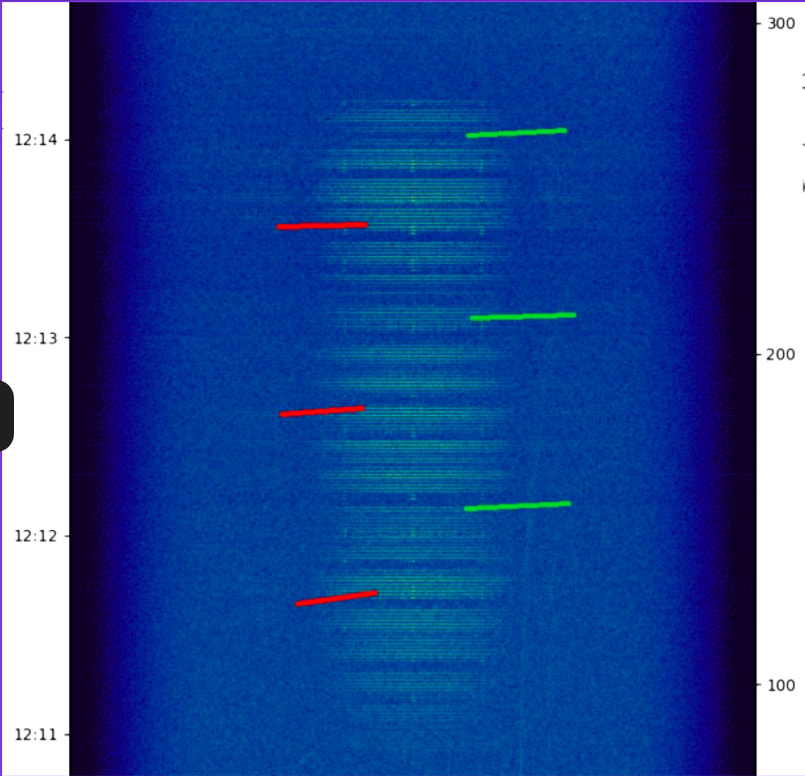
When using a Yagi antenna with linear polarisation, there was a significant drop of signal every 5-7 packets, so satellite`s polarisation changes rapidly.
2 Likes