Interesting fact, and there is a simple explanation. We are observing two different effects. With the LHCP I observe the antennas obstruction only, when its behind the spacecraft and pointing away from earth, but not much polarisation-related fading. With the linear pol, you observe both effects, the polarisation-mismatch related fading and the obstruction-related fading. I did many measurements on this effects with the PY4 cluster (diagram on my QRZ). The pol-mismatch can be overcome by a circular pol, but for compensating the obstruction only (much) more gain helps.
2 Likes
Agree with your explanation, also there is another solution, which is inplemened here - more repeats, hoping that every time lost packets will be the different ones. Also I’ve dicided to try my RHCR helical antenna next time (maybe tomorrow, maybe next pass over QTH KO95 when it is a day off) to reduse number of lost packets due to polarisation difference).
P.s trying to match the polarisation change last time resulted in more lost packets than the first time when I held my Yagi still
2 Likes
The fade rate matches roughly with the spin rate we see in the IMU data. We know there was a fault in the antenna deployment (that’s the ‘H’ in the beacon) and suspect that as a result the antenna pattern is elliptical and more dipole-like. We see significant fades on each pass, and often get better reception on RHCP than LHCP.
3 Likes
That seems plausible, as If the polarisaton on the satellie`s antenna will be circular there will be no such drop in signal strength - only few dB loss, in this case linear to linear reception is quite a challenge and a ground antenna with curcular polarisation is the deal. Nothing is perfect but never the less the mission continues.
2 Likes
I am not sure, but doesnt a LHCP antenna pointing away from grounstation radiate RHCP on the backside? This would explain why both, R and L pol work for the GS.
It does. In fact, we bought an RHCP antenna then realized it would point predominantly across the back of the spacecraft with the magnetic stabilization, thus we should have been mainly LHCP. I suspect that the spacecraft is pretty elliptical with the antenna fault.
1 Like
My other wish for the next mission is polarization diversity combining at the ground station.
2 Likes
Mebbe we can run a reeeally long string with two cans?
1 Like
It’s theoretically possible to implement automatic polarization switching at our ground station using the diversity antenna signal from the AX5043, but that would mean disrupting our ground operations while I did a lot of hardware shuffling (and modifying and testing our ground radio code). Given the lifetime of the satellite, and the fact that right now, we can’t even get to our ground station (snow and ice!), we’re better off letting our students focus on operations (and the collecting all the knowledge we got out of our first one!)
I’ve done some modeling of the satellite dynamics, but we are suffering from a lack of continuous data (and an inertial reference) to truly understand what’s going on. I have data from one pass where we were able to get measurements across the entire pass, but the rest of the data points are separated by hours/days. I’m going to try integrating our RSSI measurements to see if that adds any insight. The AX5043 provides an RSSI estimate on every packet, which gives a nice relative measure of signal strength over time.
We do know that the antenna did not deploy correctly, but don’t know the mode it failed…did 1 door fail to open, 2? 3?
For that one dataset, it looks like the satellite has about an 8 second spin which is precessing every 36 seconds around an axis not aligned with our Z-axis. Our packets tend to be about 200mS, so if the fades are every few packets, and the antenna is truly more dipole like (you get two nulls per rotation), that would line up with the spin rate. I’d like to see if our RSSI data might show some of the 36 second precession effect.
It seems to be affecting our tweet mode more than anything else since our payload team had the wisdom to repeat the SSDV broadcast multiple times.
I expected fading would be amplified in lower latitudes because our antenna would be more edge-on, but maybe our actual spacecraft attitude is making it work better sporadically, if not consistently.
5 Likes
The following SSDV sessions were scheduled on 30 January 2026:
Region Time
| Belarus | 2026-01-31T07:54:00 |
|---|---|
| Europe | 2026-01-31T09:26:00 |
| Europe | 2026-01-31T10:51:00 |
| Europe | 2026-01-31T11:04:00 |
| Europe | 2026-01-31T12:37:00 |
| E. Europe | 2026-01-31T12:47:00 |
| W. Europe | 2026-01-31T14:08:00 |
| Europe | 2026-01-31T14:18:00 |
| Europe | 2026-01-31T15:50:00 |
| Central US | 2026-01-31T16:59:00 |
| Europe | 2026-01-31T17:24:00 |
| Ireland | 2026-01-31T18:58:00 |
| Melenesia | 2026-01-31T21:16:00 |
| Central US | 2026-01-31T23:24:00 |
| Belarus | 2026-02-01T11:30:00 |
| India | 2026-02-01T13:21:00 |
| Africa | 2026-02-02T03:55:00 |
| Africa | 2026-02-02T05:30:00 |
| Asia | 2026-02-02T07:25:00 |
| E. Europe | 2026-02-02T10:37:37 |
| E. Europe | 2026-02-02T12:13:16 |
| Ireland | 2026-02-02T13:37:00 |
| W, Europe | 2026-02-02T13:41:57 |
| N America | 2026-02-02T21:26:38 |
| E Asia | 2026-02-03T00:11:00 |
| India | 2026-02-03T03:10:00 |
| E. Europe | 2026-02-03T09:38:32 |
| E. Europe | 2026-02-03T11:14:11 |
| W, Europe | 2026-02-03T12:42:44 |
| W, Europe | 2026-02-03T14:18:38 |
| N America | 2026-02-03T22:03:00 |
| E Asia | 2026-02-03T23:11:00 |
| N America | 2026-02-03T23:38:37 |
| India | 2026-02-04T02:10:00 |
| Asia | 2026-02-04T03:54:00 |
| E. Europe | 2026-02-04T10:14:51 |
| W, Europe | 2026-02-04T13:19:11 |
| SE Asia | 2026-02-04T23:37:00 |
| E. Europe | 2026-02-05T09:15:17 |
| E. Europe | 2026-02-05T10:50:53 |
| W, Europe | 2026-02-05T12:19:29 |
| Canada | 2026-02-05T20:01:00 |
| S America | 2026-02-05T21:53:00 |
| E Asia | 2026-02-05T22:48:00 |
| Asia | 2026-02-06T06:40:00 |
| E. Europe | 2026-02-06T08:15:30 |
| E. Europe | 2026-02-06T09:51:05 |
| W, Europe | 2026-02-06T12:55:25 |
| N America | 2026-02-06T20:39:00 |
| SE Asia | 2026-02-06T21:38:00 |
| C America | 2026-02-06T22:22:00 |
| India | 2026-02-07T00:49:00 |
| E. Europe | 2026-02-07T08:51:02 |
| W, Europe | 2026-02-07T11:55:14 |
| E Asia | 2026-02-07T22:24:00 |
| E. Europe | 2026-02-08T07:50:45 |
| E. Europe | 2026-02-08T09:26:19 |
| W, Europe | 2026-02-08T10:54:49 |
| W, Europe | 2026-02-08T12:30:37 |
| E. Europe | 2026-02-09T06:50:15 |
| W, Europe | 2026-02-09T11:29:57 |
13 Likes
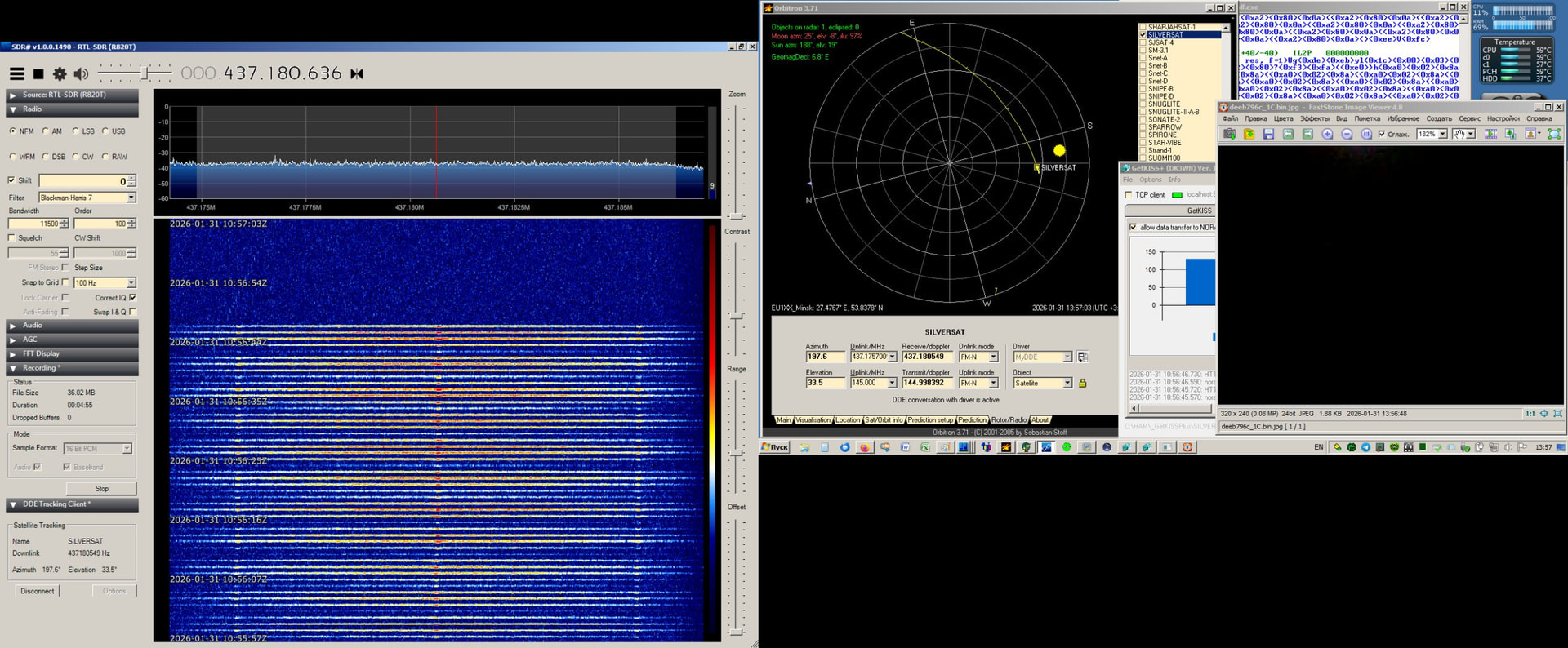
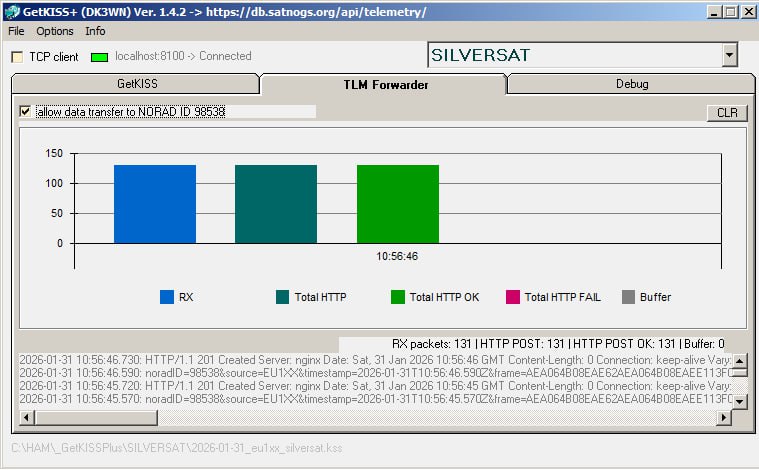


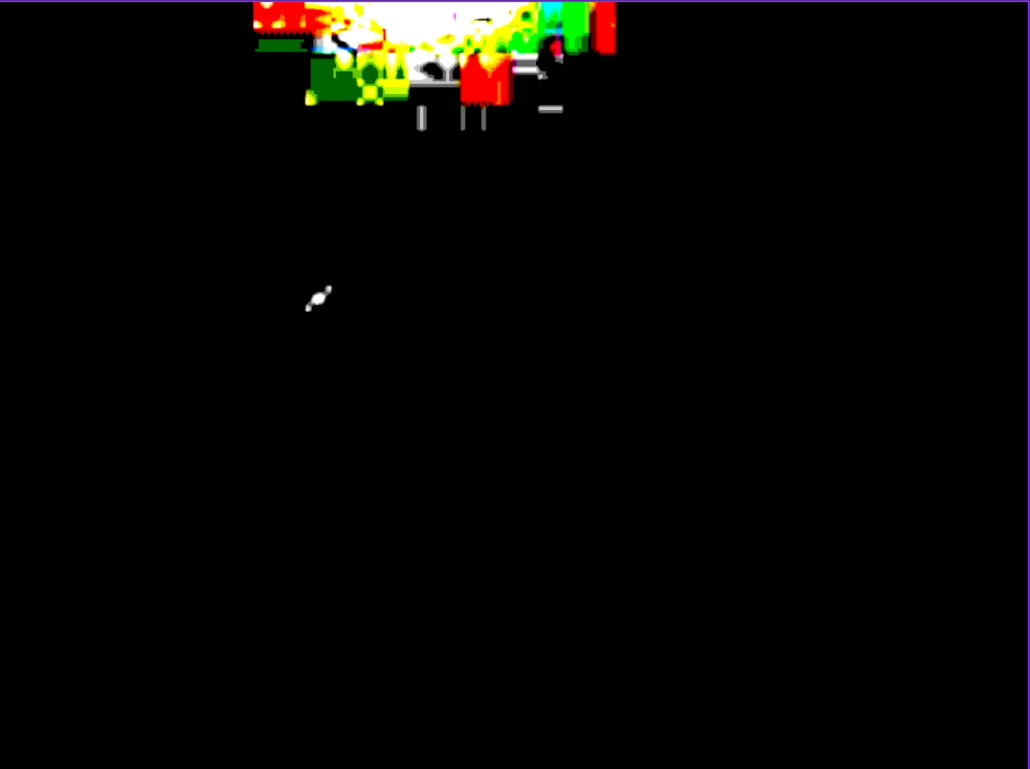



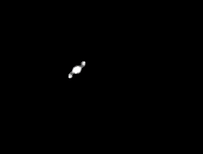
beautiful
1 Like
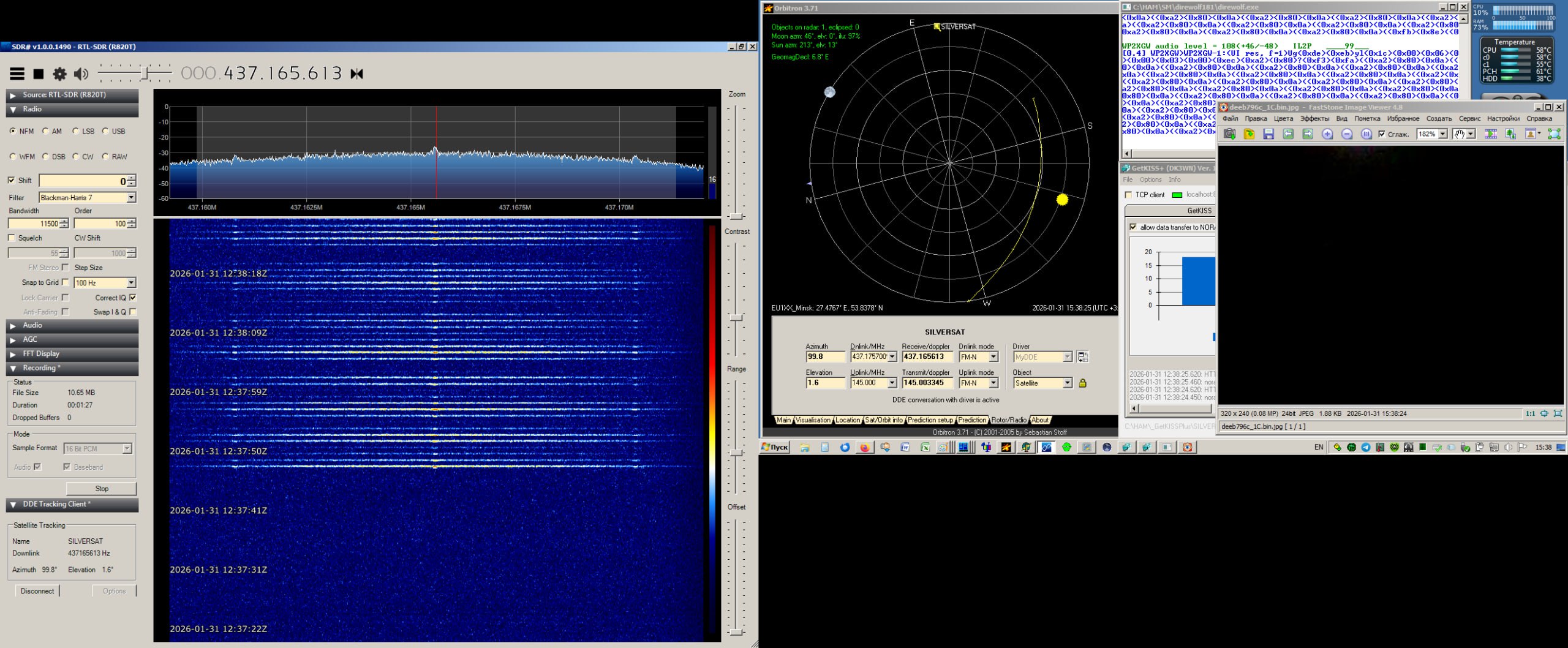
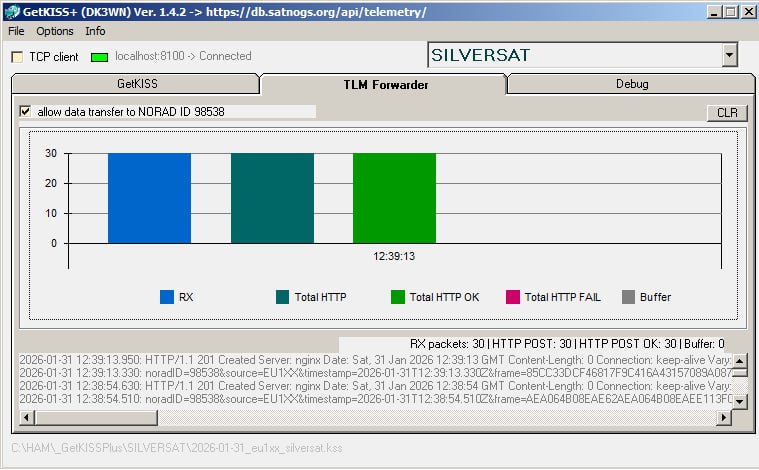
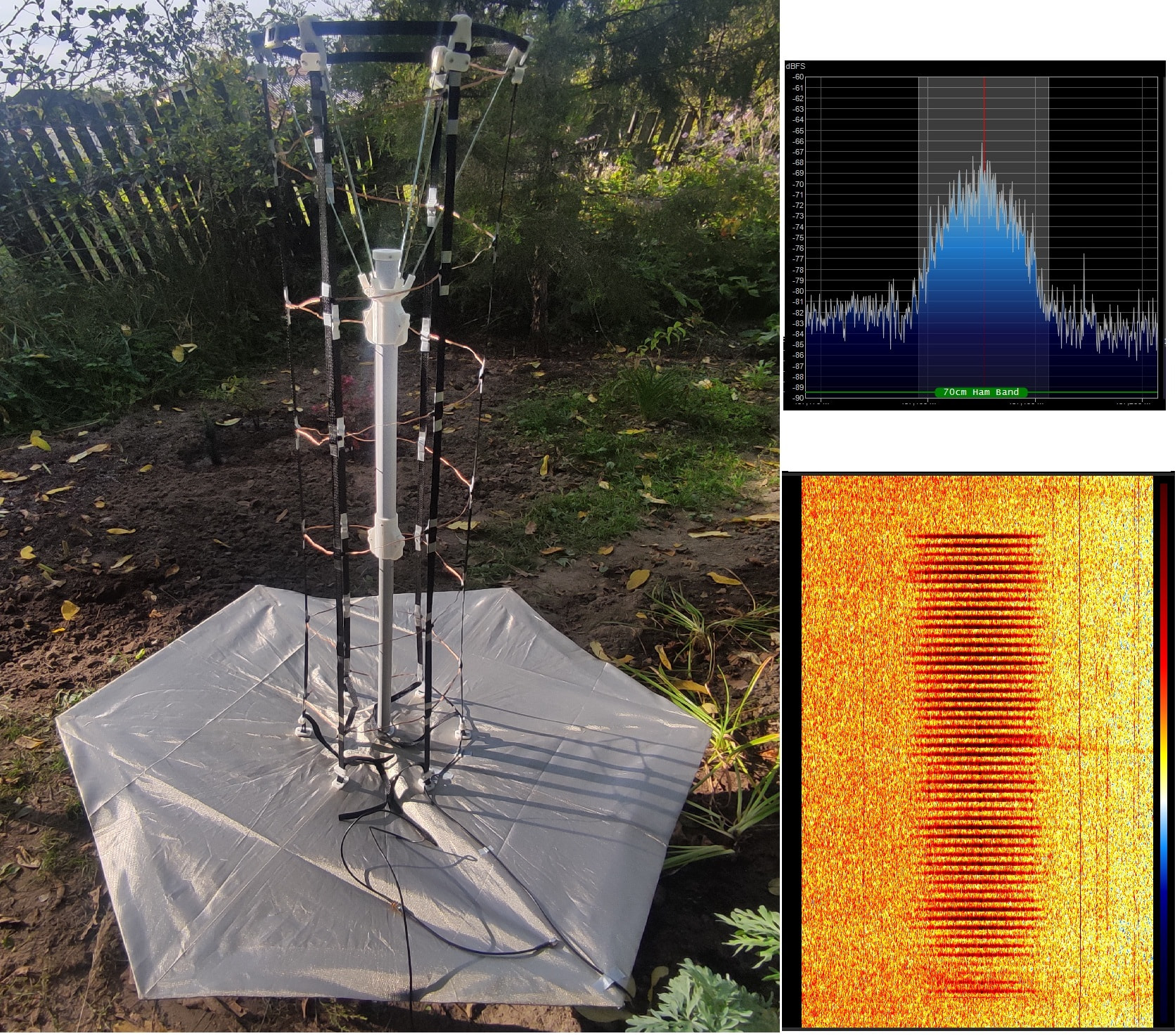
This time I tried helical antenna RHCP - it was a bit difficult to hold it open in th cold wind (and it is still a prototype with long ”to do” list), but the main goal was acheved - frequent drops of signal strength were not spotted, but the pulsation with value of few dB is still present but it won’t affect on decoding process that much ( in comparison with linear Yagi)
Time 10:55:08-10:56:47 UTC, 51 visible packet recieved, 22 decoded.

Also attaching an overal view of my helical antenna, and screenshots of the full waterfall and maximum peak signal form in case if satellite operators need this information.
10 Likes
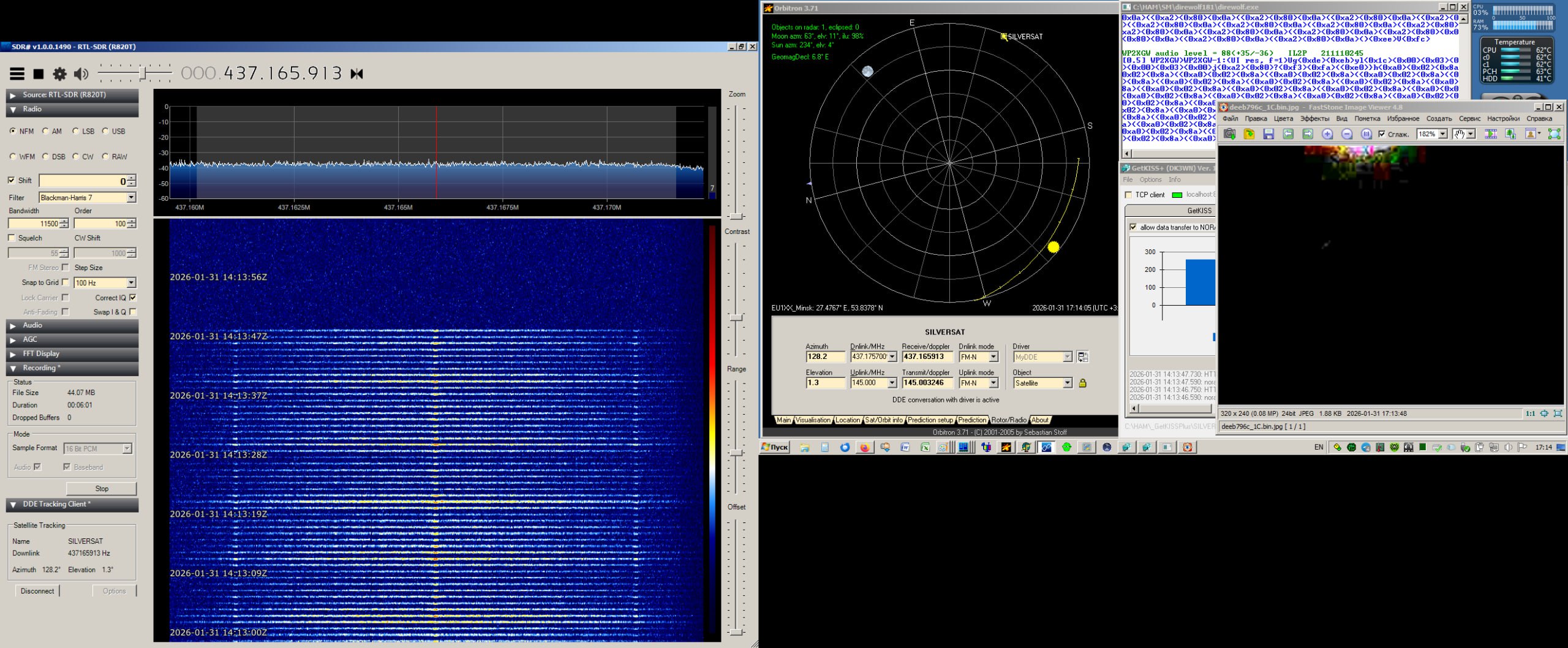
Sorry to spoil the fun; SilverSat has a wide lens, so it cannot photograph other planets. I suspect that shape might be a lens flare.
3 Likes


1 Like