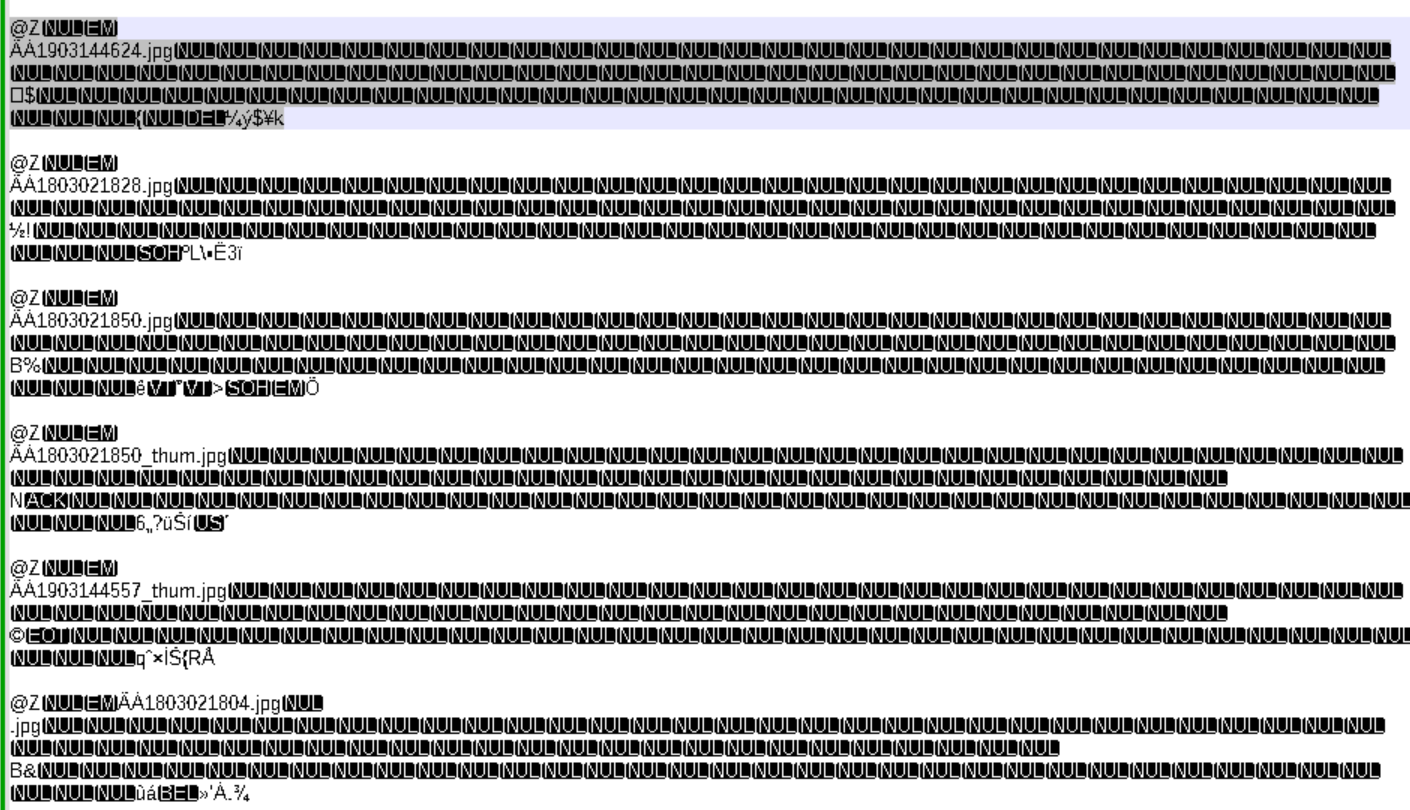
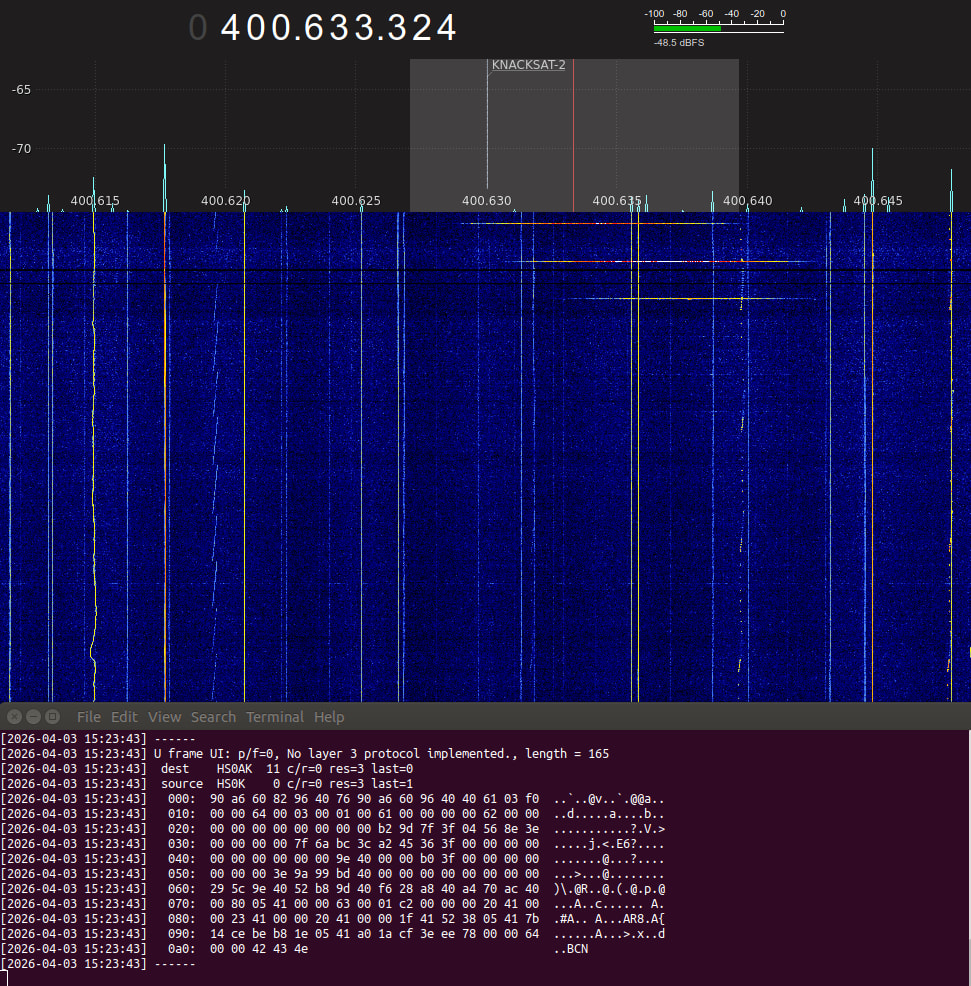
More interesting burst data from KNACKSAT-2 and not only beacon
Regarding Observation 13612715 and Observation 13618802 from VN
It looks similar @E25YUS received
Reference → dashboard.knacksat.com ar-callsign=E25YUS&var-gs_id=TSC_NARIT
More interesting burst data from KNACKSAT-2 and not only beacon
Regarding Observation 13612715 and Observation 13618802 from VN
It looks similar @E25YUS received
Reference → dashboard.knacksat.com ar-callsign=E25YUS&var-gs_id=TSC_NARIT
Unofficial APRS Operation Notice – KNACKSAT-2
Sorry for the short notice.
We have unofficially turned on the APRS mission on KNACKSAT-2
from 12:50 to 17:50 UTC on April 1, 2026.
If any member has some free time, please feel free to try receiving or accessing the APRS signal at: Frequency: 145.825 MHz, Mode: APRS 9600 bps
No path set is needed.
We plan to open the APRS mission on the weekend after confirmed it’s function.
APRS Operation Notice – KNACKSAT-2
The KNACKSAT-2 APRS payload will be turned ON on April 3, 2026 at 12:45 UTC.
There is currently no planned time to turn it off. We will monitor power consumption closely and, if conditions allow, we will try to keep the APRS payload active for an extended period.
Great news!
Can you share what TO: and VIA: settings the digipeater will respond to?
Thanks!
name: KNACKSAT-2
norad: 67683
data:
  &tlm Telemetry:
    telemetry: ax25
transmitters:
  9K6 FSK downlink:
    frequency: 145.825e+6
    modulation: FSK
    baudrate: 9600
    deviation: 2400
    framing: AX.25 G3RUH
    data:
    - *tlm
KnackSat-2 400 MHz telem downlink continues to look great, but nothing heard on 145.825
No VIA (page 2)
The TO callsign should be arbitrary.
no signal detect pass over my gs in indonesia
KNACKSAT-2’s 9k6 VHF digipeater seems to be on.
The packet from this observation however looks a little bit strange.
AE 48 E4 F4 40 40 00 40 40 40 40 40 40 60 90 A6 60 96 40 40 61 03 F0
$ decode_frame knacksat2 data_13741328_2026-04-07T11-04-10
{
“digi_dest_callsign”: "W$rz ",
“digi_src_callsign”: " ",
“digi_src_ssid”: 0,
“digi_dest_ssid”: 0,
“rpt_instance_0_callsign”: "HS0K ",
“rpt_instance_0_ssid”: 0,
“rpt_instance_0_hbit”: 0,
“digi_ctl”: 3,
“digi_pid”: 240,
“digi_message”: “”
}
This is not a digipeated packet (“rpt_instance_0_hbit”: 0), it came directly from KNACKSAT-2.
Will try the digipeater tomorrow for myself.
Update knacksat-2 APRS
decode by gr_satellites
That’s where I’m quickly inclined to believe it’s a fake.
However, we have those 3 packets in SatNOGS DB (uploaded) observed directly from the transmitter on earth (without “Via HS0K”) by HS0ZQS (HS0ZQS_VHF-OK03fu).
2026-04-05 01:15:07|82828282828260848484848484E103F048656C6C6F20576F726C6420|13738832|HS0ZQS_VHF-OK03fu
2026-04-05 01:15:03|82828282828260848484848484E103F048656C6C6F20576F726C6420|13738832|HS0ZQS_VHF-OK03fu
2026-04-05 01:15:00|82828282828260848484848484E103F048656C6C6F20576F726C6420|13738832|HS0ZQS_VHF-OK03fu
So the screenshot could just show a reply.
If so, why does the waterfall of HS0ZQS’s observation only show the locally transmitted (actually) 4 packets, but not the by KNACKSAT-2 digipeated packets?
Next question however would be who in the world uses BBBBBB as sender callsign on amateur radio frequencies? And why AAAAAA as destination callsign?
Anol,
Is it correct, that KNACKSAT-2’s digipeater doesn’t set the hbit to 1 if it digipeats a packet?
Daniel
Yes, that’s what decode_frame did.
No response from digipeater on max. 24° el. pass on 2026-04-08 08:0x UTC.
Will try again on next pass.
I can confirm these were test transmissions from the KMUTNB ground station in Bangkok to KNACKSAT-2. A station in Chiang Mai also received the packets directly over RF.
That station in Chiang Mai is not part of the SatNOGS network. I will ask them for the IQ file and share it with the group.
Regarding the callsigns (BBBBBB / AAAAAA) — apologies for the confusion. I forgot to update them to the actual callsign and destination; they were just placeholder values used during testing(C00082828282828260848484848484E103F048656C6C6F20576F726C6420C0).
Really?
Chiang Mai and Bangkok are almost 600 km apart from each other.
Yes, both stations are seeing the same satellite pass. Chiang Mai also receives KNACKSAT (400 MHz) and forwards it to the KNACKSAT server, regularly receiving the same Downlink as Bangkok. It can also handle 145 MHz. AOS timing can differ by about 2 minutes, and some passes aren’t visible to that station depending on the satellite’s path.
Sorry, Daniel, I don’t have that information. Maybe @E25YUS or @Pao can answer this question.