It seems there was not enough coordination on our side with the operations team, so I checked again.
According to the latest confirmation, the HK beacon is still scheduled to be transmitted until Feb 16, 17:12UTC( Feb 17, 02:12 JST). However, it is quite likely that the battery will run out and the transmissions may stop during this time.
We will try another uplink from our ground station, and if we manage to re-enable or confirm the HK beacon again, I will inform you immediately.
To be honest, this situation is quite unexpected for us as well, so we are carefully monitoring what is happening.
Thank you again for your continued support and observations.
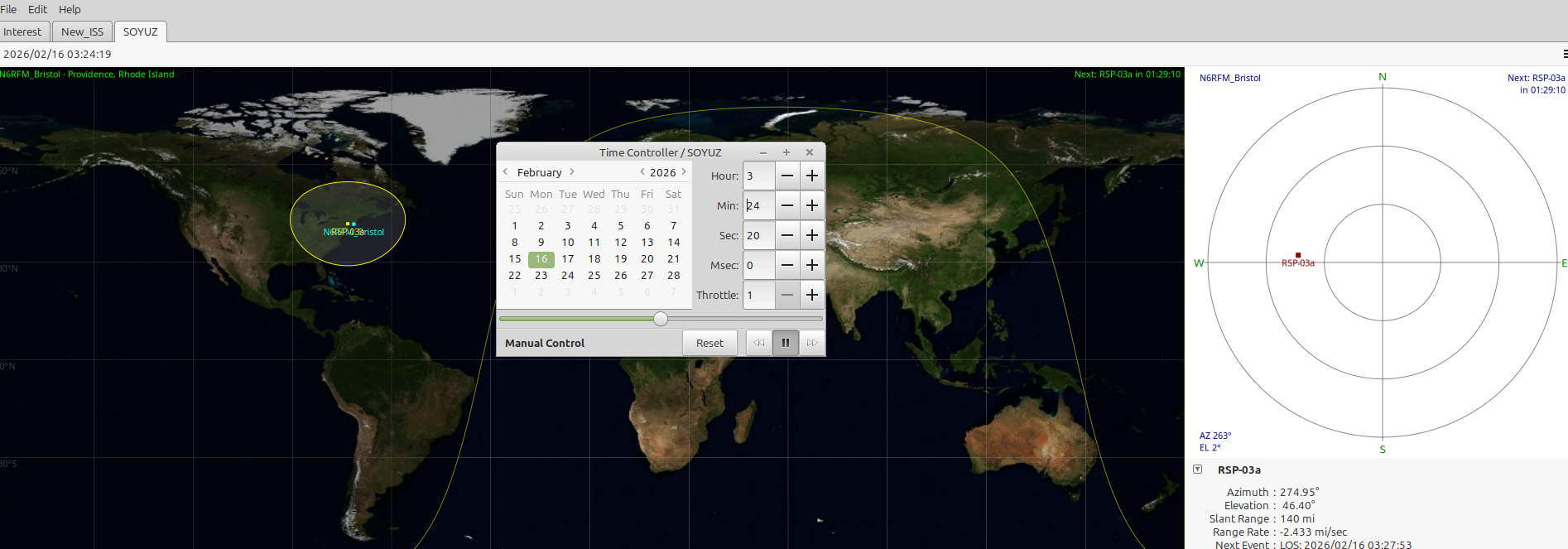
No signal from Australia pass some minutes ago at the expected stations, however it was a low pass. Next expected reception over North America in about 30min, there we can probably verify if the satellite has been re-entered or stopped transmitting or if it is still active.
Unfortunately no signals over North America, it looks like that this is the end for RSP-03.
Congratulations to the team for the this successful mission, even with the troubles and issues that faced!
Thanks to all stations of the Network participated in this challenging re-entry event and especially that managed to get even faint signals from the satellite. Thanks also the Dwingeloo team for supporting the team when transmission issues spotted, leading to completing its mission.
The last received transmission from SatNOGS was by station “4615 - yellowstone_yagi” of @bigm around 2025-02-16 11:21 UTC.
Last reception from Network with decoded GMSK data was by stations “2338 - PI9RD-V” and “384 - PI9RD”, vertical and horizontal polarization of Dwingeloo Radiotelescoop.
Thank you very much for all the valuable observations and support from the SatNOGS community.
We have been using the updated TLEs to run simulations and to confirm how the orbit had already decayed to very low altitude.
Following your latest information, we understand that this is most likely the end of RSP-03.
We sincerely appreciate all the efforts made by the stations that tried to receive the satellite, even under very difficult conditions, and especially the continuous support from the Dwingeloo team and from Fredy and the SatNOGS maintainers.
Just in case, we plan to check one more pass around 02:03 JST on Feb 17 to confirm whether any signal might still be present.
Once again, thank you for all the support and cooperation throughout this challenging re-entry tracking. It has been an unforgettable experience for our team.
Best Regards,
czh00361(estima5633)
Rymansat project
During our final operation at 02:03 JST on Feb 17, we did not receive any HK beacon or command response. Combined with the latest SatNOGS observations, we believe RSP-03 has re-entered the atmosphere.
Thank you sincerely to the entire SatNOGS community for your long-term support and tracking efforts throughout this challenging re-entry phase. Your observations, TLE updates, and advice were invaluable to us.
We would also like to document this experience — including our interactions with the SatNOGS community and the re-entry tracking process — in a web article, and help share and promote the amazing work SatNOGS enables.
Personally, although my involvement was only for a short period, I am truly glad to have been part of this effort. I have been deeply impressed by everyone’s passion, and it reminded me how wonderful the connections between people can be. I look forward to meeting you again in the future.
The RymanSat Project will now move forward to the development of our next satellite. We will keep pushing ahead to inspire young people who dream about future technology and space.
Thank you again, and we hope to meet you again in the future.
It’s been a fun ride! We were impressed by the changes the team could still make to the satellite operations while the on board communications systems had issues.
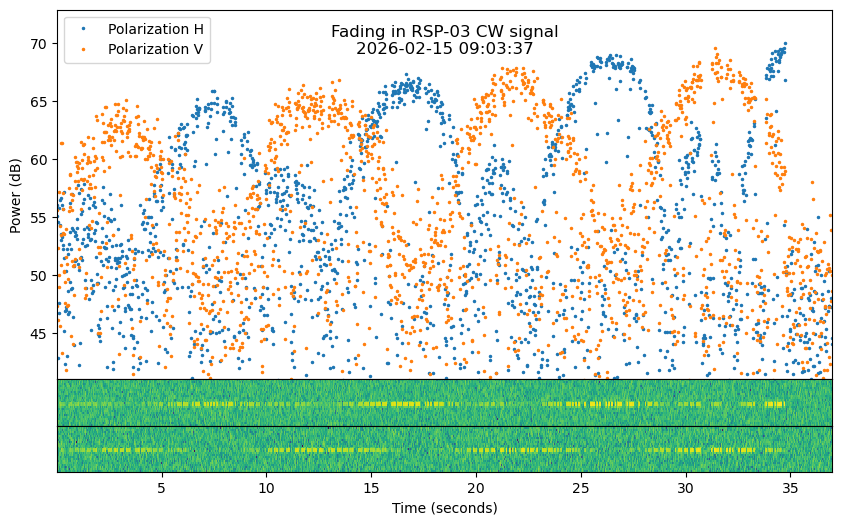
The first CW beacon of the last successful observations from Dwingeloo, 13415454 (H) and 13415455, show a nice fading pattern. This was the start of the observation, so starting at 0 degrees elevation. The satellite tumbles with a period of about 10 seconds. We could check if the decoded telemetry reflects this.
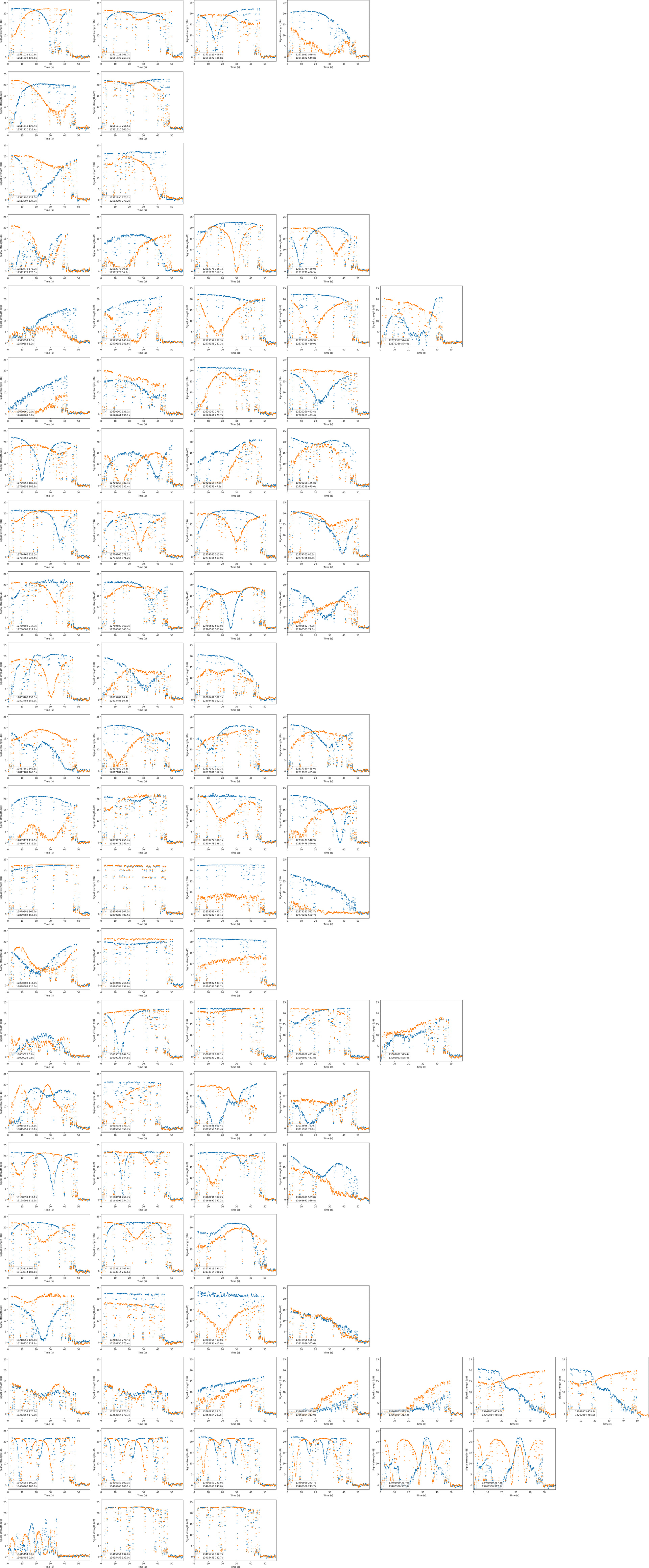
The notebook above also makes a plot of fading for all Dwingeloo observations of RSP-03. It shows that the fading of the first bit of CW (the one shown above) was nicest for the very last observation.
Great charts, indeed!
This is a very interesting topic, I already did similar measurements on the PY4-LoRa satellites, but unfortunately had only 1 antenna. The two-axis spin was visible anyway and a FFT-transform of the data showed 2 nice peaks in the frequency domain - one per axis, which matched exactly with the telemetry data. In addition the diversion of two effects, the polarisation-mismatch and antenna obstruction is also very interesting. In my charts this were -15 to -20dB negative peaks, when the antenna was obstructed by the spacecraft, which regularly happend because of the big PV-panels.
On RSP-03 there seems to be no significant obstruction, because what disappears on one antenna nicely appears on the other.
As a gimmick, I made stereo audio of observations 13415454 (left channel) and 13415455 (right channel). It’s fun to hear the CW fade from left to right and back. The noise is a bit high, that’s because this recording was taken at about 1 degree elevation.
Thanks to Fredy’s introduction, we were able to receive tremendous support from tammojan and the Dwingeloo team. Also, because bali suggested that we enhance our Grafana dashboard, we were able to accumulate and visualize observations including CW data more effectively.
Since around Sep 19, we faced a very difficult period where we could barely acquire the satellite and even CW reception was unstable. Despite this, with your continued support, our RymanSat team could stay motivated all the way through the re-entry phase in February. We are truly grateful for your technical expertise and persistent efforts.
In particular, the fading analysis and the TLE updates shortly before re-entry were strongly supported by OE6ISP Stefan as well. We plan to compile and share these technical lessons in Japan through a Qiita (engineering blog) article.
If there are any additional insights from the Element chat or this re-entry thread—such as key steps, references, or important caveats—please share them if you can.
Your stereo fading example is a very interesting and creative approach.
Thank you again for sharing it.
Before sharing it more widely, I would like to ask your permission.
We are thinking about first discussing the polarization behavior during re-entry within the RymanSat team, and then possibly introducing your stereo example on X (Twitter) or other platforms to explain the fading effect to a broader audience.
While the stereo representation of H and V polarization makes the fading very intuitive and easy to understand by ear, we are slightly concerned that it might lead to technical misunderstandings if not properly explained.
If we share it publicly, we would of course add sufficient technical explanation and clarification.
Would you be comfortable with us sharing and discussing your example in this way?
You’re welcome to use the audio file in any way if you credit the Dwingeloo telescope. I agree that it requires some explanation; horizontal and vertical are something different than left and right.