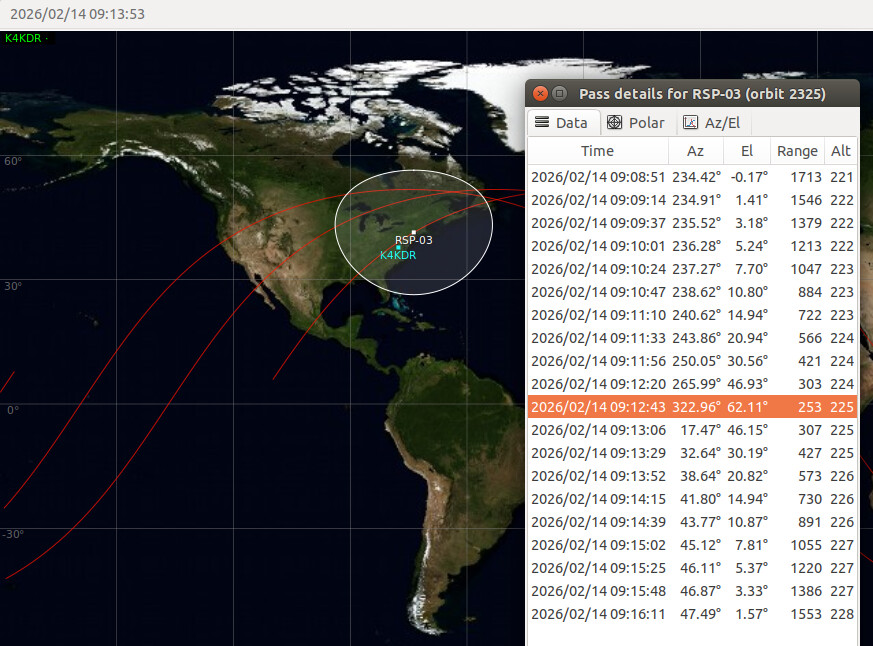
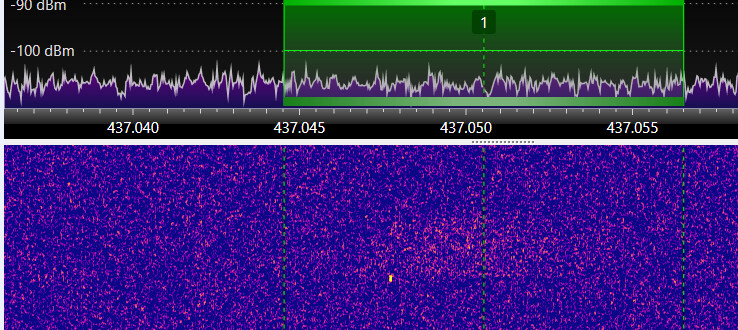
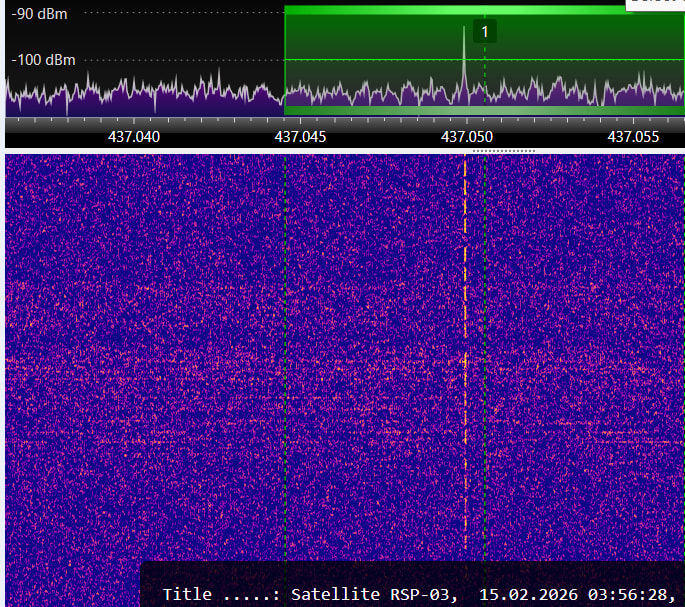
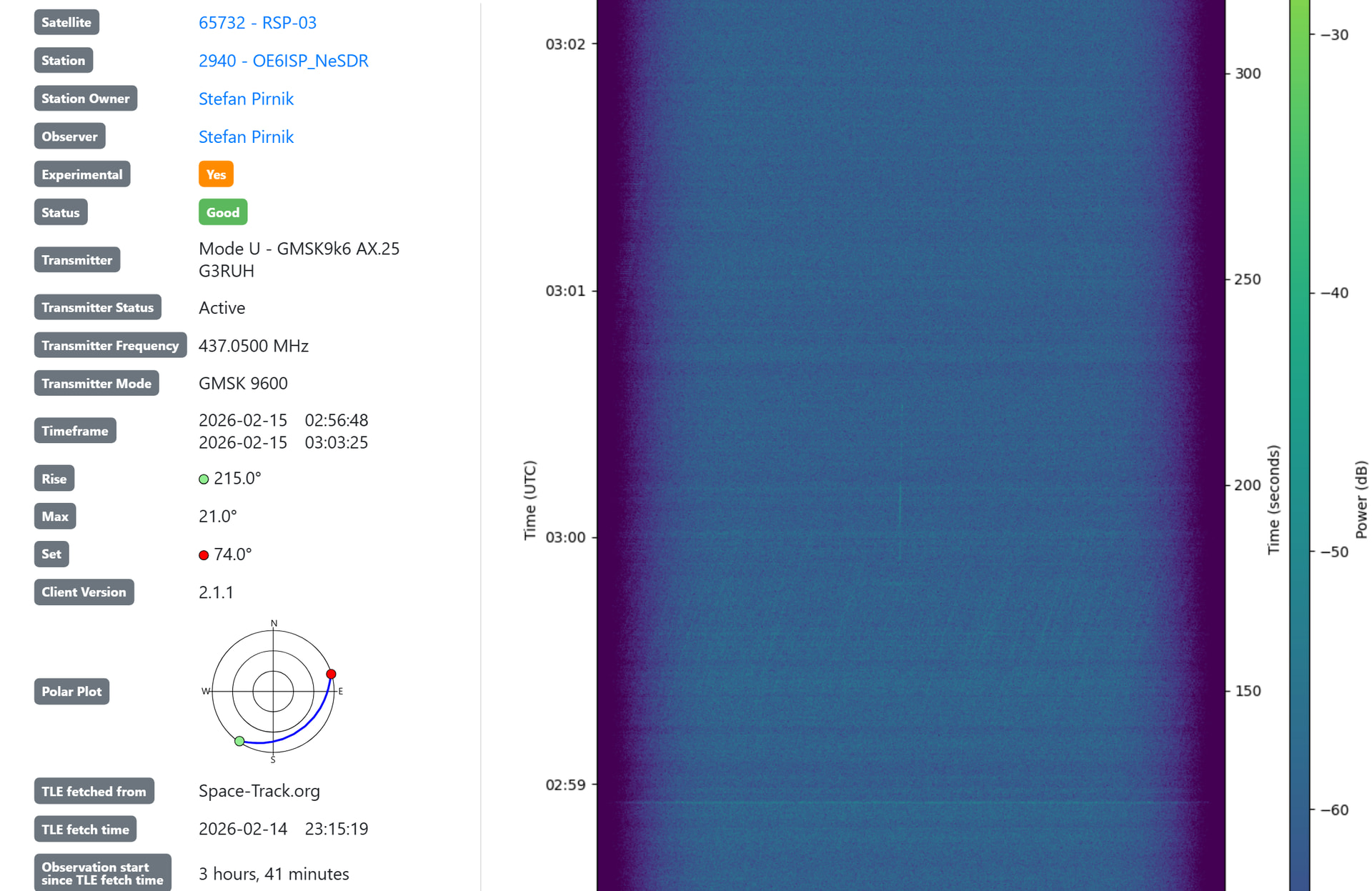
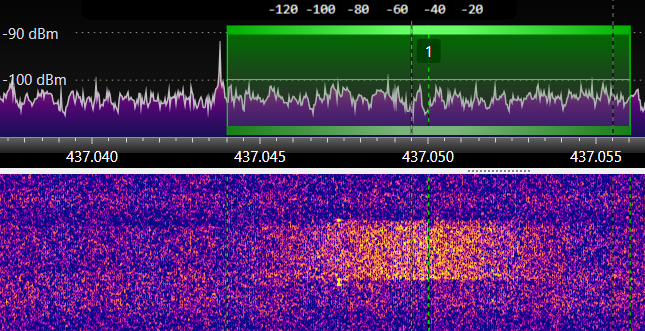
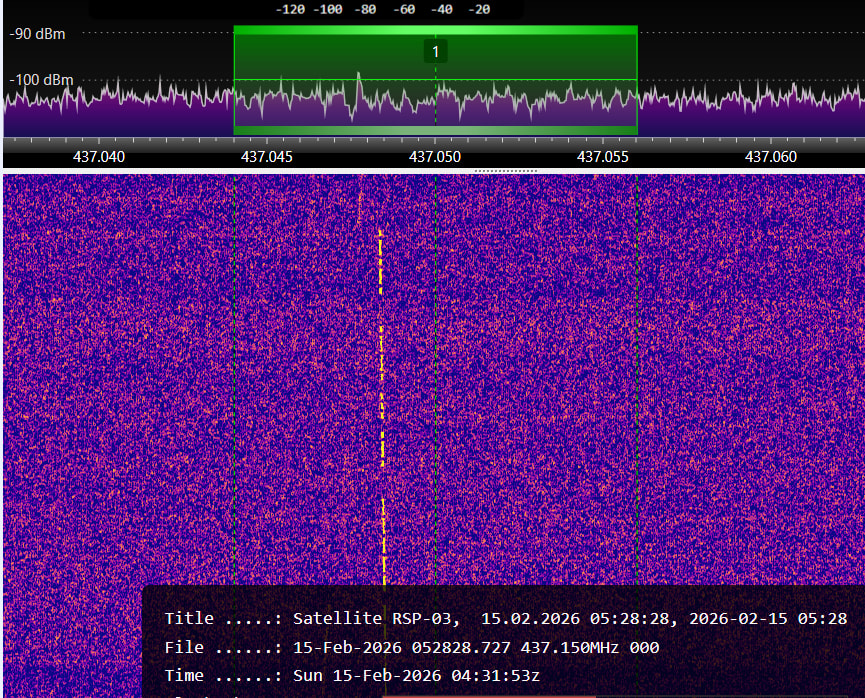
Due to some issues the transmission of RSP-03 is very weak, so it will be a challenge to receive it. However due to re-entry conditions this may change, so we try to track and observe it in its last orbits.
There will be a scheduled transmission at 2026-02-14 09:23 UTC (over Europe) and then after 2026-02-14 18:00 UTC the satellite will be set to transmit continuously short CW beacons, which the team is predicting to last a few hours due to battery limitations.
In case of reception I’m going to use this thread to publish any updated orbital data in TLE format.
Hi, All
For the Europe pass at 09:24 UTC on Feb 14, we planned to start our batch program via a timer so that Dwingeloo and other European stations could observe the downlink. However, this time no signal was detected.
Since the timer worked successfully three times in the past with Dwingeloo, we consider a configuration mistake unlikely and are currently investigating other possible causes.
According to Dwingeloo, during the 09:24 UTC pass their telescope was able to track the TLE, and even in a 1 MHz baseband recording there was no signal anywhere near the RSP-03 frequency. Their assessment is that the satellite was most likely not transmitting during this pass.
Possible causes include: (a) the uplink did not reach the satellite, (b) the uplink contained incorrect timing, (c) the satellite has run out of power, or (d) the satellite has already re-entered.
Although we are concerned about TLE accuracy for our Japanese ground station, we will attempt to reactivate the CW beacon (callsign + “BYE HAMO”) around 18:00 UTC on Feb 14 over Japan. We would greatly appreciate reception support from any observing stations.
Re-entry is expected sometime between Feb 15 and Feb 16.
This TLE is giving identical predictions to the 26044.75705030 TLE used by the Dwingeloo telescope this morning, confirming that RSP-03 was in the telescope beam. Hence the lack of signals was likely due to the satellite and not the telescope not pointing at the satellite.
We sent commands for RSP-03 at 03:00 JST on Feb 15.
We were able to complete one CW uplink and downlink, but we could not switch to the HK beacon or to a short CW message as planned.
At the moment, we suspect that the battery may be depleted or that the satellite systems are no longer fully operational.
We are planning to attempt another uplink to restore the HK beacon during the upcoming passes over Japan, around 04:30 JST and 10:45 JST.
@fredy@tammojan
10:46 JST, the uplink was successfully received at our ground station in Japan. We were able to resume the CW & GMSK HK beacon transmissions that can be decoded on SatNOGS. We are currently analyzing the CW signal to assess the battery status.
The battery voltage was Battery 1: 7.453 V and Battery 2: 7.340 V. The batteries are in a significantly discharged state. We are currently operating with relatively high power consumption, as the MOBC (Raspberry Pi) is running and the HK beacon is being transmitted.
Given that GMSK is also active, I’m re-scheduling to use the GMSK mode on observations in order to have a chance to decode the signals. CW will be visible too and will help us to track the satellite.