And lets not forget the new HydraSDR RFOne that also has no center spike and great performance.
For now using it, in combination with a S-band down converter.
Jan | PE0SAT
And lets not forget the new HydraSDR RFOne that also has no center spike and great performance.
For now using it, in combination with a S-band down converter.
Jan | PE0SAT
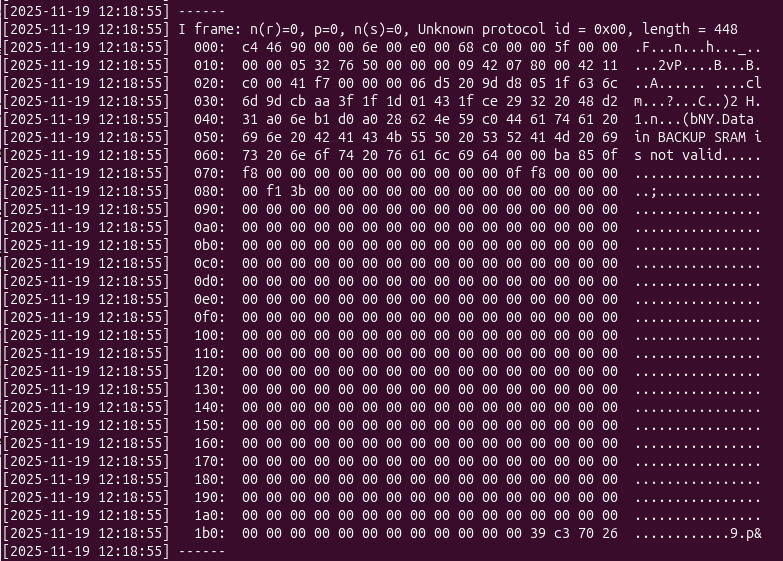
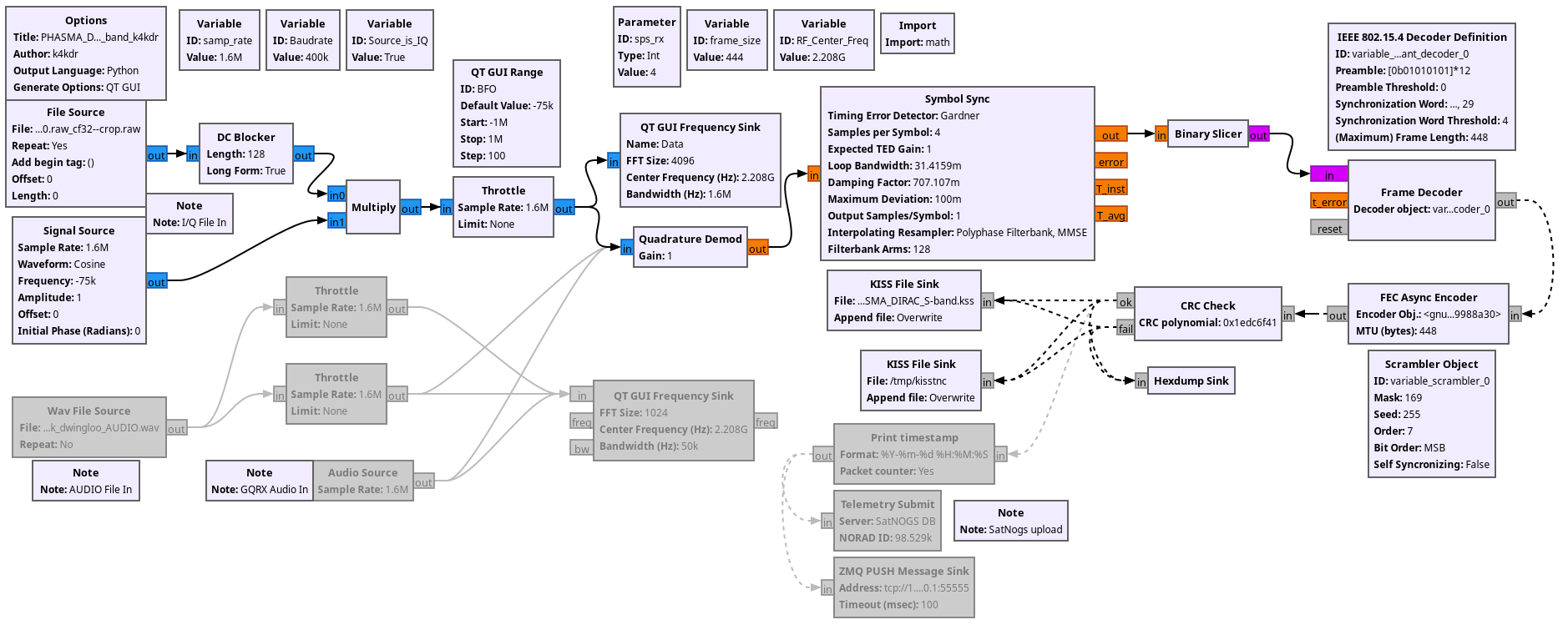
Ok, success with decoding 400k baud packets from the 1.6M I/Q file very kindly provided earlier. You DO get a number of valid frames with the CRC check enabled, but naturally even more when both the ‘OK’ and ‘Fail’ outputs are monitored. (as shown in the screen shot of the GRC file farther down)
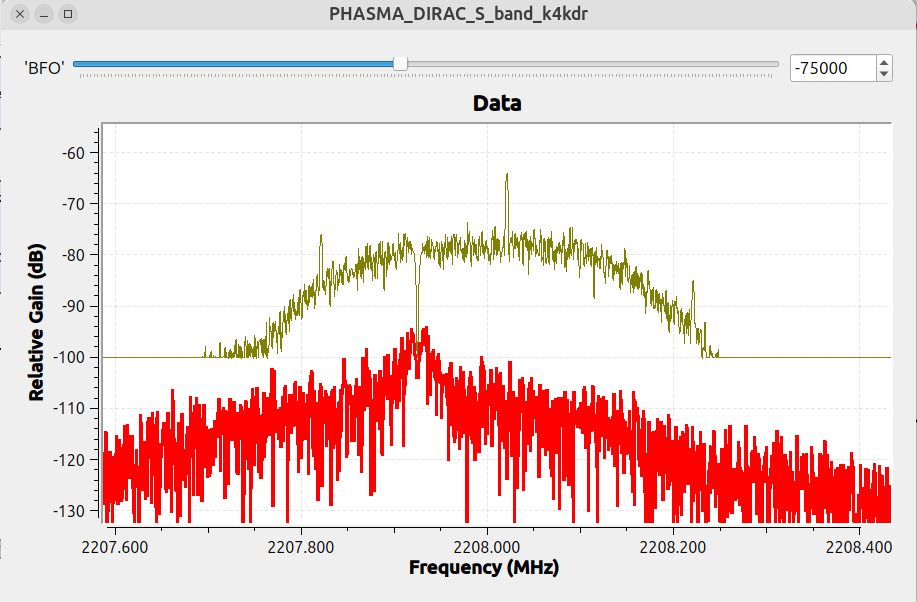
… please note the signal after muting the DC spike and shifting over a bit to center the data packet:
(this may or may not be the exact center - please experiment & improve!)
Here is the entire flowgraph (using a short crop of the original 1.6M I/Q file so there’s no wait for frames)
… which is available at the following URL if anyone would like to use portions of this in a flowgraph arranged to suit your personal preferences. (also please note that I’ve only tested w/ the 32-bit float I/Q file input - audio input blocks are present but I don’t expect that 400k baud can be decoded from audio) {so, I might add an SDR Source in the flowgraph for live decoding - but for now at least we can test w/ an I/Q file source}
its work with satnogs? you have sample obs with this device?
Yes, have a look at station 2173.
Soapy support can be found at the HydraSDR github page.
Jan | PE0SAT
Check below for TLE:
TLE set for PHASMA satellites:
PHASMA-DIRAC
1 98528U          25330.80269676  .00000000  00000-0  50000-4 0    01
2 98528  97.4380  36.0210 0011918   0.0000 345.3910 15.18682558    01
PHASMA-LAMARR
1 98531U          25330.80269676  .00000000  00000-0  50000-4 0    05
2 98531  97.4380  36.0210 0011911   0.0000 345.3910 15.18681301    03
Waiting to compare them with celestrak preliminary ones.
A new TLE set calculated better:
PHASMA-DIRAC
1 98529U          25330.76458333  .00000000  00000-0  50000-4 0    07
2 98529  97.4380  35.4833 0011918   0.0000 144.7372 15.18682558    09
PHASMA-LAMARR
1 98530U          25330.76458333  .00000000  00000-0  50000-4 0    09
2 98530  97.4380  35.4833 0011911   0.0000 144.7373 15.18681301    00
Updated TLE based on celestrak ones for launch date: 2025-11-28 18:18 UTC:
PHASMA-LAMARR
1 98530C 25276AE  25332.80257208 -.00021974  00000+0 -10938-2 0    04
2 98530  97.4397  38.1888 0001372  66.5176 286.5636 15.17686729    15
PHASMA-DIRAC
1 98529C 25276AF  25332.80269940 -.00022056  00000+0 -10977-2 0    03
2 98529  97.4396  38.1890 0001368  67.3306 286.4458 15.17689147    12
I’m working on an updated TLE that will be published later today before launch, however the above one can be used for the first hours after deployment.
TLE generated by following this guide
PHASMA-DIRAC
1 98529U          25332.76458333  .00000000  00000-0  50000-4 0    09
2 98529  97.4380  37.4546 0011918   0.0000 144.7372 15.18682558    02
PHASMA-LAMARR
1 98530U          25332.76458333  .00000000  00000-0  50000-4 0    01
2 98530  97.4380  37.4546 0011911   0.0000 144.7372 15.18681301    02
Expected timeline for PHASMA mission:
| Relative to Launch Time | UTC Time | Action |
|---|---|---|
| T-00:00:00 | 2025-11-28T18:44:30Z | Rocket Launch |
| T+00:57:44 | 2025-11-28T19:42:14Z | PHASMA-LAMARR Deployment |
| T+00:57:55 | 2025-11-28T19:42:25Z | PHASMA-DIRAC Deployment |
| T+01:27:44 | 2025-11-28T20:12:14Z | PHASMA-LAMARR First Transmission |
| T+01:27:55 | 2025-11-28T20:12:25Z | PHASMA-DIRAC First Transmission |
Updated with the new launch time: 2025-11-28 18:44:30 UTC
New TLE based on the celestrak one but changed for the latest launch time: 2025-11-28 18:44:30 UTC:
PHASMA-LAMARR
1 98530C 14900A   25332.82097486  .00000000  00000-0 -10938-2 0    05
2 98530  97.4397  44.8319 0001372  66.5176 286.5636 15.17686729    07
PHASMA-DIRAC
1 98529C 14900A   25332.82110218  .00000000  00000-0 -10977-2 0    05
2 98529  97.4396  44.8321 0001368  67.3306 286.4458 15.17689147    04
TLE generated by following this guide based on the new launch time: 2025-11-28 18:44:30 UTC
PHASMA-DIRAC
1 98529U          25332.78298611  .00000000  00000-0  50000-4 0    02
2 98529  97.4380  44.0978 0011918   0.0000 144.7372 15.18682558    05
PHASMA-LAMARR
1 98530U          25332.78298611  .00000000  00000-0  50000-4 0    04
2 98530  97.4380  44.0978 0011911   0.0000 144.7372 15.18681301    05
EDIT: Fixed NORAD IDs and Naming
In ref to this post ( https://x.com/LibreSpace_Fnd/status/1994526523525931274 ), I was not able to decode from the audio.
By chance is an I/Q file available?
Thanks!
Here is an IQ I recorded but not enough SNR
Jan | PE0SAT
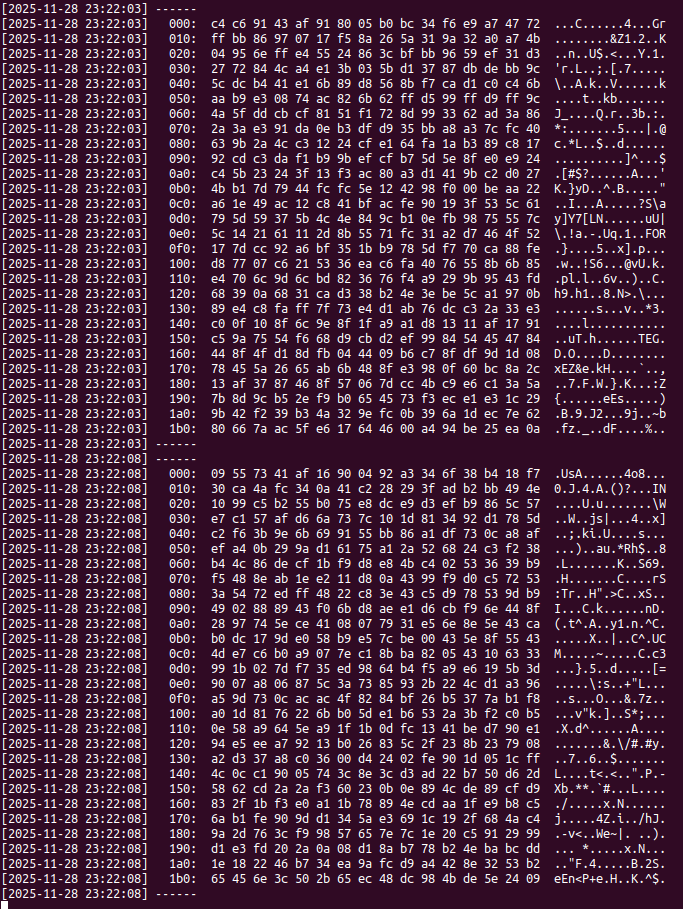
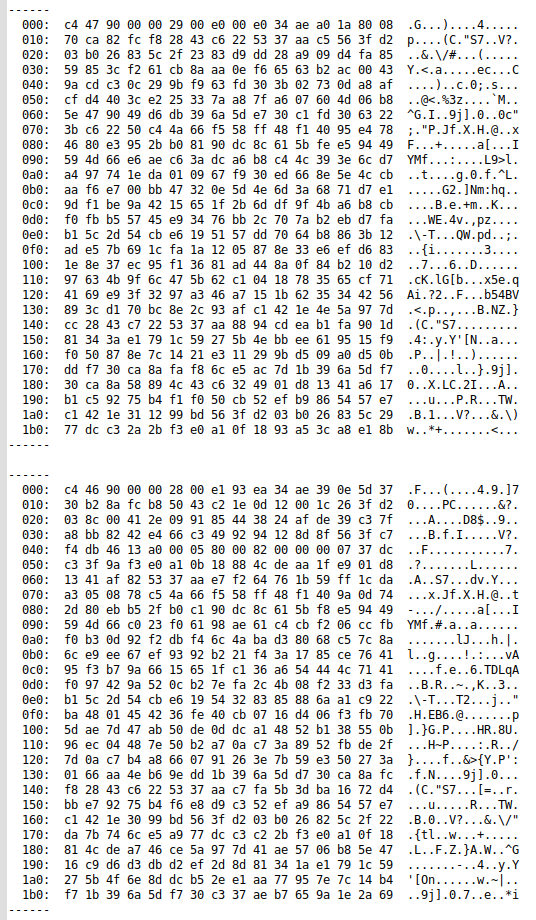
If I remove the CRC block in GNU Radio, a couple of the packets from your I/Q file decode. Do either of these payloads look like what we should expect from the PHASMA sats?
The first one could be something but without the crc difficult to say.
Post-launch TLE from satcat.com for PHASMA satellites:
0 PHASMA-LAMARR 799601753
1 99029U 00000AC  25332.82079396  .00000000  00000-0  47961-3 0    12
2 99029  97.4385  44.8326 0006532   1.7634 350.3547 15.16313754    04
0 PHASMA-DIRAC 799601754
1 99030U 00000AD  25332.82092127  .00000000  00000-0  47961-3 0    11
2 99030  97.4363  44.8329 0005848   7.4340 345.3837 15.16492238    02
Changed to the temporary NORAD ID used in SatNOGS DB:
0 PHASMA-LAMARR 799601753
1 98530U 00000AC  25332.82079396  .00000000  00000-0  47961-3 0    18
2 98530  97.4385  44.8326 0006532   1.7634 350.3547 15.16313754    00
0 PHASMA-DIRAC 799601754
1 98529U 00000AD  25332.82092127  .00000000  00000-0  47961-3 0    13
2 98529  97.4363  44.8329 0005848   7.4340 345.3837 15.16492238    04
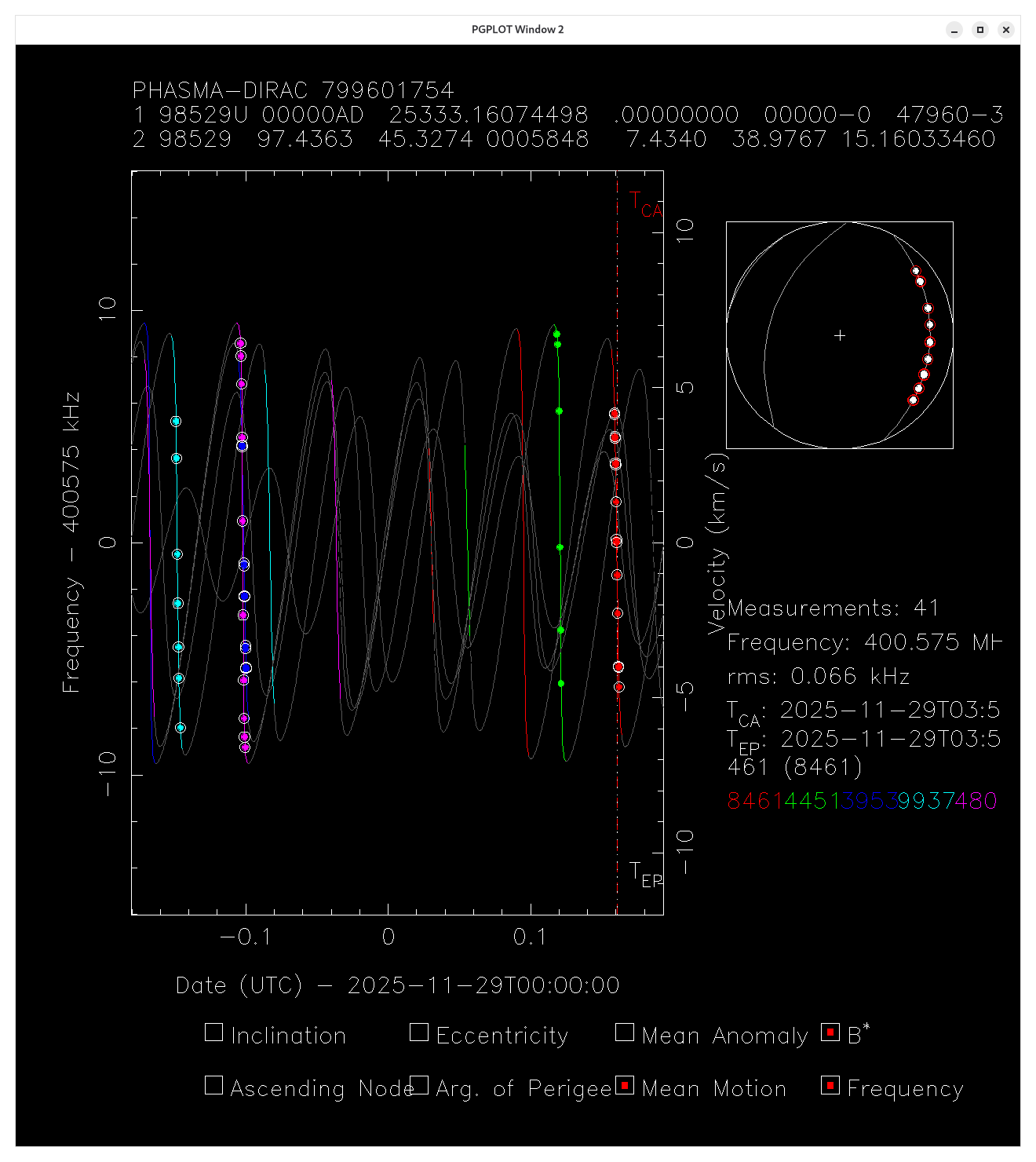
Using the above, TLE set update for PHASMA-DIRAC based on Network and strf observations:
PHASMA-DIRAC
1 98529U 00000AD  25333.16074498  .00000000  00000-0  47961-3 0    01
2 98529  97.4363  45.3274 0005848   7.4340  38.9767 15.16033503    02
dirac_303_v1.dat (1.7 KB)
sites.txt (11.6 KB)
One small update on the TLE of PHASMA-DIRAC:
PHASMA-DIRAC
1 98529U 00000AD  25333.37408547  .00000000  00000-0  47961-3 0    00
2 98529  97.4363  45.5488 0005848   7.4340 123.3102 15.16881059    00
sites.txt (11.6 KB)
dirac_303_v2.dat (1015 Bytes)
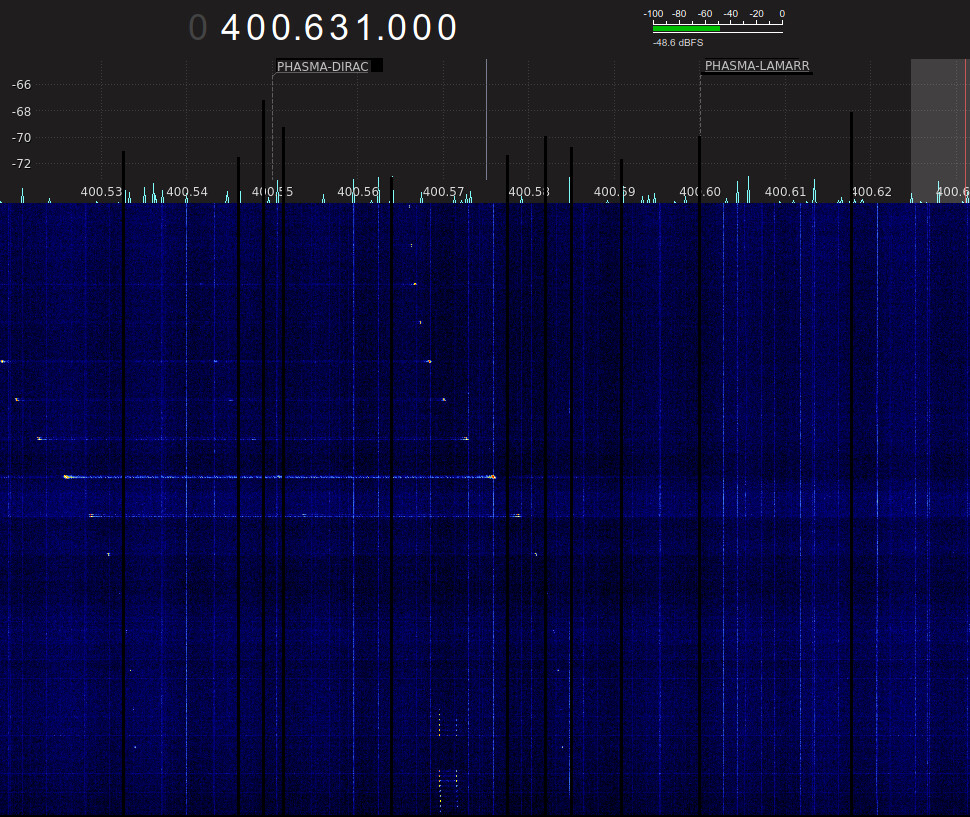
Got my first look at the PHASMA sats w/ decent elevation. Good signals in the waterfall (blacked out noise lines) for PHASMA-DIRAC, but could only decode w/ CRC-check block bypassed. Will test more w/ the strongest packets in capture; started w/ the most powerful burst at the 166-second point in my recording. Will get I/Q files uploaded asap & post URL.
First, if anyone would like a smaller download w/ only the strongest packets from my pass tonight, the URL is:
… this I/Q file is a Float-32 w/ Sample-Rate = 156250
And here is the entire I/Q (32-bit float, Sample-Rate = 156250).
Please note that the center freq was 400575000 because I was monitoring both PHASMA freqs.
The date/time stamp (20251130_033116) is UTC.
My location is: 37.78 N, 77.61 W