I’m with OnB Space, operator of SLEDGE. I only have first-hand details for our satellite, so the rest of the table is left for the other teams / anyone who knows more — corrections and additions welcome.
Satellite
Operator
Frequency
Transmission
Notes
SLEDGE
OnB Space
401.775 MHz
19k2 GFSK AX.25
GNSS-RO ionosphere observation.
GBSAT
KAIST
?
?
High-energy proton flux observation in the geomagnetic field
PERSAT02
Quaternion
?
?
Marine debris / ocean current analysis around Jeju
UEL-Y-Sys
Unmanned Exploration Laboratory (UEL)
?
?
Particulate matter monitoring, domestic space-grade parts
SD-1 SAT
SpaceLinTech
?
?
Radiation data collection, space-environment materials test
No, the call sign and text used to generate the WAV file are just placeholders. After the actual launch, we will need to analyze the real signal from the satellite and recreate the RX.grc file.
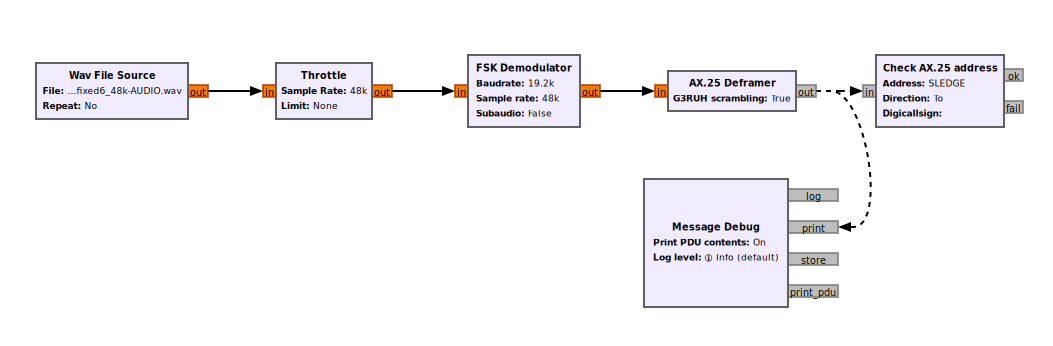
I ask because many people use a block in GNU Radio called “Check AX.25 address” as a way to avoid uploading junk / noise decodes to SatNogs & elsewhere.
I’ve linked actual recording from the satellite.
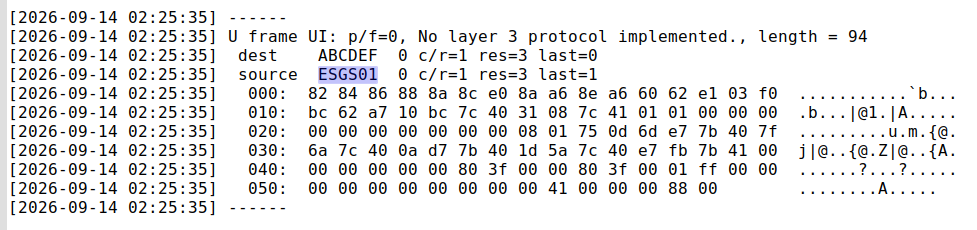
Current callsign of SLEDGE is ESGS01-0, the default setting for the transmitter.
While we can update AX.25 source address in-orbit this is the current AX.25 code.
Unfortunately I missed updating AX.25 source address at the last step before launch.
Here is a shortened version (the original contains so many packets rapid-fire that it would lock up my computer) and also as a standard 48k audio file:
Hello, K4KDR. Thank you for your suggestion.
I added a “Check AX.25 Address” block and updated to the file “SLEDGE_GFSK_19200_RX_GNURadio31012_fixed6_direct.grc”.
The generated “fixed6.wav” file uses a temporary test address of “From:SLEDGE” for AX.25 frames created during testing. This temporary test address must be replaced with the official address once the satellite’s official callsign has been confirmed.
callsign for SLEDGE mission will be ESGS01 at the launch, it can be only reconfigured we finish full-operation test which may take up to months.
Please consider ESGS01 as callsign for SLEDGE.
GBSAT also used UHF frequency and they’re also registered as GBSAT. I asked the project leader to share detailed information and provide sample audio file to Satnogs community.
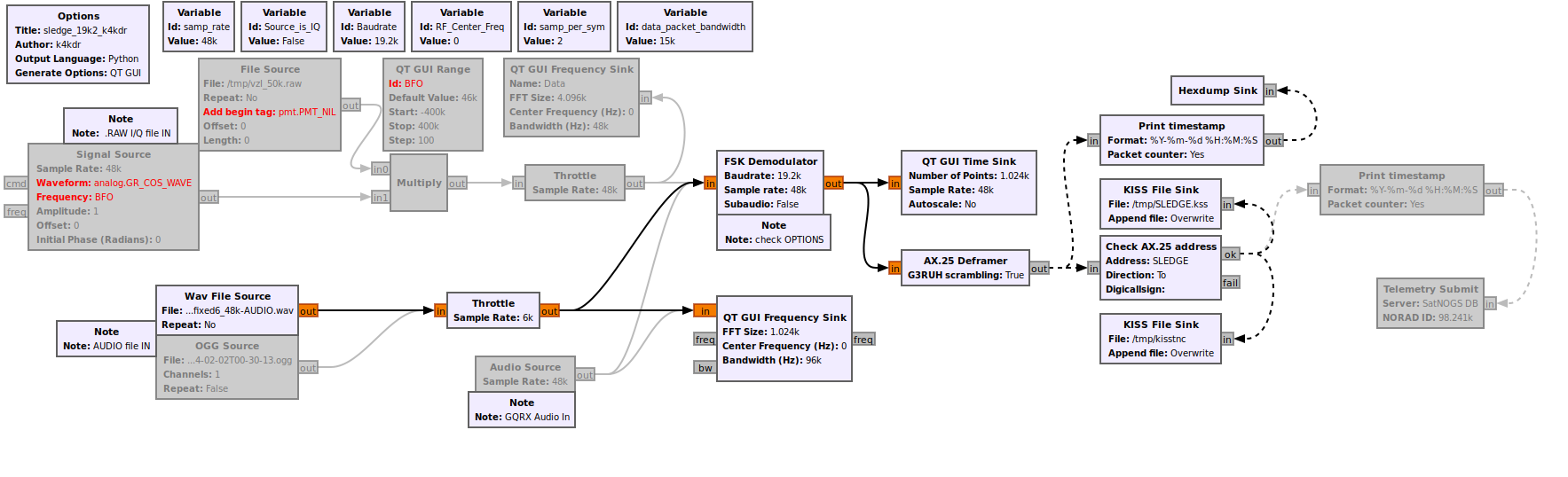
I have a ‘standard’ that I use for just about everything - but of course with variations where needed. You have input choices of a recorded I/Q file (w/ manual adjustment to center the signal of interest), recorded AUDIO files (.wav or SatNogs .ogg), or ‘live’ audio from some other source; in my case, GQRX.
Of course that is followed by demodulation & deframing.
Outputs are a hex dump to the lower monitor in GNU Radio, a KSS file, and a special KISS output to pseudo-device ‘/tmp/kisstnc’ which feeds an instance of Direwolf running w/ the ‘-p’ option to provide a display format that I like:
Lastly (disabled for test files), is the ‘Telemetry Submit’ block to upload decodes to SatNogs. As I said, I used this over and over with changes to baud rate, demod, & deframing as needed. Custom output destinations are added if a Team provides an upload proxy or decoder that is listening on a UDP or TCP port.