Thank you.
1 Like
Hi, this is Hyunmin Kim from GBSAT.
GBSAT operates on 435.95 MHz using an EnduroSat Transceiver II.
Our satellite registration is complete, and we’re now preparing to upload the transmitter information and Kaitai decoder.
Would it be okay to upload them here, similar to what SLEDGE did?
4 Likes
go ahead
I have uploaded the GBSAT pre-launch beacon test files to the following Google Drive folder:
Google Drive Link:
The folder currently contains the following files:
- Beacon_RAW.iq
A complex IQ recording of the GBSAT beacon captured from our SDR.
The sample rate is 1 MSPS.
- gbsat.yml
A SatYAML configuration file used to test the beacon with gr-satellites.
The configuration uses 9600 bit/s FSK/GFSK with AX.25 G3RUH framing.
- beacon_test.bin
An 84-byte AX.25 frame decoded from Beacon_RAW.iq using gr-satellites.
- gbsat_beacon_satnogs.ksy
The Kaitai Struct definition used to parse the GBSAT beacon frame.
- gbsat.py
The Python parser generated from the .ksy file using the Kaitai Struct compiler. This was used to verify the decoder locally.
The IQ recording was successfully decoded using:
“gr_satellites gbsat.yml --rawfile Beacon_RAW.iq --samp_rate 1e6 --iq --hexdump”
For this test, the decoding procedure was carried out in the following order.
First, the 1 MSPS complex IQ recording in Beacon_RAW.iq was provided to gr-satellites.
Second, the signal was demodulated as a 9600 bit/s FSK/GFSK signal.
Third, G3RUH descrambling, NRZI decoding, HDLC processing, and AX.25 frame recovery were performed by gr-satellites.
Fourth, the recovered AX.25 frame was saved as beacon_test.bin.
Finally, the recovered frame was parsed using gbsat_beacon_satnogs.ksy, and the generated gbsat.py parser was used to verify the decoded telemetry locally.
GBSAT was assigned the callsign 6M2CK. However, during a post-loading review, we found that the step of changing the AX.25 source address from the test callsign GBSAT0 to the assigned callsign had been missed.
Therefore, the beacon transmitted by the spacecraft will use:
AX.25 destination: KAIST0
AX.25 source: GBSAT0
The provided IQ recording, AX.25 sample frame, and Kaitai decoder have been tested successfully with the current KAIST0 / GBSAT0 frame format.
If any additional files, protocol information, recordings, sample frames, or a different test format would be useful for SatNOGS integration, please reply here and I will try to prepare and upload them to the same folder.
3 Likes
thank you bro. very friendly satellite operator
1 Like
Hi Hyunmin,
Welcome to the community and thanks for sharing information about your satellite’s telemetry.
Am I right that you missed to submit a coordination request to IARU?
If this is the case, your satellite will be marked as Frequency misuse.
This comes with some limitations especially like this:
Anyway, if you don’t have a gitlab account, I can create a merge request on satnogs-decoders repository for you.
And, my favourite question: Do you plan on confirming beacon receptions with QSL cards?
73
Daniel, dl7ndr
Thanks very much for the GBSAT test files and great info!
I think my local decode of the test packet looks good:
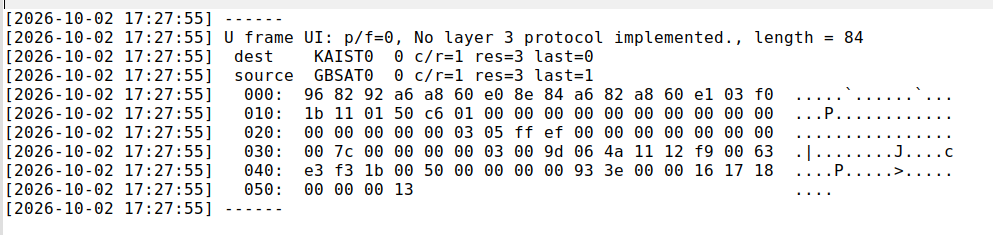
… and it seems to test out ok against your .KSY file:

Best of luck with your satellite!
.. doesn’t output anything for me.
Could you put an already demodulated beacon as a (zipped) 48 kHz .wav file into this thread?
Greetings!
The original I/Q sample file contained -2- packets; I’ve been doing all my testing w/ the first one.
I added a .wav file sink to my flowgraph to produce an audio version. It repeats twice (same frame) just so it’s not so awfully short. I’ve confirmed that the frames decode from the 48k audio file (attached).
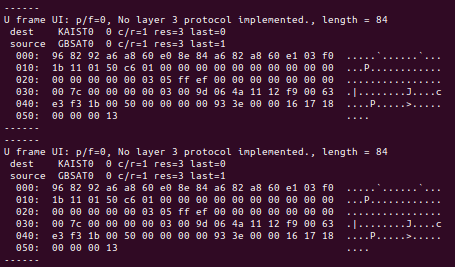
Audio file #2. Sorry for the initial mis-step. My goodness… good help is hard to find!!
GBSAT_Sample_AUDIO-x2.zip (105.9 KB)
2 Likes
So sorry - I realize now that I created that audio file in error.
Will replace that ASAP; please discard that first effort.
1 Like
Correctly formatted audio file positioned up on the original post. Sorry!
2 Likes
Thanks everyone for the helpful replies!
About the IARU frequency coordination request: GBSAT received its experimental radio station license in July, and I should have submitted the IARU coordination request around that time, but unfortunately I missed it.
For the SatNOGS decoder Merge Request: I don’t have a GitLab account and I’m not very familiar with GitLab yet, so I’d really appreciate it if you could create the Merge Request for us. Thanks a lot!
As for the QSL card, we still need to discuss it within the team, but I’m personally very positive about the idea. Once we make a final decision, I’ll post an update here!
Thanks a lot for converting the sample to a WAV file and uploading it! We’ll also save a copy of the WAV file in our team’s Google Drive.
2 Likes
You still have three days.
Done: Merge Request
as @dl7ndr suggestion, pls push and try hard so it pass the iaru coordination frequency. without it your sat in satno db will be labeled as :
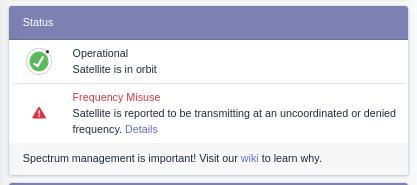
and when satno user want make observation , an error message will be show like this :

this is horror story. but if you desperate to submit the coordination, dont worry. you still can list your satellite on other alternate like sonik.space . but the ground station not much as on satno.
hope this suggestion help you..
73
Thanks everyone for the info, as we getting closer to the launch, I’ll review all the satellite and transmitter suggestions related to this launch later today and tomorrow.