What do you mean ? If you are following the correct object, it should be stable in frequency, regardless of which specific frequency that is. If you compare it and it differs, that just means one should be varying in frequency and depending on where you measure it, it will be off by some amount.
What you would expect in a mismatch is the image above, a hump to either higher or lower frequency depending on if it’s early or late compared to the correct TLE.
Exact frequency measurement should be done when the doppler is rock solid, no variation (might be, due to transmitter affecting the reference clock thou).
This is from an observation scheduled in satnogs for e-kagaku-1 as linked above. When the frequency is constant but shifted, this is a strong indikation, that the signal comes from the object, the TLE is associated with. Nevertheless in this observation, the signal does not match the emissions of the expected object. So the question remains, where the signal came from and comes every pass of e-kagaku-1.
@K4KDR
e-kagaku-1 beacon is CW, not FM or USB.
You can hear morse code in the wav file.
@stefanp
The wav file is just “ sample” recorded in our lab environment, so it’s not from observation.
2 Likes
do you have the original sound that only cw beacon. because we hear someone drop something at first record and at the end sound of someone talking to others.
We have 3 TLE for the deployed satellites in space-track.org.
Interestingly and strangely already identified, probably due to the small number of them(?).
For now I’ve set them to follow these objects in DB instead of identify them directly, let’s do first some further analysis to verify the identifications in space-track:
0 YOTSUBA-KULOVER
1 65941U 98067XN  25284.36555888  .00015108  00000-0  26691-3 0  9996
2 65941  51.6291  91.2741 0003103 189.9376 170.1553 15.50556389   150
0 E-KAGAKU-1
1 65942U 98067XP  25284.17217977  .00023375  00000-0  40796-3 0  9997
2 65942  51.6345  92.2253 0007426 223.4264 136.6140 15.50553459   123
0 BOTAN
1 65943U 98067XQ  25284.36553998  .00003834  00000-0  73976-4 0  9990
2 65943  51.6335  91.2721 0003699 215.8784 144.1957 15.50451380   155
3 Likes
BOTAN 12-10-2025 11.23.49 UTC over KO83ba GMSK 4k8

2 Likes
From a quick check, it looks like that the TLE sets are not fully accurate. Let’s see if they are going to improve in the next hours, if not we are going to generate new ones 
4 Likes

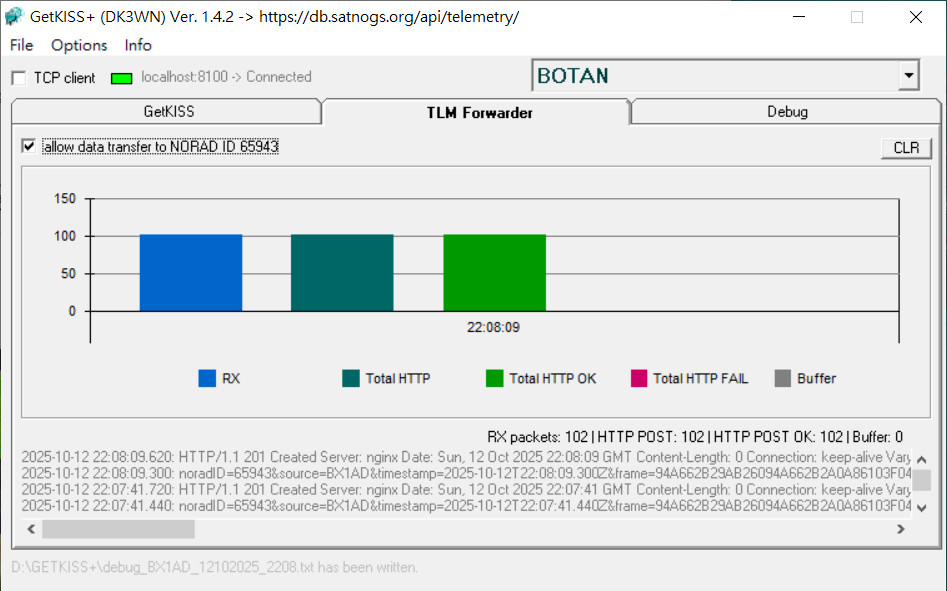
You still have to upload to Norad ID 98543.
No problem to be at 65943, after identification all the data will be merged to one entry. The only issue is that until then (I’ll check later today or tomorrow morning) will not be shown in the dashboard.
1 Like
From a quick check BOTAN fits 65942, and I’m going later to identify it in DB. For now I’ve swapped BOTAN and e-kagaku in DB, so now we follow 65942 for BOTAN, and 65943 for e-kagaku.
2 Likes
The dashboard for BOTAN is now available.
Feel free to upload received CW beacons manually to be display on the dashboard.
3 Likes
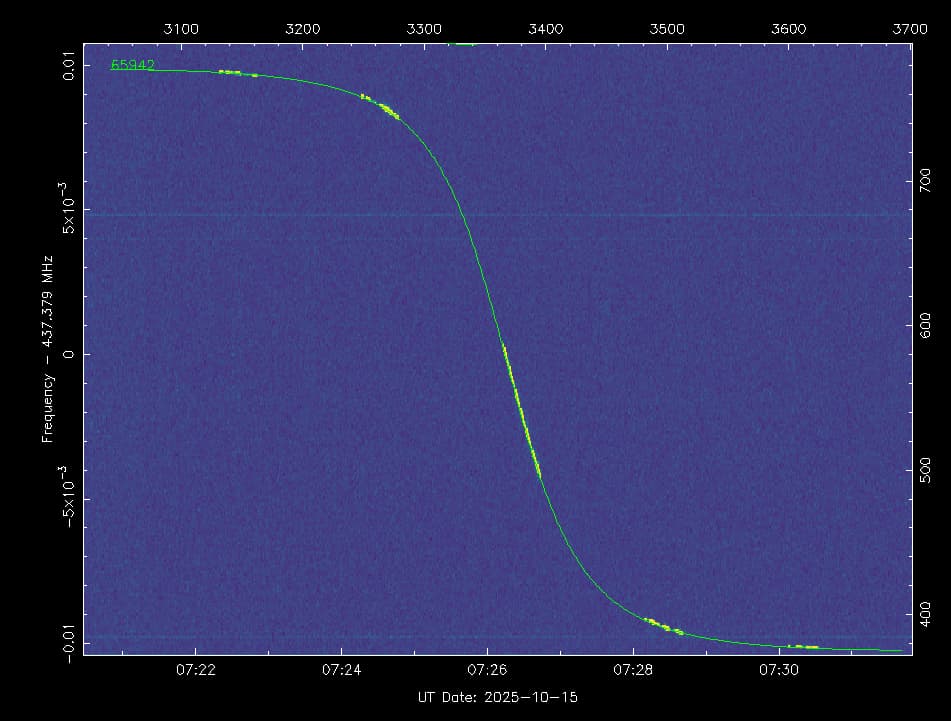
BOTAN is now identified as 65942, iknos results can be found here.
3 Likes
The dashboard seems to have stopped operation on 22.10. 08:04 UTC. No more updates since that time.
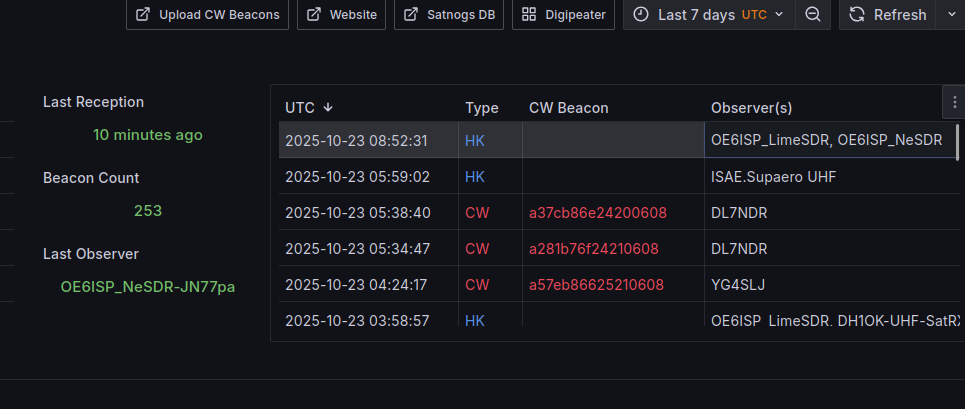

OK, thx - obviousely a mysterious browser-issue here. Even “refresh” and clearing cache + reload page didnt help. Finally shutting down everything and reopening solved the problem.
2 Likes
Hello together,
has anybody received a signal from e-kagagu-1 in the last few days? I tried it out but really not a beep here on my X-Yagi and on the SatNogs-receiver.
Is he alive?
BTW: what kind of soundmodem do i have to use for this satellite?
Hardware Model – 送信機型番: TXE145MFMCW-302A-RU
Operating Frequency – 周波数: 145.840 MHz