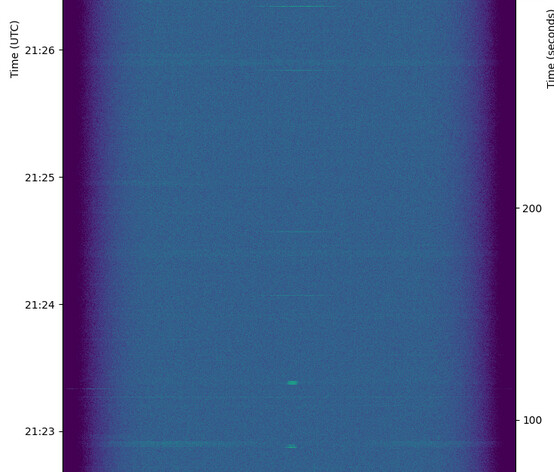
wow, you caught them 
1 Like
Updated TLE for GEMINI-POLLUX:
GEMINI-POLLUX
1 98320U          26124.45978745  .00000000  00000-0  56250-4 0    01
2 98320  97.7370  22.6951 0013854  89.0140 202.8198 14.92084624    05
3 Likes
Yes, we confirmed that both transmissions are from Gemini-Pollux.
3 Likes
Many thanks for the update!
1 Like
i wondering how to engineer both signal, with different view on waterfall, but same encoding..
We have managed to contact both NuLink-1 and NuLink-2! 
The TLE that we used to contact the satellites are:
NULINK-1
1 98321U          26123.38857226  .00000000  00000-0  00000-0 0    01
2 98321  97.7405  21.6745 0003186 120.9252 180.4328 14.92395341    08
NULINK-2
1 98322U          26123.38836855  .00000000  00000-0  00000-0 0    07
2 98322  97.7383  21.6781 0003069 103.2528 197.0225 14.92336124    08
4 Likes
Is there any schedule when it changes from one to another?
I’m asking in order to schedule each time the appropriate transmitter to achieve more demodulated frames.
1 Like
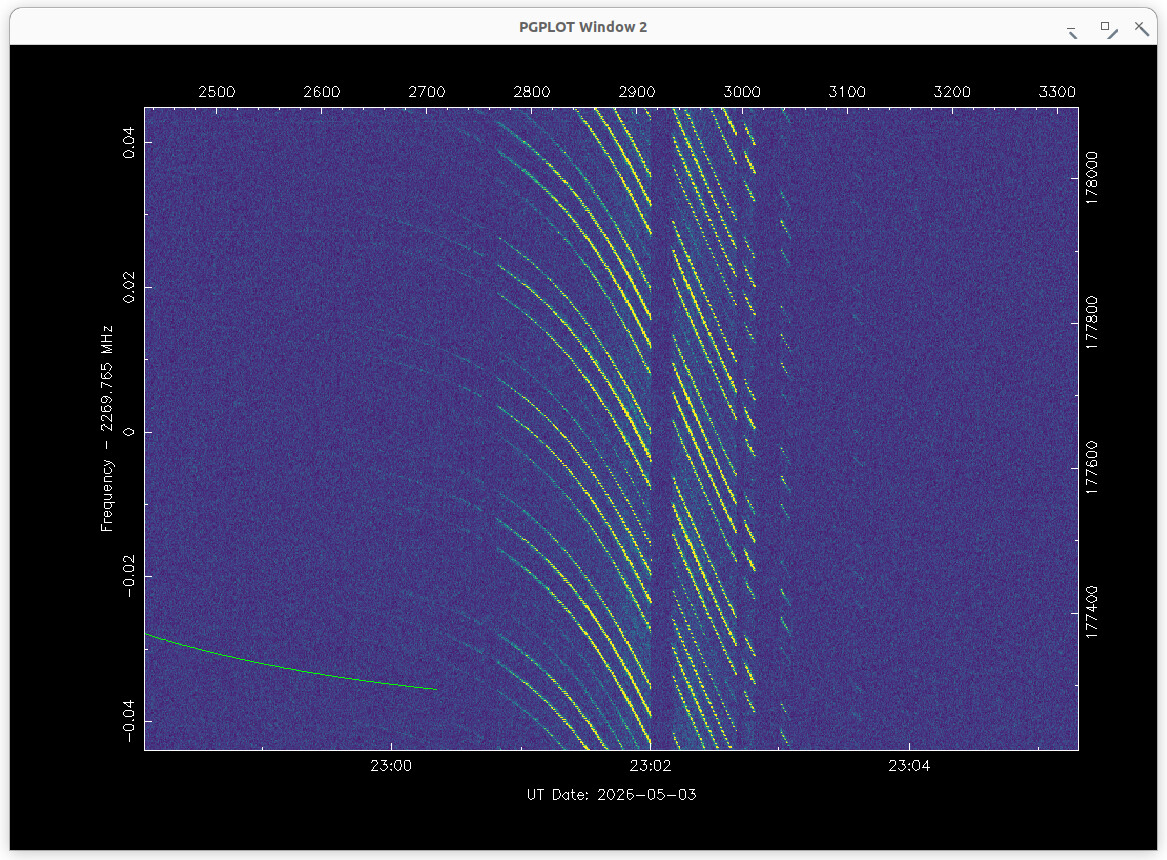
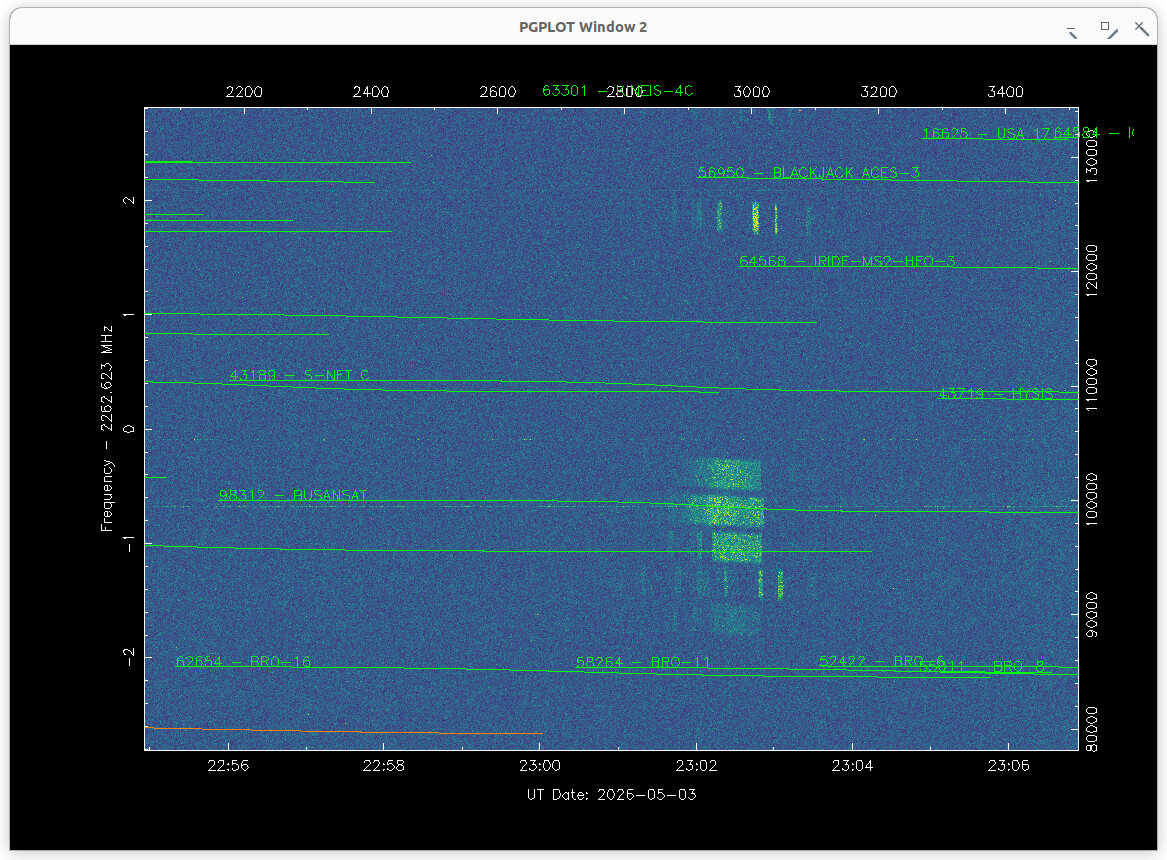
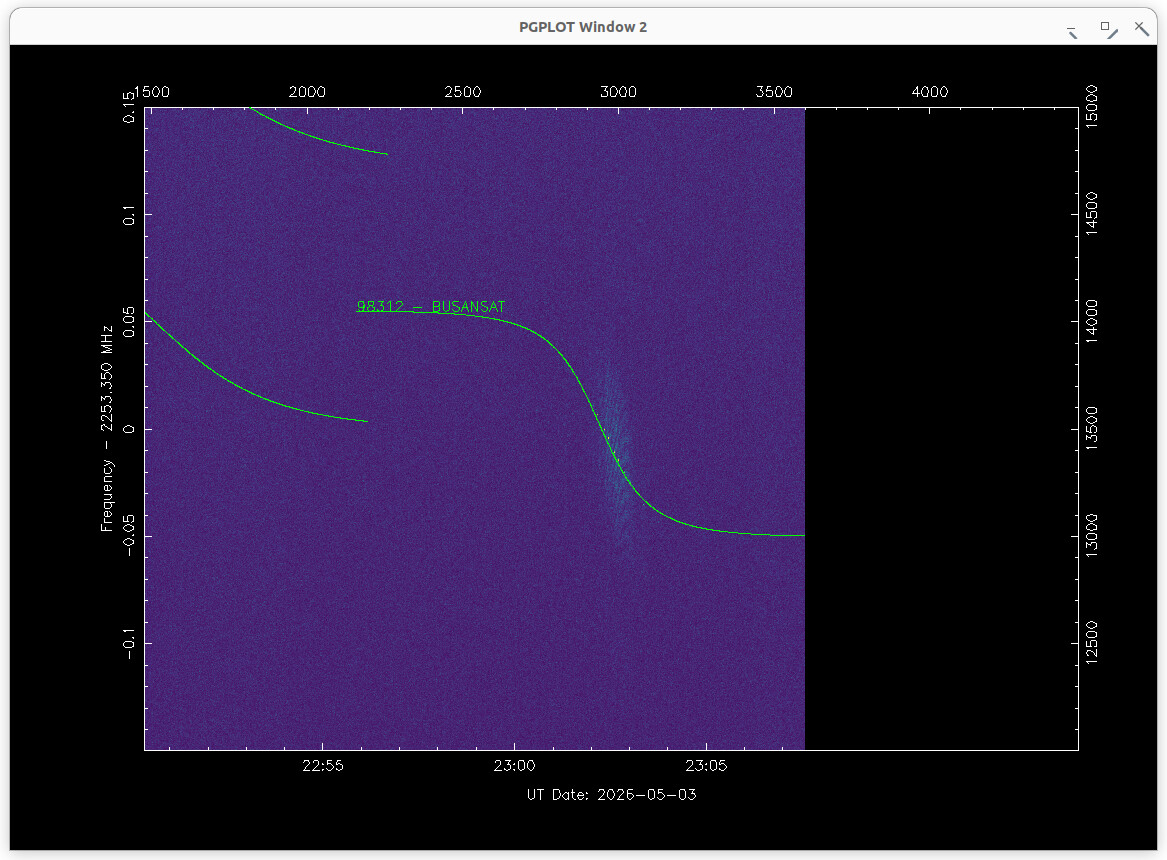
And still wondering if the signal some MHz on top of 98312 is part of it’s transmission or some other satellite from that launch
1 Like
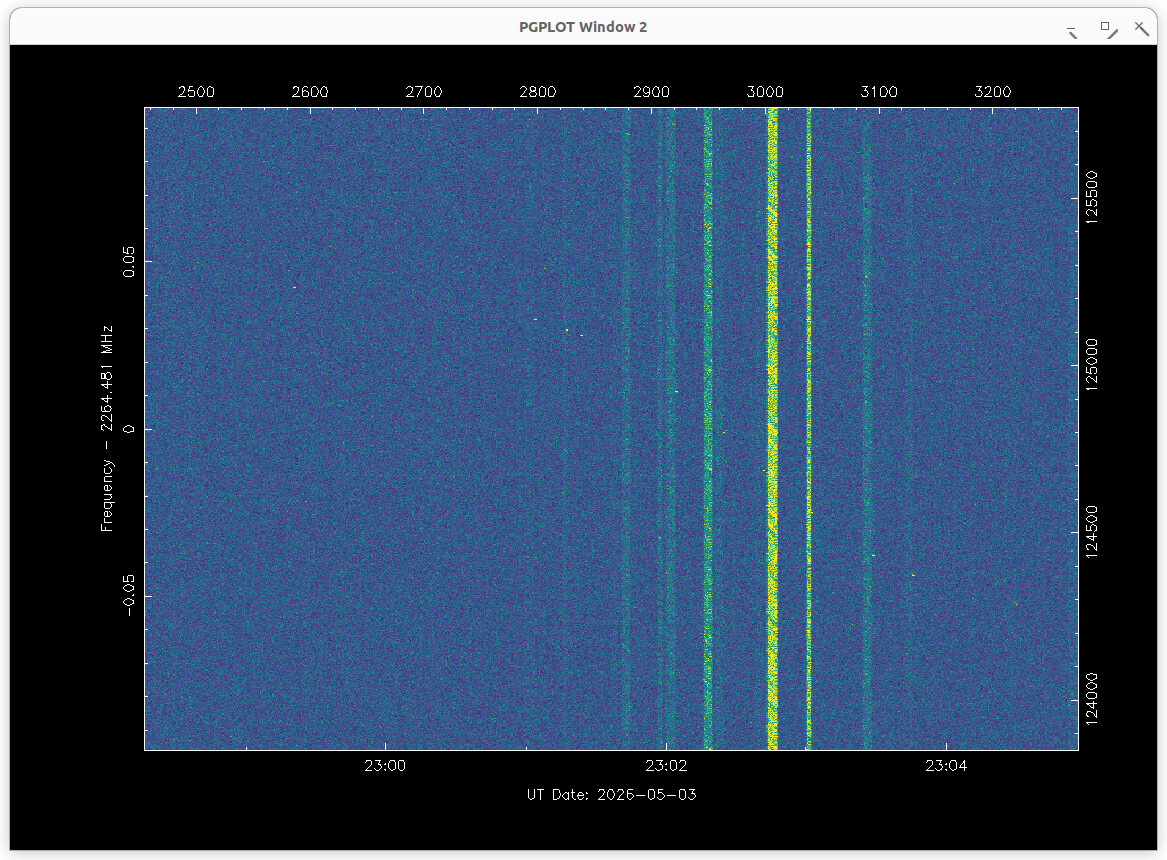
and one yet undefined in the same time space on 2260 MHz
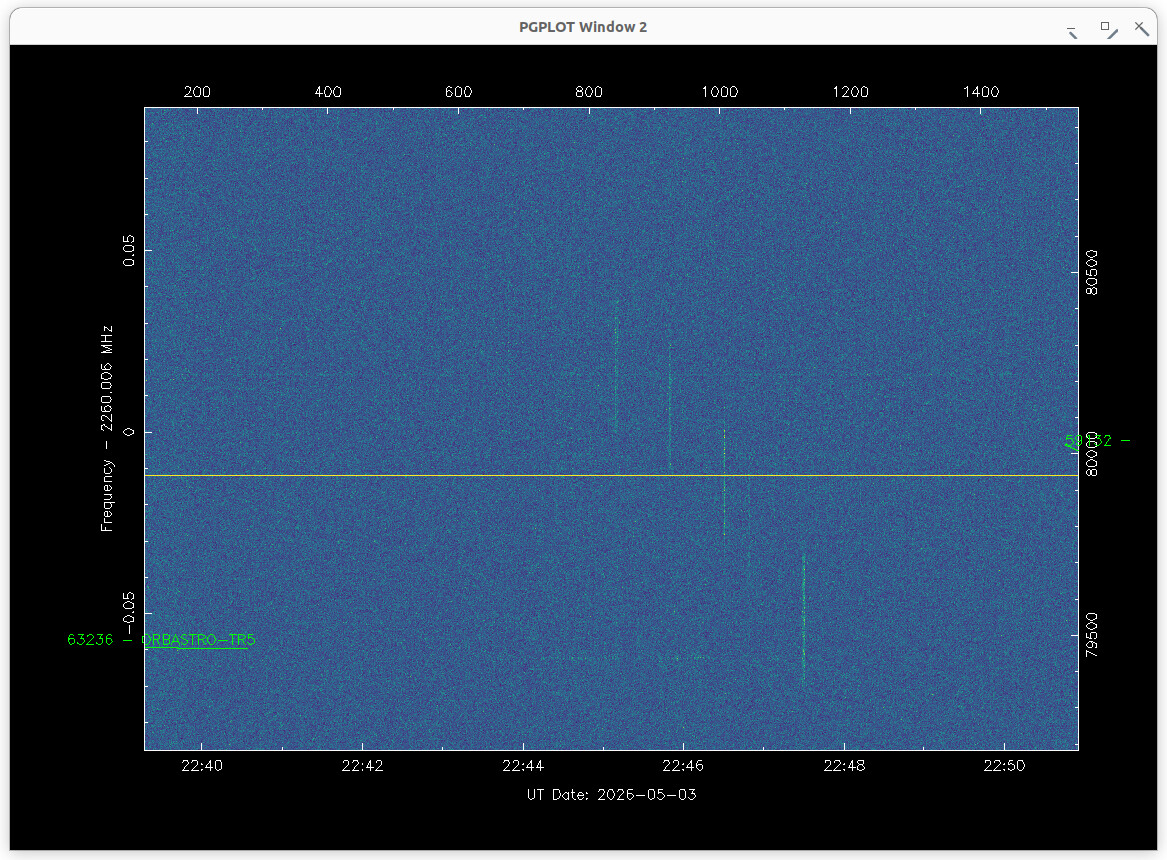
Edit:
Could be a match to QUBE 2 or QUBE II)

2 Likes
While listening for QUBE II on 435.6 MHz I’ve received some 2k4 FSK beacon packets (bundled by 3) in intervals of 1 min 7 sec.
I was able to decode them using the modem for Bluewalker-3.
A sample from pass 2026-05-04 09:2x UTC.
01 20 00 96 F3 02 00 83 05 2F 00 26 67 F8 69 DA 62 01 00 02 00 00 00 00 00 00 0C 0F 00 00 00 0F 00 00 00 00 80 00 00 00 80 00 00 89 FF FF FF 00 00 00 00 DE C4 00 00 F7 3B 01 00 BC 25 13 25 35 22 FD 2C 6F 00 94 00 67 00 34 00 E0 01 D3 02 21 00 01 00 44 20 83 02 00 00 8D 00 0D

01 20 00 96 F3 02 01 00 00 00 0D 03 E8 00 15 01 BE 00 00 00 03 00 00 00 B6 00 00 00 00 00 27 00 00 00 0F 0F 10 10 10 10 10 0F 0F 0A 0A 09 00 00 00 14 04 00 00 00 D2 C4 00 00 04 00 00 00 00 32 82 40 E2 82 E1 43 00 00 1E 41 00 00 C0 7F 00 00 C0 7F 00 80 8B 41 00 00 C0 7F 00 00

01 20 00 96 F3 02 02 C0 7F 9C 66 F8 69 00 00 00 C0 7F 00 00 C0 7F 00 00 C0 7F 00 00 C0 7F 00 00 00 00 0A 00 00 00 01 00 00 00 03 67 F8 CD 3E 71 75 A4 40 B5 6E 7E 3D 08 24 D6 BC 44 C0 5E BD 33 CB 1E 45 00 78 00 45 CD 4C 64 C5 66 8E 48 C5 CD C4 00 00 03 00 00 00 01 00 00 00
5 Likes
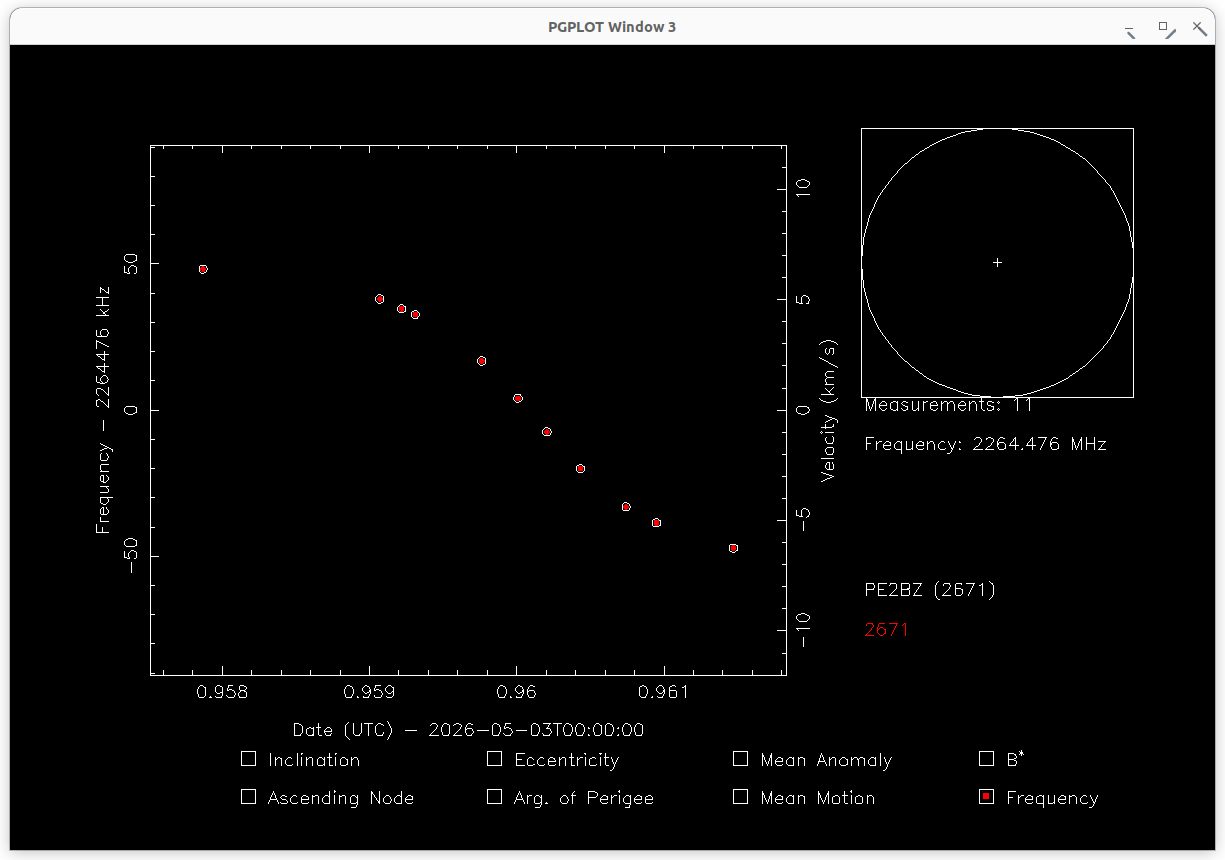
QUBE2 TLE Update:
QUBE2
1 98314U          26124.01421565  .00000000  00000-0  50000-4 0    06
2 98314  97.3900  22.2275 0014528   0.0000 123.1021 15.19371101    04
# 20260503.88-20260504.02, 19 measurements, 0.067 kHz rms
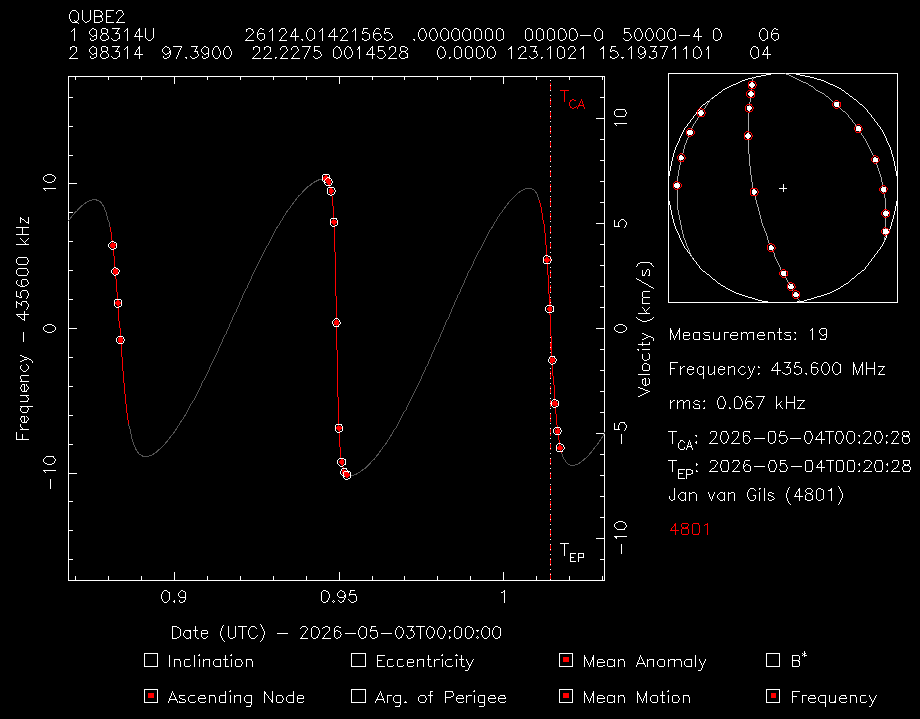
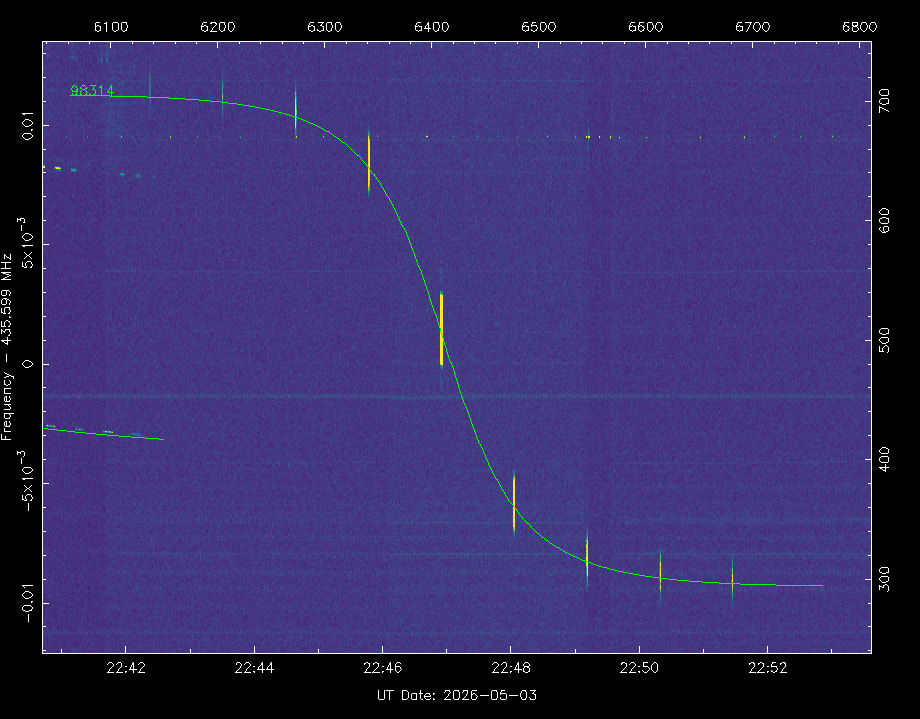
Jan | PE0SAT
4 Likes
Can you share the obs, or maybe even an IQ recording?
Jan | PE0SAT
It was not on the network and I’ve recorded only in wav.
2026-05-04T09:26:06Z DL7NDR.wav.zip (98.0 KB)
It looks like this:
I wouldn’t ask this here, but it’s relevant for two of these sats (NuLink-1 & NuLink-2).
Most of the 400 MHz ‘observations’ from SatNogs stations have around 40 kHz of spectrum shown.
Even though we don’t decode LoRa here, when a satellite is known to have, say, 125k LoRa (or any other modulation, for that matter), is it possible to schedule SatNogs observations to watch much wider bandwidths?
I ask because when you see the center 40k of a possible signal, it’s difficult to know if you’re just looking at noise or what. But if the amount of spectrum was, for the NuLinks, more like 250k, then it would be obvious if a 125k signal was visible on the waterfall.
Thanks!
2 Likes
Hi Fredy,
Thank you very much for your help and support.
We have seen a few unexpected reset events, and after such events, the transmitter configuration may not always return to the intended state. Our team is currently investigating this issue and working on a solution.
If we cannot stabilize the current configuration soon, our fallback plan is to operate the beacon at 1200 bps and move it to 436.500 MHz, which is the IARU-coordinated frequency.
For now, I will register this possible configuration in SatNOGS as an additional transmitter entry. If we actually switch to this configuration, I will mark it as active.
Thanks again for your support and for helping us collect more demodulated frames.
3 Likes
As of the last TLE update above, are perhaps the satellite IDs for NuLink-1 and NuLink-2 reversed?
I was setup to track NuLink-2 since it was going to be arriving first per the TLE, but I only saw downlinks where you would expect them when I switched over to tracking the “NuLink-1” TLE.
Naturally, the end result was that I missed both horribly, but that’s the way it goes sometimes. Early in deployments like this I usually use a wider portion of spectrum but tonight I was hoping to improve SNR by taking a more narrow look at each object. Of course that only works if you’re on the RIGHT object.
Thanks for any clarification those TLEs!
1 Like
It is something we are working on, I’m not sure when it will be released but as you said it will be very helpful.
Thank you for the update, the transmitter is now in the satellite’s entry and in inactive status.
1 Like