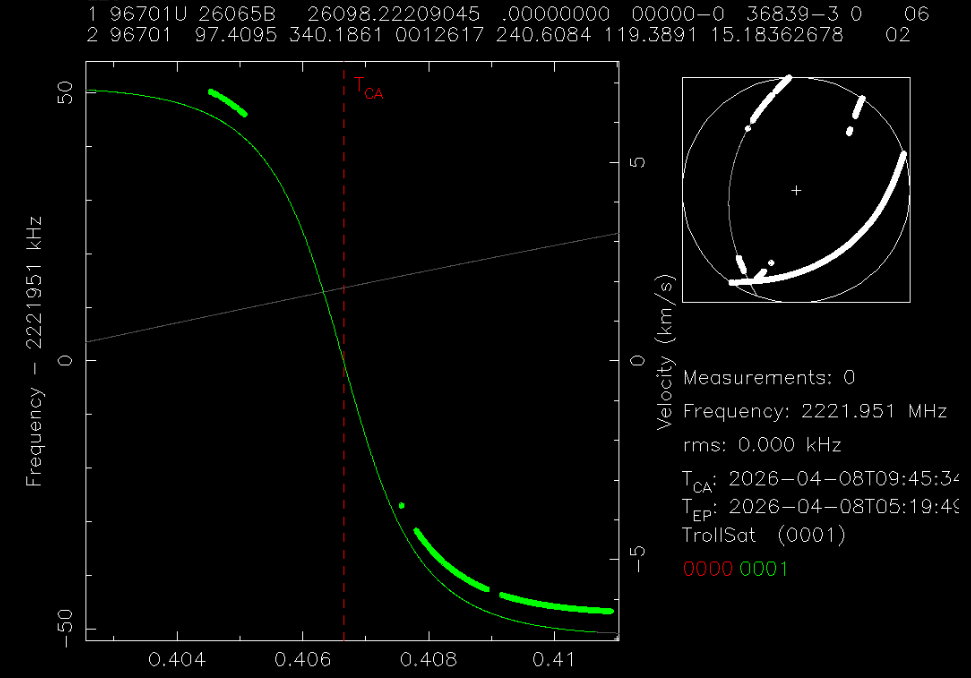
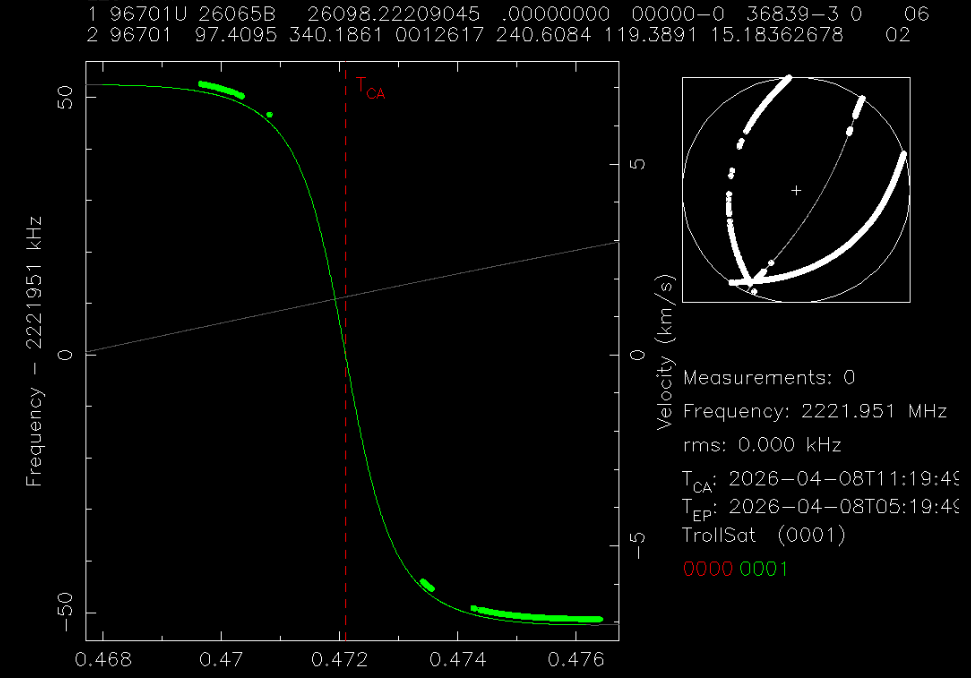
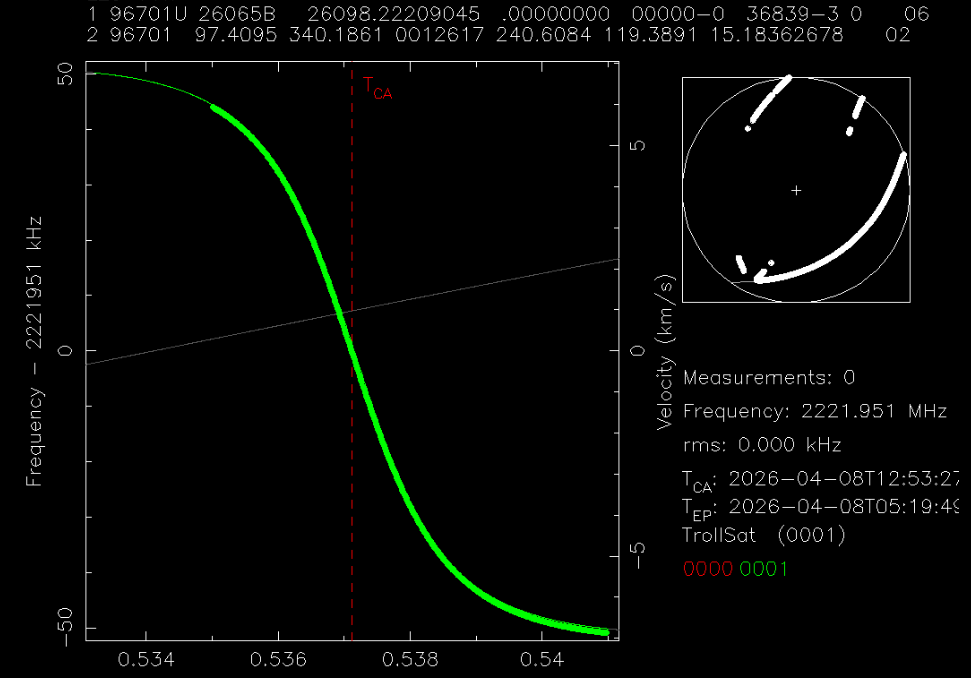
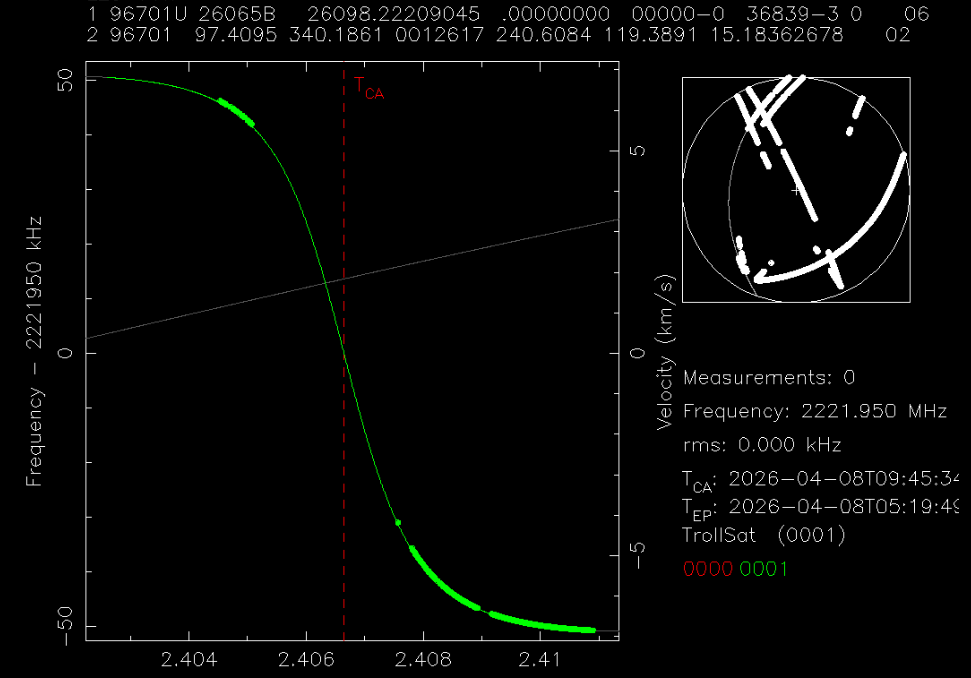
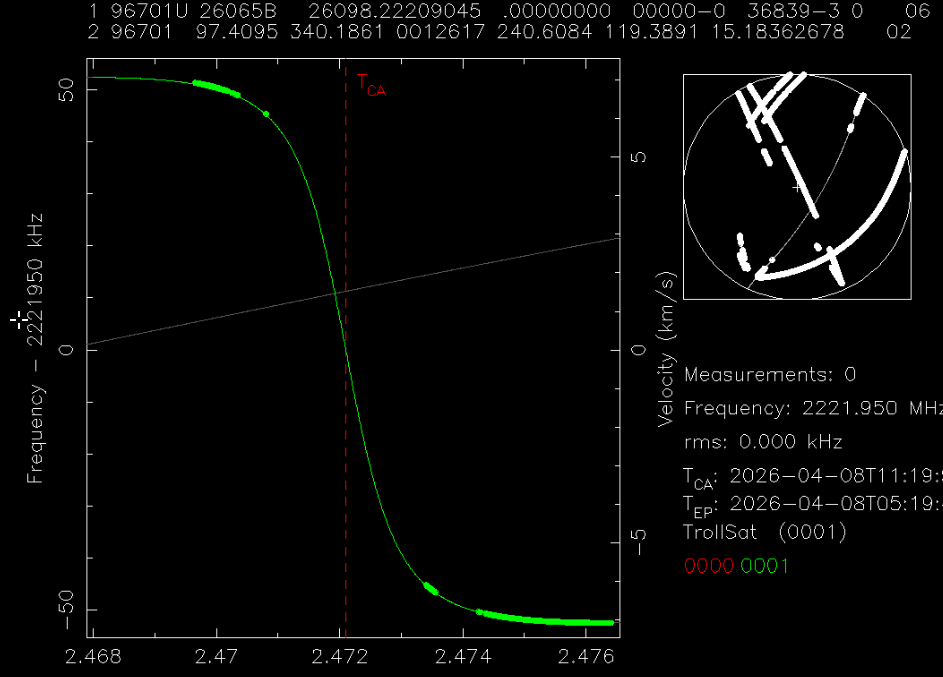
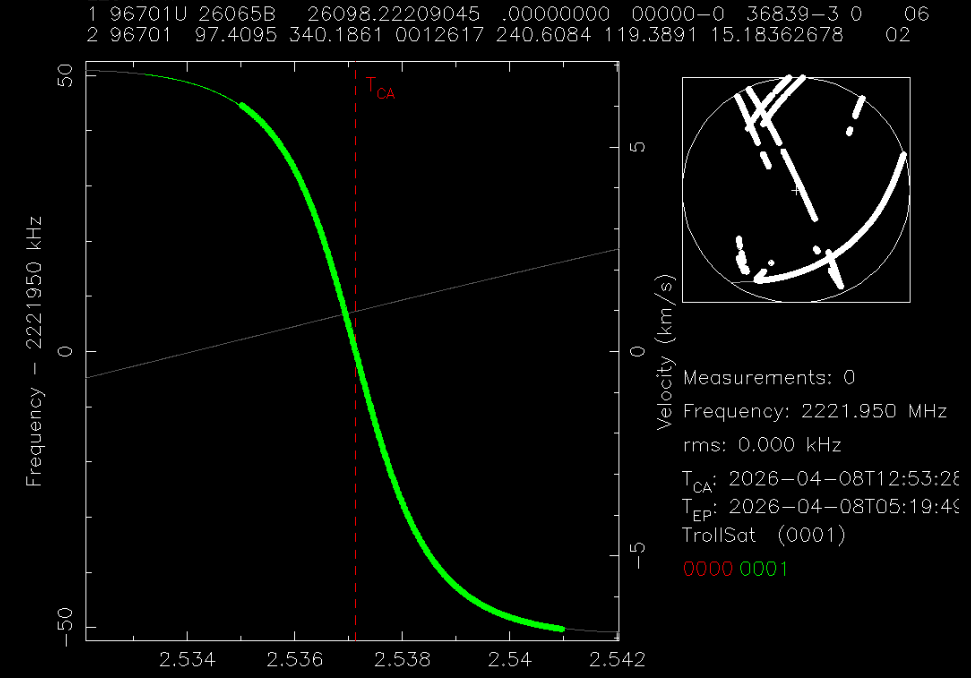
I’ve concat *3-5.dat files which contain the station 0001 in their points.
I’ve used space-track.org TLE with epoch the previous day (I assume from the file name that the points coming from 2026-04-08 day, so I get the TLE with epoch 26097):
0 LPNTSAT-001
1 68408U 26065A   26097.62895194  .00002905  00000-0  14459-3 0  9995
2 68408  97.4111 339.6065 0015466 248.0097 111.9495 15.18292519  1559
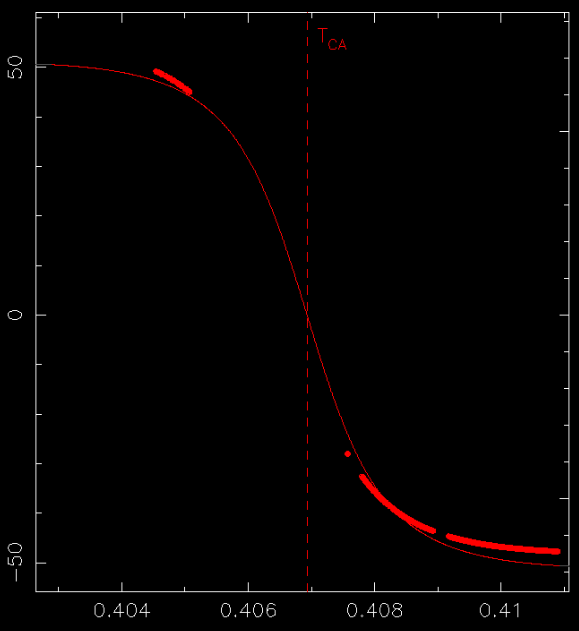
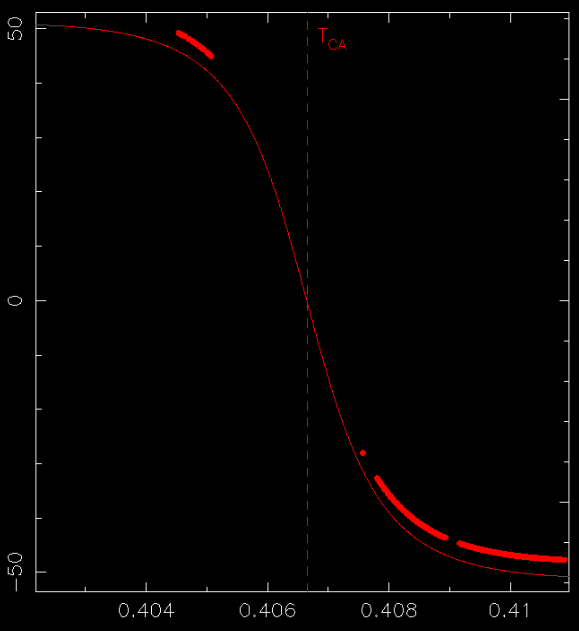
The points don’t fit well in this TLE, as you noticed, however for each of them if you fit Ascending Node (AN) and Mean Anomaly (MA), you get good fits (rms < 0.100KHz, for all of them it was around 0.050 KHz).
What I’ve noticed is that for each of the above fits, the frequency fit is quite different, from the more recent pass to the oldest one: 2221.950365 MHz (0.365 KHz from the center frequency), 2221.952246 MHz (2.246 KHz from the center frequency) and 2221.955099 MHz (5.099 KHz from the center frequency). If I get orbital mechanics right, this doesn’t necessarily means change in the frequency satellite transmits or station receives but it could be due to orbit change or time changes on the station, or a combination of all of the above. Unfortunately I can not help more on spotting what causes these differences.
My method to generate new TLE from observations, start with the above, fitting AN and MA together for each of the passes, then I proceed to bring everything to fit at the same frequency, preferably the center frequency of the satellite, which here I assume is 2221.950 MHz. So, I move points from each pass as much as the difference from the center frequency, in our example -0.365 KHz, -2.246 KHz and -5.099 KHz respectively.
With this process I kind of fixing/mitigate the errors in time and frequency, so the next step is to choose the parameters to fit. Usually from experience there are three parameters that need fixing/fitting AN, MA and Mean Motion (MM), the last one needs at least two different passes. So, I fit first AN and MA for the points of most recent pass, then choose additionally the points from the oldest one and fit AN, MA and MM. Then either choose all the in-between passes or from the oldest to the newest continuing fitting after adding new points in the selection.
When everything is chosen and fit we have a new TLE, however this is at the same epoch with the one we started from, so we need to move it. This can be done by hitting e key which changes the epoch to the one of the most recent pass (note that points of this pass should be at the top of the .dat file, you can verify it by where Tca vertical line shows up). Now we have moved the epoch, points will be again outside the expected orbit, here is where I re-do the same process.
Fitting AN and MA for each pass and moving points in center frequency, when I’m done then I fit again AN and MA for the more recent, then additionally select the points of the oldest and fitting AN, MA and MM and then as previously continuing with the in-between passes. Note here that this time the difference from the center frequency should be around 0-10 Hz for S-band fitting, this is an indicator that the fit before changing the epoch was a good one. In our case I moved them -0.004 KHz, -0.007 KHz and -0.006 KHz respectively.
After that you have a new TLE that it should be good enough (rms < 0.100 KHz), in our case I got the TLE below:
LPNTSAT-001
1 68408U 26065A   26098.53717203  .00000000  00000-0  14476-3 0    06
2 68408  97.4111 340.5163 0015466 248.0097  33.1152 15.18541788    08
# 20260408.40-20260408.54, 1015 measurements, 0.050 kHz rms
The above compared with the closest in epoch TLE from space-track.org:
1 68408U 26065A   26098.61753319  .00002729  00000-0  13600-3 0  9998
2 68408  97.4110 340.5749 0015506 244.1688 115.7947 15.18298060  1704
gives very good results near (±24 hours) the epoch time.
From the above, my guess is that the satellite hasn’t any significant or abnormal change in its orbit, so it is probably something either with the satellite’s expected (2221.950 MHz) frequency or with the station time that resulting to such difference in frequency-time pair in each pass. If I had to choose I would say something is off with the station (time?) than the satellite, but this is just a speculation as I don’t know how both of them work.
Disclaimer: the above process is coming from experience and its successful results, however I haven’t found time to examine it, prove that/how it works or find how vulnerable in errors is, so use with caution!