Transporter-18 Rideshare: VSFB SLC-4E : 2026-10-01 18:32 UTC

Transporter-18 official payload update

SpaceX has published the official mission page and deployment sequence for Transporter‑18:

The mission is scheduled for 1 October 2026 from SLC‑4E at Vandenberg Space Force Base and will carry 130 payloads.

Payloads identified in the SpaceX deployment sequence

  • SPRITE
  • UASAT‑NANO
  • Sateliot‑6
  • GHGSAT C19 Aidan
  • Flock 4J‑18
  • GOMX‑5
  • GHGSAT C18 Eleanor
  • CRIMSON‑1
  • KENSAT
  • JACK‑006
  • LEMUR‑2‑MDQURESHI
  • GYEONGGISat‑2A
  • Sateliot‑5
  • Flock 4J‑17
  • GPDM
  • LEMUR‑2‑VARUN
  • Watchdog v0‑A
  • Sateliot‑8
  • Sateliot‑7
  • Tomorrow‑S12
  • FOREST‑20 Araucaria
  • LEMUR‑2‑WHITEHOTCREW
  • GuaraniSat‑2
  • AE4La
  • BRO‑23
  • IRIDE‑MS1‑EAGLET‑2‑21
  • eLEAF‑01
  • Blackwing Space Baby Bird
  • Tomorrow‑S13
  • IRIDE‑MS1‑EAGLET‑2‑24
  • Watchdog v0‑MK
  • IRIDE‑MS1‑EAGLET‑2‑18
  • NewSat‑64
  • HERMES
  • IRIDE‑MS1‑EAGLET‑2‑20
  • NewSat‑56
  • IRIDE‑MS1‑EAGLET‑2‑22
  • IRIDE‑MS1‑EAGLET‑2‑17
  • IRIDE‑MS1‑EAGLET‑2‑23
  • Sateliot‑9
  • Terra Nova
  • DHRUVA SPACE LEAP‑2
  • Merlin‑1
  • MERIDIAN FCL
  • IRIDE‑MS1‑EAGLET‑2‑19
  • BRO‑32
  • NewSat‑57
  • ION SCV Absolute Andreas
  • GNOMES‑10 via Muon Space
  • ICEYE‑2
  • Athene 1 Seranis Mission
  • ION SCV Empowering Ekaterina
  • ICEYE‑3
  • OSSIE
  • ICEYE‑4
  • BOB
  • F2G1
  • KEVIN
  • Project Suncatcher M1
  • Tanager‑2
  • STUART
  • ION SCV Alluring Alexander
  • Altair‑1
  • Element‑1
  • SSPICY Otter
  • Reason‑1
  • HotSat‑3
  • ICEYE‑1
  • Star Catcher Protostar
  • Varda W‑9
  • Varda W‑8

PocketQubes currently identified

  • UTNH — 1P, Universidad Tecnológica Nacional – Facultad Regional Haedo, Argentina.
  • SAJILO / SanoSat‑3 — 1P, AMSAT Nepal.
  • UNNE‑1B / HADES‑E2 — 1.5P, AMSAT‑EA.
  • HADES‑L — 2P, AMSAT‑EA.
  • ERMINAZ‑2U — 1P, AMSAT‑DL.
  • ERMINAZ‑2V — 1P, AMSAT‑DL.
  • ERMINAZ‑2X — 1P, AMSAT‑DL.
  • SIDLOC PQ‑03 — Libre Space Foundation.
  • SIDLOC PQ‑04 — Libre Space Foundation.
  • SIDLOC PQ‑05 — Libre Space Foundation.
  • SIDLOC PQ‑06 — Libre Space Foundation.
  • NIS‑PQ — Libre Space Foundation.

SpaceX lists the deployment of OSSIE at approximately T+01:00:26.

Additional spacecraft carried aboard orbital vehicles and hosted payloads may be added as their individual manifests become publicly available.
5 Likes

I’ve added 3U GUARANISAT-2 (CW, 4k8, LoRa [up+down], APRS).
+ 00:56:21
IARU

6 Likes

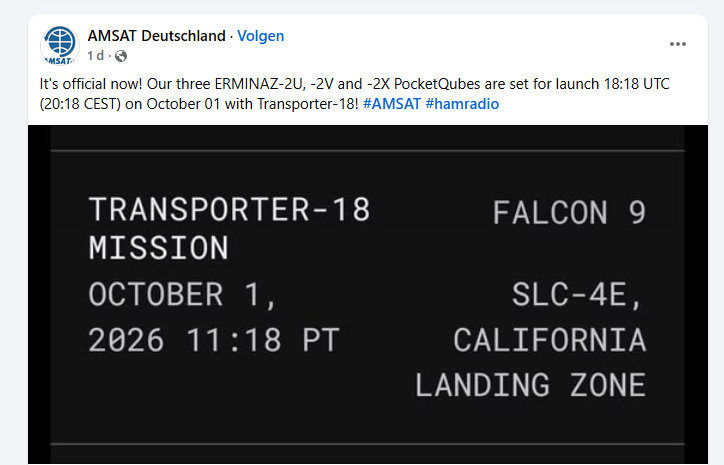
Amsat Deutschland mentions 2026-10-01 now being official date

2 Likes

Could you please remove the LoRa transmitters from the GuaraniSat-2 satellite information, as well as the launch time? We have signed an NDA that prevents us from publishing this information, even though the launch time is already publicly available on the SpaceX website. We are glad that SatNOGS, as well as the amateur radio community, can benefit from GuaraniSat-2. However, we kindly ask that, in the future, you contact the person responsible for the mission who signed the IARU coordination form before publishing or modifying information related to the satellite.

Thank you for your understanding and cooperation.

2 Likes

why? who are we ?

1 Like

Hi eferrer,

Thanks for joining the community.

Since you didn’t introduce yourself, I’m guessing from the name @eferrer that you are Eladio Javier Ferrer Torres ZP6MET, the responsible operator for GuaraniSat-2 according to its IARU frequency coordination entry.

Thank you also for providing the link to the website of your satellite.
In the newer versions (2025-12 instead of 2025-07) of the documents available there, LoRa was removed from GUARANISAT-2_Overview_20251212.pdf and GUARANISAT-2_Communication_plan 20251212.pdf, even though it is still mentioned under the main missions on the website itself.

Interestingly, even though you ..

.. you still publish those information directly on your satellite’s webpage and keep older versions of documents with this information online.
On the other hand, you ask me - who didn’t sign this NDA - to remove this information.

It would have been easier to let the IARU update your satellite’s entry.

I’m going to remove the transmitter suggestion for LoRa from SatNOGS DB, because the newer versions of the documents also doesn’t mention it any longer.

The launch time however is, as you stated, already publicly available on the SpaceX website and also crucial for generating correct orbital data. So I want to leave it in my satellite suggestion.

By the way, I’ve contacted the person responsible for the mission who signed the IARU coordination one hour after I made those suggestions to the SatNOGS DB.
He hasn’t replied to my email yet.

73
Daniel, dl7ndr

Supplement:

It’s actually the other way around.

1 Like

Hi Daniel,

Thank you for your detailed response. After reading it again, I think I may not have explained my original request clearly enough, so I would like to clarify a couple of points.

First, you are correct about my identity. I should have introduced myself in my original message. I am Eladio Ferrer (ZP6MET), and I am involved with the GuaraniSat-2 mission, particularly in the communications and frequency-coordination aspects.

Regarding the LoRa information, thank you for removing the transmitter suggestion from SatNOGS DB. The newer GuaraniSat-2 documentation reflects the current configuration of the mission, in which the LoRa transmitter is no longer included. I appreciate your willingness to update the SatNOGS information accordingly.

Regarding the launch time, this is actually the information to which I was referring when I mentioned the NDA in my previous message. I understand your point that the launch time is now available on the SpaceX website and that it is useful for generating orbital data.

However, our request is not based on whether the information can be found publicly. The issue is that the launch information is covered by an agreement that AEP has signed, and therefore we at AEP have to be careful about how we redistribute or confirm that information ourselves. I hope you can understand the distinction.

I also understand why you found the situation confusing, particularly because some older GuaraniSat-2 documents are still available on the AEP website. We are working to keep the publicly available documentation consistent with the current mission information, and some older documents have not yet been removed or replaced. I agree that this can make the situation appear contradictory from the outside.

I also appreciate that you mentioned contacting the person responsible for the IARU coordination. Unfortunately, I have not received that email, but in any case, my previous message was not intended to suggest that you had acted without trying to contact the appropriate person. I was simply trying to make sure that future questions regarding information covered by mission agreements are coordinated with the appropriate contact.

Finally, regarding my comment that SatNOGS and the amateur-radio community can benefit from GuaraniSat-2, I understand your point. I did not intend to suggest that the relationship is one-sided. Quite the opposite: we genuinely appreciate the work of SatNOGS and the amateur-radio community. The worldwide ground-station network, observations, tracking, and reception reports are extremely valuable for satellite missions, and we greatly appreciate the contribution of the community.

Thank you again for your work and for taking the time to explain your position. I hope this clarifies what I meant in my original message, and I apologize for any misunderstanding caused by my previous message.

73,

Javier
ZP6MET

1 Like

the interesting part maybe this:

MUA mission: The M.U.A mission (Monitoring Unit of the South Atlantic Anomaly) aboard the GuaraniSat-2 nanosatellite aims to study the radiation environment inside and outside the South Atlantic Anomaly (SAA), a critical region that affects both satellite systems and radio communications across the southern cone of South America

Whether it’s true or not, many satellites are reportedly said to experience electronic failures or anomalies when passing over this area. remind me about bermuda triangle, but this is space version.

but i’m wondering, what and how satelite operator protect their electronic on satellite board from this radiation.

I didn’t see any pop-up messages about the P satellites on the webpage, which means these satellites may have been integrated into the ION SCV in-orbit deployer.
So, before knowing which satellites the SCV is carrying, do we need to first calculate their orbital elements?

what and how satelite operator protect their electronic on satellite board from this radiation.

Thanks to the anti-radiation path paved by our predecessors, satellite radiation protection is now very complete.
Take what I know as an example:

“Add more redundancy.” Since radiation will damage part of our system, we just need to build several more systems!
(The downside is that cost and weight will increase.)

“Software watchdog.” We stuff an initial software suite into a chip, with triple backup, and when the satellite has a problem, it switches to this package.
(It treats the symptoms but not the root cause. If the payload is broken, everything is finished.)

“Heavy-armored knight.” We wrap all important payloads extensively to prevent damage, such as lead plates, shielding covers, one layered over another.
(Good luck to those designing the thermal budget and attitude and orbit control. Launch costs too.)

1 Like

can you share any experience like video, or presentation about this.

I’m curious how cubesat for example like asrtu-1 or even pocket cube like HADES managed to withstand this extreme radiation and continue operating properly for more than a year. Was it partly due to luck, or was it the result of careful calculations?

Hi Javier,

Thanks for clarifying the situation.

Well, in that case SpaceX distributed it and I redistributed it, so AEP didn’t do it. Your agreement is safe.

73
Daniel

2 Likes

Is anyone on the list going to be at Vandenberg?

1 Like

CelesTrak has pre-launch SupGP data for the #Transporter-18 launch from Vandenberg SFB on 2026-10-01 at 18:17:59.990 UTC: Deployment of 70 satellites is set to occur 2026-10-01 19:12:24.250 UTC until 2026-10-01 19:23:17.350 UTC.

7 Likes

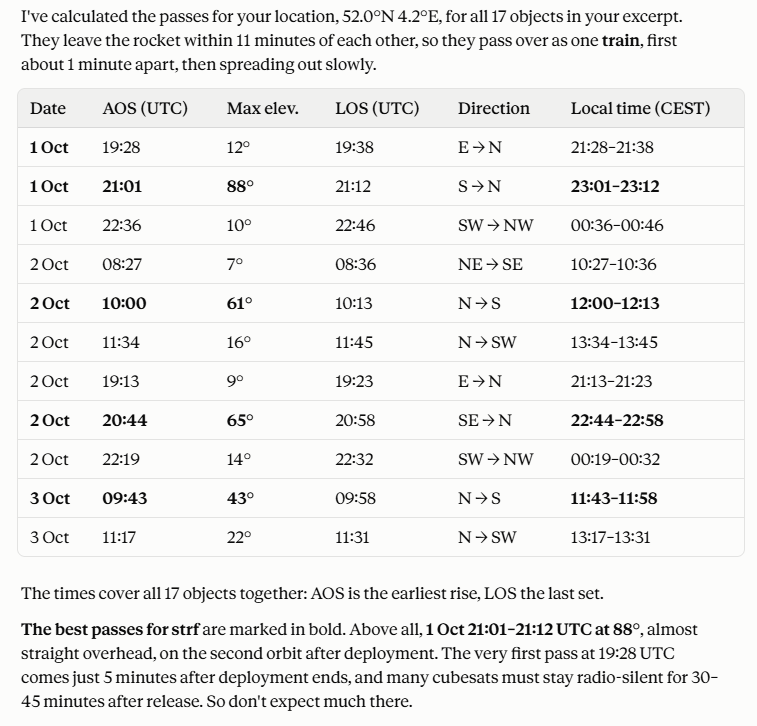
Now, for the Dutch (strf) observers I have had created a pass prediction for the first days IF the satellite launches on time. My problem with new TP launches was allways how / where to find the pass prediction info, I now have fed db2os his info into Claude.

Now to decide which band / range…

2 Likes

tle

SPRITE
1 99299U 26227A   26274.80028067 -0.00020066  00000-0 -98230-3 0   03
2 99299  97.4417 340.8162 0005870 136.9011 202.0478 15.18253118    05
1 Like

I’m adding the satellites and frequencies in DB, so we can decide which ranges are best to track.

It will take some time, maybe it will be fully done tomorrow UTC morning.

3 Likes

thank you @fredy

2 Likes

this is my favourite satellite for this launch. hope successfully deploy and tx rx the telemetry. go go go!

2 Likes

All these satellites are travelling aboard UARX’s OTV, housed in different deployers, rather than inside ION SCV.

Before deployment, we can use the OTV’s orbital elements to predict their passes, since they all follow the same trajectory.

After each satellite is released, we can estimate its initial orbit using the OTV’s position and velocity at the deployment time, together with the separation velocity and direction. Once individual TLEs become available, we can track each satellite separately.

Therefore, we don’t need to know the complete payload manifest to calculate the OTV’s passes, but we do need deployment details to estimate each satellite’s orbit after separation.

3 Likes