According to the D-Orbit mission booklets, the seven Spire satellites are LEMUR-2-STARLIGHT, LEMUR-2-TARTIFLETTE, LACUNA-3, LACUNA-4, deployed from ION SCV Stellar Stephanus, and LEMUR-2-HOTSPUR-TOM, LACUNA-5, LACUNA-6, deployed from ION SCV Galactic Georgius.
3 Likes
Black Kite-1 TLE update, it is strange that after 3.5 months from the launch this satellite doesn’t seem to have an object to track and identify, which makes me wonder if we miss something or it is just that not everything from this launch has been tracked yet:
Black-Kite-1
1 98527U 25276E   26068.83716011  .00000000  00000-0  29878-3 0    02
2 98527  97.4293 144.0630 0005477 177.7111 251.7791 15.18915954    03
1 Like
One more TLE for Black Kite-1:
Black-Kite-1
1 98527U          26081.81391454  .00000000  00000-0  30139-3 0    05
2 98527  97.4293 156.6089 0005477 177.7111 250.5648 15.19148096    04
bk1_082_v1.dat (2.2 KB)
sites.txt (12.8 KB)
Currently the OJBECT CD (66741) seems to be very close to Black Kite-1, however some weeks ago it wasn’t. Let’s keep an eye on it but to be honest I think that that Black Kite-1 is one of the missing (not announced yet?) objects from this launch.
1 Like
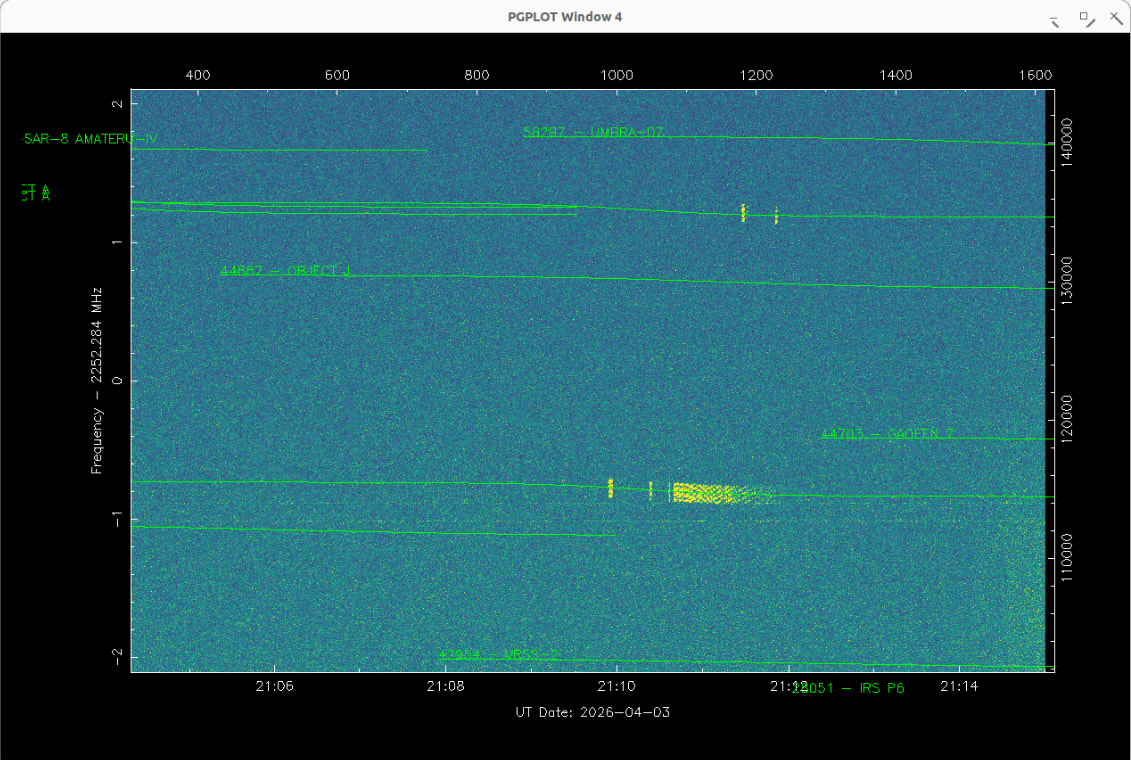
ION-SCV-022 66682 shows up at 2 frequencies at the same time. When you see this in your strf 3 times you think it’s not an incident 
And as soon as you add that frequency (2253.520 ) to 66682 you get confirmation.
4 Likes
Hi @Fredy,
Would you be open to switching the TLE currently used for TORO-2 to TRANSPORTER-15 OBJECT H, NORAD 66673 (2025-276H)?
I’ve been looking into which of the unidentified Transporter-15 objects is most likely TORO-2, and Object H stands out for a few reasons:
Deployment sequence. TORO-2 was the first payload released on Transporter-15 (19:39:09 UTC), and Jonathan McDowell’s GCAT assigns 2025-276H to TORO2 on that basis.
Drag behaviour. From Space-Track element-set history and orbit-averaged NRLMSISE-00 density, I derived the ballistic coefficient of every object on the launch. Object H decays about 2.6 times faster than the attitude-controlled 8U CubeSats from the same launch (A/m ≈ 0.021 m²/kg versus 0.005–0.009). Only two of the eleven unidentified objects behave like that, and it’s what you’d expect from a satellite with deployed panels and no attitude control, which is reportedly TORO-2’s state.
Match to the spacecraft. Using TORO-2’s CAD model (11 kg, panels deployed), the projected area gives an A/m between 0.013 (random tumble) and 0.018 (largest face into the flow). Object H sits at the upper end of that range. The other candidates at 0.007–0.008 would need stowed panels or active control.
Sanity check. The same method applied to PARUS-6U1 (NORAD 68456, whose mass, size and tumbling state are known) reproduces its A/m to within 5%.
I’m currently trying to command TORO-2’s from our ground station using Object H’s TLE, so having SatNOGS observations pointed at the same object would be a big help in confirming whether anything comes back.
Thanks a lot for your help with this. Happy to share more detail if it’s useful.
Hi @eric_huang unfortunately I can say for sure it is not OBJECT H (66673) as this has been identified to be PHASMA-LAMARR, 3U satellite with deployed panels.
If you have any other candidate I would be happy to set it in DB and schedule some observations in Network for TORO-2.
1 Like
Hi Fredy,
Thanks for the quick reply, good to know H and R are the PHASMA pair.
After taking those two out, the next best guess is OBJECT DD (66765). It’s the only remaining unidentified object with a drag profile that fits an 8U with deployed panels, and it still has a usable TLE (the other possible one, OBJECT CJ / 66746, dropped out of the catalog in April). Could you switch TORO-2 in DB to follow DD?
1 66765U 25276DD  26259.02058251  .00010227  00000-0  40435-3 0  9990
2 66765  97.4139 332.5178 0000959  76.6067 283.5278 15.25670514 44312
Thanks again.
1 Like
If we have some details on the transmission by TORO-2 we could see if we have Doppler signals in our STRF runs.
Jan | PE0SAT
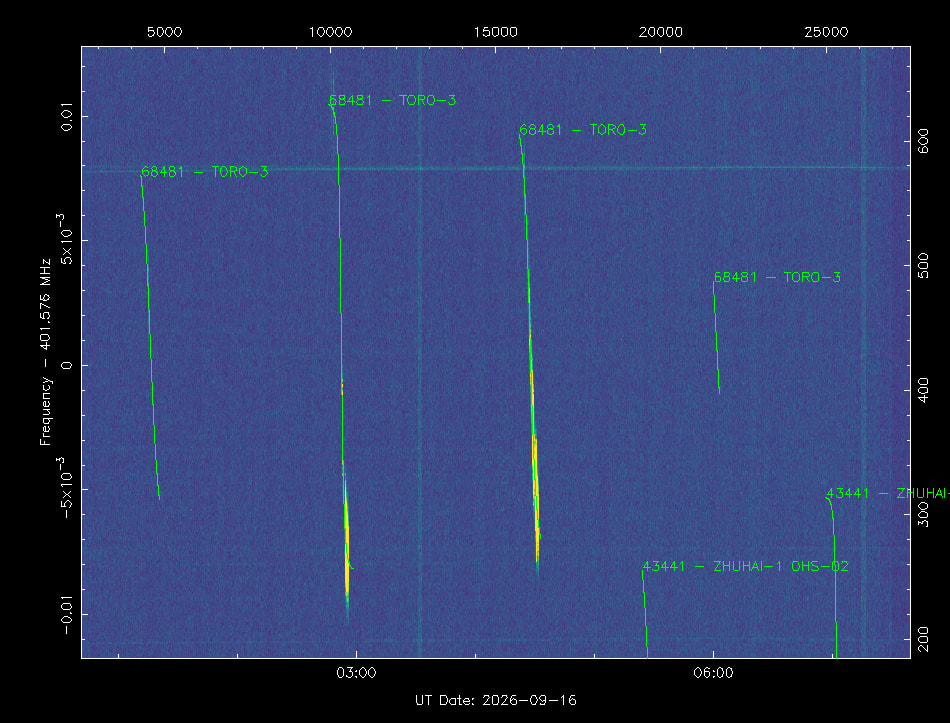
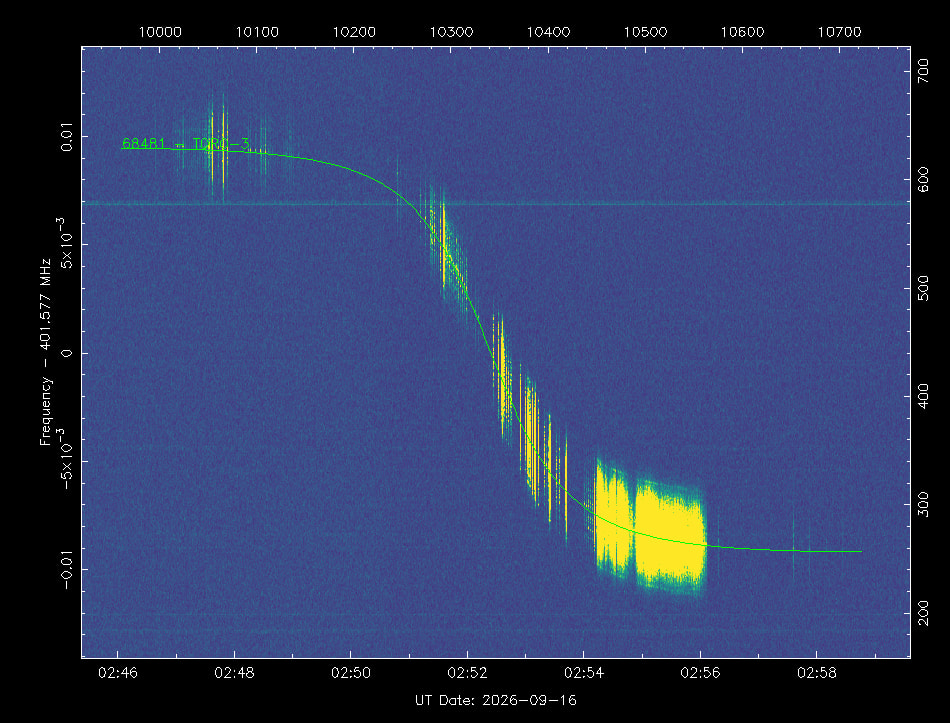
Going over a 24 hours STRF Doppler measurement run, no unknown signals on 401.580 MHz
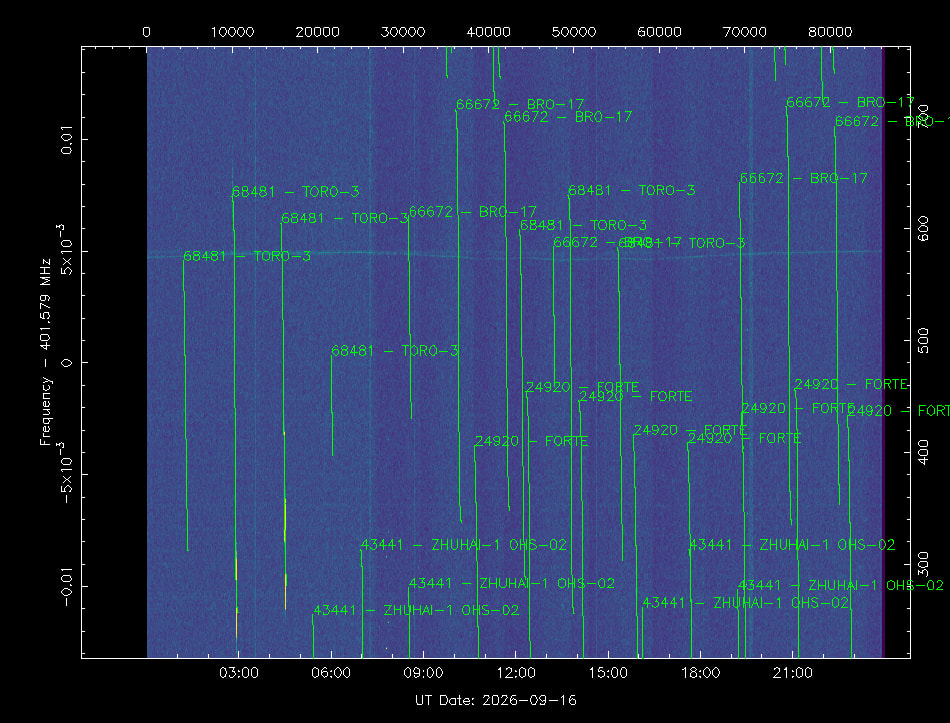
We can clearly see TORO-3
Jan | PE0SAT
4 Likes
66751 ICEYE-X58 suggested, 2263.600 center frequency.
2 Likes