Soyuz-2-1b Fregat - Vostochny 2026-11-14 01:16 UTC

Temporary NORAD ID Satellite Frequency Notes Deployed
VHF
- - - - Directly
UHF
- A1393 435.050 MHz Directly
- A1388 435.140 MHz Directly
- A1397 435.905 MHz Directly
- SX1262 / A1399 436.905 MHz Directly
Not in DB
- KOEN - Directly
- KINOSPUTNIK IC - Directly
- KAISANT/GERMES 6U - Directly
- KAISANT/GONETS 16U - Directly
- CSTP-5.1 3U - STTs Directly
- CSTP-5.2 3U - STTs Directly
- CSTP-5.3 3U - STTs Directly
- CSTP-5.4 3U - STTs Directly
- CSTP-5.5 8U - STTs Directly
- CSTP-5.6 8U - STTs Directly
- MARAFON IOT IC - Directly
- - - - -
- - - - -
- - - - -

Source: Russian Space Web
Source: Nasa Space Flight

3 Likes

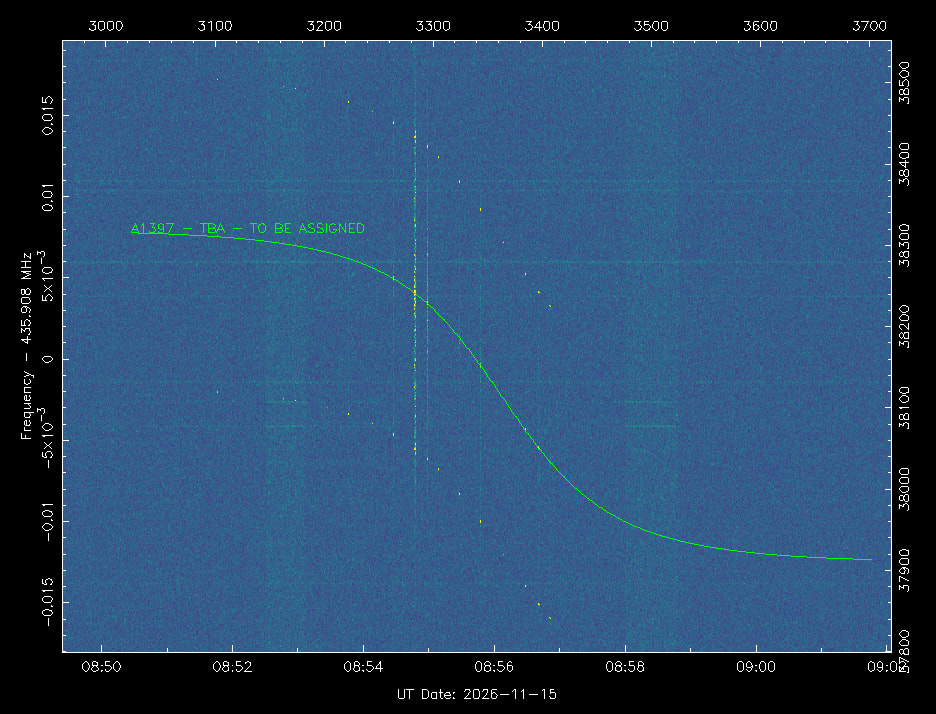
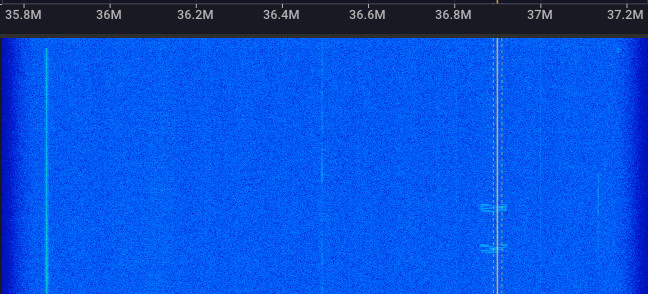
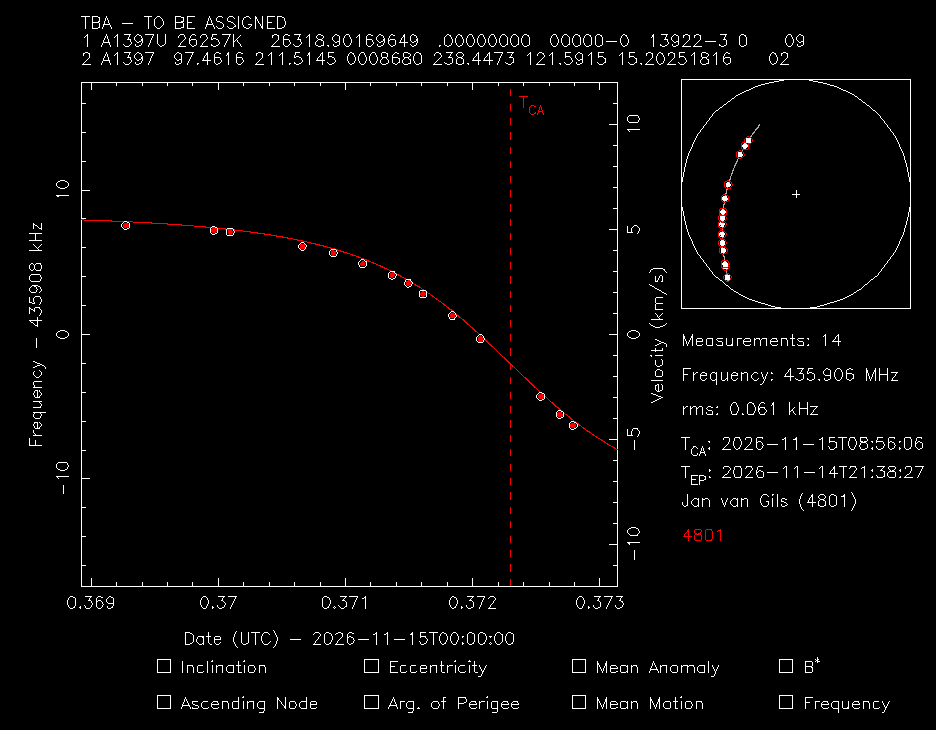
I have already received signals that belong to a satellite that is part of this launch.

Norad ID A1397 (101395) Cospar ID 26257K

Jan | PE0SAT

4 Likes

TLE for the satellite above from space-track.org changed to use the temporary NORAD ID we have in DB:

0 TBA - TO BE ASSIGNED
1 98183U 26257K   26318.90169649  .00002953  00000-0  13922-3 0  9994
2 98183  97.4616 211.5145 0008680 238.4473 121.5915 15.20251816    90
4 Likes

Using known framing hasn’t resulted in any decodes.

This is a pretty good observation

Lets wait for an IQ recording a go from there.

Jan | PE0SAT

2 Likes

Paging @bali if online…

By chance could you share an I/Q for

https://network.satnogs.org/observations/15454834/

Thanks!

1 Like

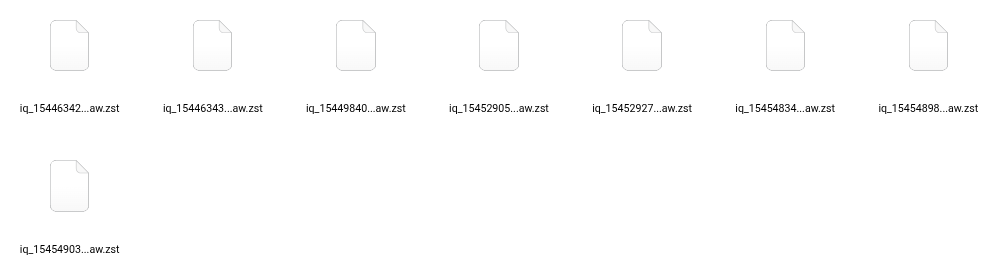
You can find it at this location.

File: iq_15454834_TBA—TO-BE-ASSIGNED_435905000_57600.raw.zst

Jan | PE0SAT

1 Like

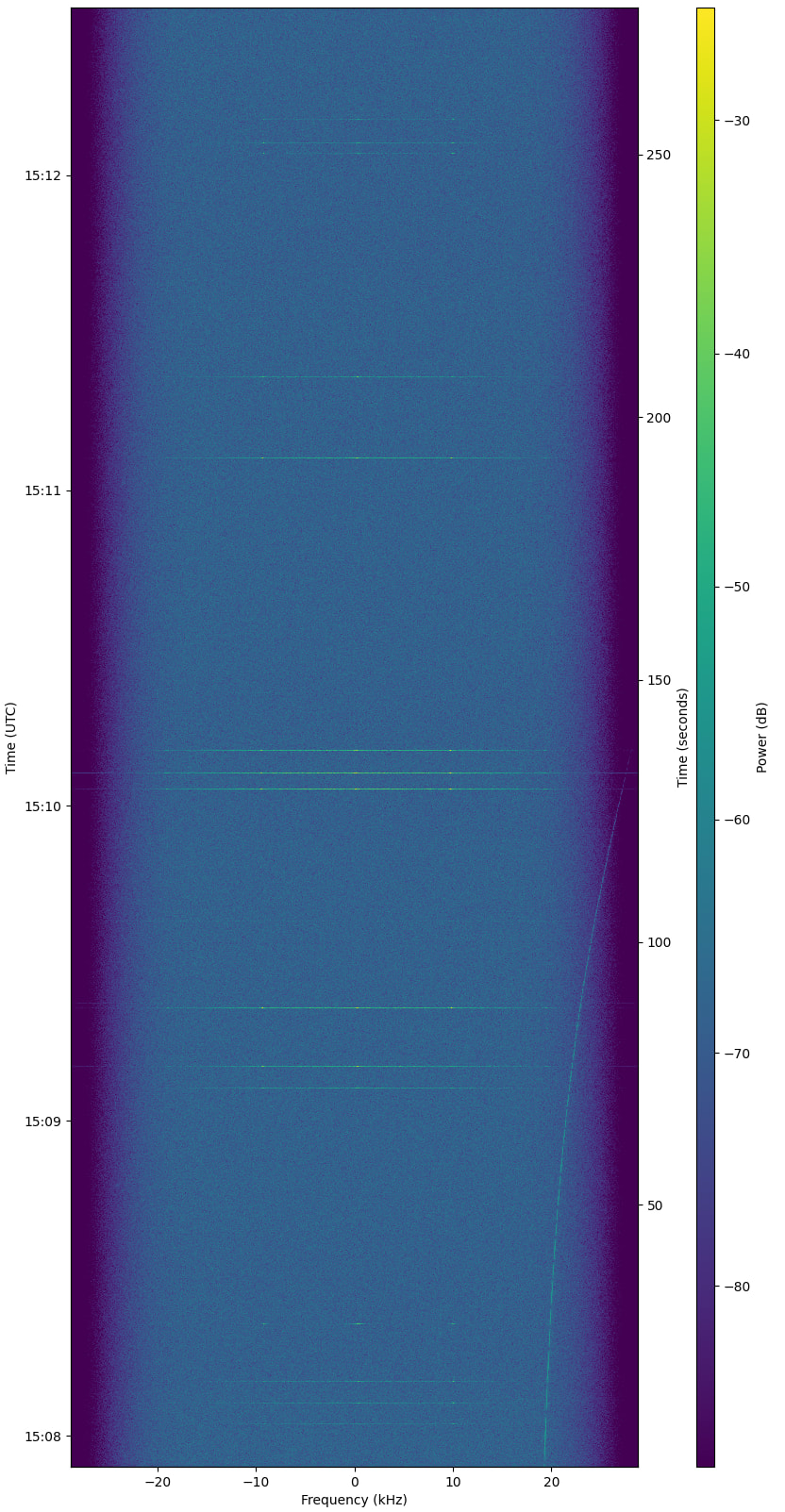
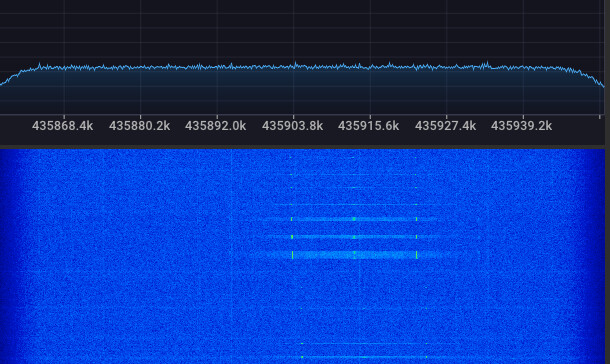
Well, there is CW in there that I think is from ERMINAZ-2U (??)

<KA> HI HI DE DP0PQA! <AR>

… but I’ll continue working on the FSK-looking packets. There are some around 20k wide and a different set around 10k wide

1 Like

As for the wider packets, ChatGPT was not able to find any native GNU Radio / gr-satellites blocks for the framing, but the structure is:

Field Observed value
Preamble At least 160 consecutive alternating bits immediately before sync, aligned as 55 bytes
Start sequence EB 90 at 0.75913 s
Coded body 152 bytes in 19 BCH(63,56) blocks, each carrying 7 information bytes and 1 parity/fill byte
Final block fill Five 55 bytes after the frame data
Tail sequence C5 C5 C5 C5 C5 C5 C5 79 at 0.82330 s
Total CLTU length 162 bytes from sync through tail, excluding preamble

… and one of the resulting frames is:

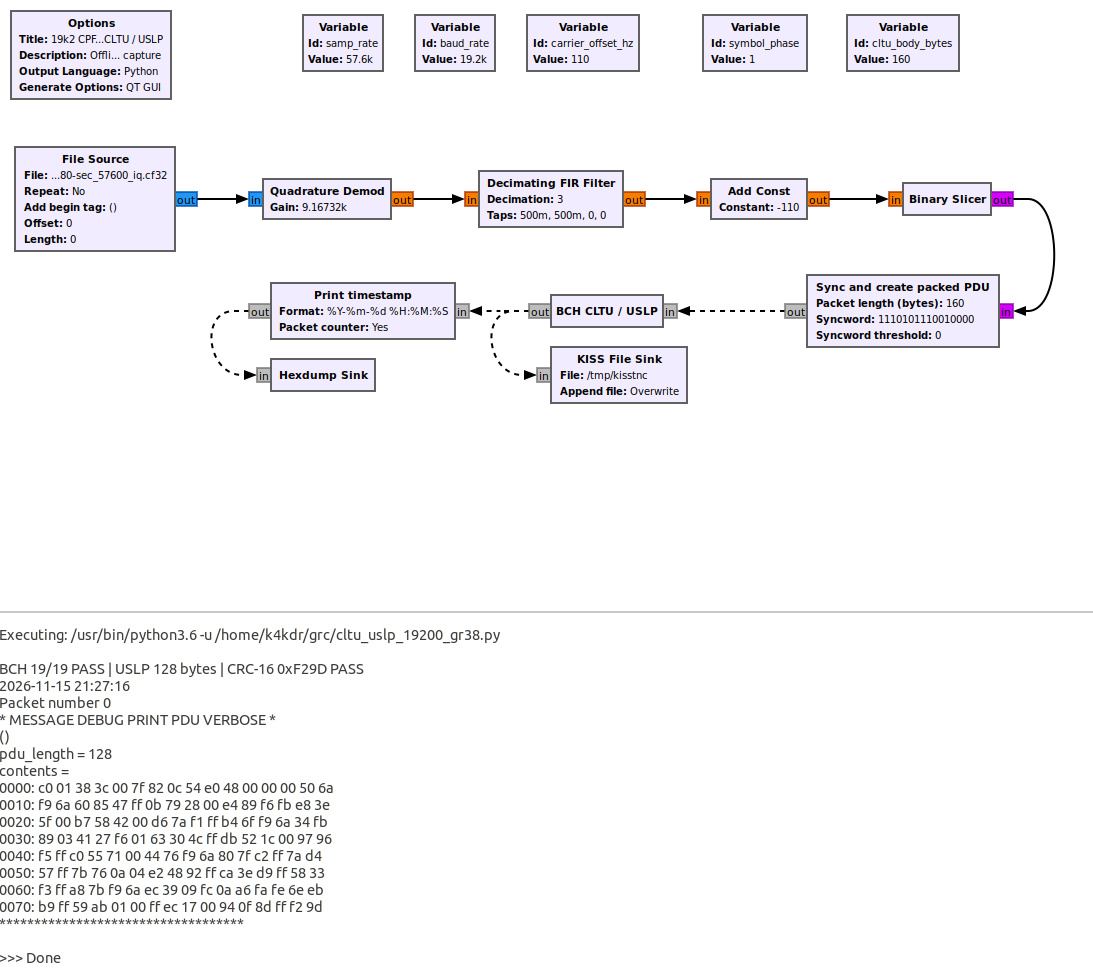
  000:  c0 01 38 3c 00 7f 82 0c 54 e0 48 00 00 00 50 6a  ..8<....T.H...Pj
  010:  f9 6a 60 85 47 ff 0b 79 28 00 e4 89 f6 fb e8 3e  .j`.G..y(......>
  020:  5f 00 b7 58 42 00 d6 7a f1 ff b4 6f f9 6a 34 fb  _..XB..z...o.j4.
  040:  f5 ff c0 55 71 00 44 76 f9 6a 80 7f c2 ff 7a d4  ...Uq.Dv.j....z.
  050:  57 ff 7b 76 0a 04 e2 48 92 ff ca 3e d9 ff 58 33  W.{v...H...>..X3
  060:  f3 ff a8 7b f9 6a ec 39 09 fc 0a a6 fa fe 6e eb  ...{.j.9......n.
  070:  b9 ff 59 ab 01 00 ff ec 17 00 94 0f 8d ff f2 9d  ..Y.............

… that’s decoded w/ one of those embedded python blocks when there is not a native block to accomplish a particular task. I’ll get the .GRC file and the strongest packet sample I/Q posted asap.

2 Likes

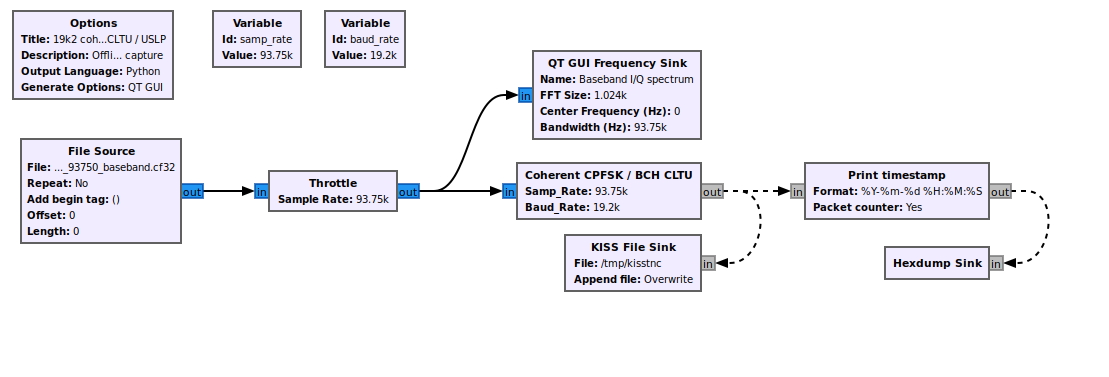
I’m sure there is room for improvement, but if anyone would like to experiment further, the GRC is at:

https://www.dropbox.com/scl/fi/5fxbwtaswnnyoa9plpk9p/cltu_uslp_19200_gr38.grc?rlkey=iarobyxbwg3srzucyraqx4wf3&dl=0

… and one of the strongest packets from that I/Q is at:

https://www.dropbox.com/scl/fi/yw36q60c3kqnl965f21oo/20k_unk_280-sec_57600_iq.cf32?rlkey=q0721n67yigwkun9h2z4cilol&dl=0

(please note that this sample is the standard 32-bit float I/Q)

2 Likes

Thanks Scott,

Here an IQ I create just some minutes ago.

There seem to be some longer bursts in the recording.

Jan | PE0SAT

1 Like

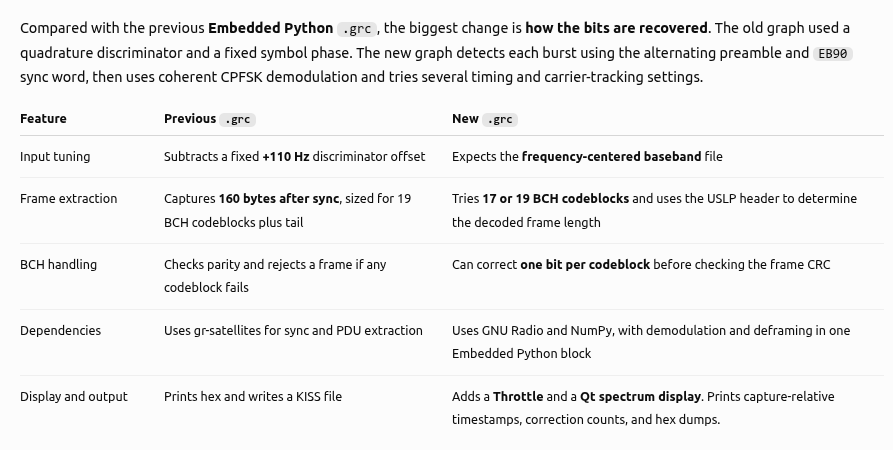
Those frames required some modifications that ChatGPT summarized as:

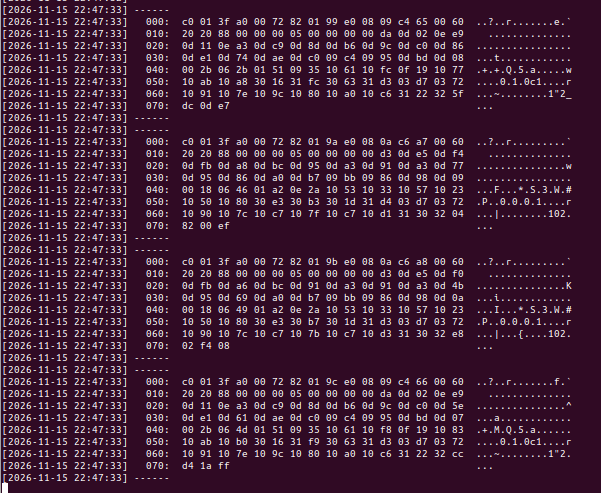
… and produced, in part, output like this:

… I’ll upload the new GRC asap.

And the latest GRC file is at:

https://www.dropbox.com/scl/fi/i1qe9ghqu0gryf2zihv10/cltu_uslp_19200_coherent_93750_gr38.grc?rlkey=sjcg3y52r7qnrjfmfrrpxdjez&dl=0

3 Likes

running this grc on this observation, resulting :

[2026-11-16 04:30:13] ------
[2026-11-16 04:30:13]  dest    `....?  1 c/r=1 res=0 last=0
[2026-11-16 04:30:13]  source  .'p...  4 c/r=0 res=3 last=0
[2026-11-16 04:30:13]   000:  c0 01 38 20 00 7f 82 16 4e e0 00 00 02 68 01 da  ..8 ....N....h..
[2026-11-16 04:30:13]   010:  01 e3 30 20 0a 0a 0f 0f 36 84 f7 00 00 00 00 00  ..0 ....6.......
[2026-11-16 04:30:13]   020:  00 00 00 00 02 73 01 55 01 b0 30 20 7f 7f 7f 7f  .....s.U..0 ....
[2026-11-16 04:30:13]   030:  36 84 0a 01 00 00 00 00 00 00 00 00 00 00 00 00  6...............
[2026-11-16 04:30:13]   040:  00 00 00 00 00 00 00 00 00 00 00 00 0b 44 02 00  .............D..
[2026-11-16 04:30:13]   050:  00 00 3f 2c d9 87 34 d8 d4 f0 f1 00 00 00 00 00  ..?,..4.........
[2026-11-16 04:30:13]   060:  00 00 00 00 00 00 00 00 00 00 00 00 00 00 00 00  ................
[2026-11-16 04:30:13]   070:  00 00 00 00 00 00 00 00 00 00 00 00 00 00 90 23  ...............#
[2026-11-16 04:30:13] ------

IQ file:

script for convert satno raw to cf32 compatible by @PE0SAT
raw2gqrx.sh.txt (746 Bytes)

3 Likes

Hi Everyone,

Did a bit more digging (with Claude). Based on Scott K4KDR’s ChatGPT assisted grc, added some refinements. Just remove zip suffix.

Added carrier estimation and de-rotation, all codeblock counts instead of just 17 and 19, and brute-force 2-bit repair of up to two bad codeblocks, with the CRC and the 0x55 fill check deciding. The sample rate is a variable (tested at 93750, 57600 and 50000), and it writes UTC timestamps, KISS and CSV output. Hard decisions only, so bursts with more than about 3–4% bit errors are lost.

cltu_uslp_19200_cpfsk_93750_v2.grc.zip (28.1 KB)

Good Hunting All,

Bob

N6RFM

2 Likes

TLE Update based on space-track.org catalogue, changed to use temporary NORAD IDs from DB until we complete the support of NORAD IDs > 99999:

0 OBJECT K
1 98183U 26257K   26319.95482065  .00004409  00000-0  20618-3 0  9998
2 98183  97.4626 212.5534 0008866 233.2111 126.8311 15.20263682   252
1 Like

I couldn’t help myself, I had to drop the HEX image in Claude.
This satellite would be running on 3 cells in series, monitored on each cell.

Yes, I can read it from the image. I transcribed the first frame and decoded it. Short answer: nothing in common with GRITSS, but it decodes nicely in its own right.

Why it isn’t GRITSS-like:

No AX.25 header. There are no shifted call signs like GRITSS’s GRTSFM.
None of GRITSS’s frame types (8C, 8D, 8F, A0, A2 …).
No Unix timestamp. I searched every 4-byte position, little- and big-endian, and found nothing within a year of the reception time.
A different battery. GRITSS has a 4-cell pack at 14.5–16.1 V. This one has 3 cells (see below).

What it does show:

Frame start c0 01 3f a0 00 72 82. It’s the same in every frame, then comes a big-endian frame counter at bytes 7–8: 01 99 → 01 9a → 01 9b → 01 9c.
Two alternating frame types. You can tell them apart by bytes 9–15 (e0 08 09 c4 6x and e0 08 0a c6 ax).
From byte 27, uint16 little-endian values, mostly in pairs:
about 3444–3601 (14 values in pairs, perhaps min/max or A/B)
2496/2500
4149, 4092, 4215 and then 12456, the exact sum of those three: 4149 + 4092 + 4215 = 12456. That’s a 3S Li-ion battery with cells at 4.09–4.27 V and the pack at about 12.5–12.8 V. The next groups do the same: 4193/4121/4267 with 12566, and 4210/4222/4224 with about 12.7 V.
979/983, perhaps a current or another voltage
The last bytes are probably a checksum or CRC.

Because 4149 + 4092 + 4215 adds up exactly, my reading of those bytes from the screenshot is confirmed. A misread elsewhere is possible, but small. Which satellite is it? With the name I can look for a frame description.
1 Like

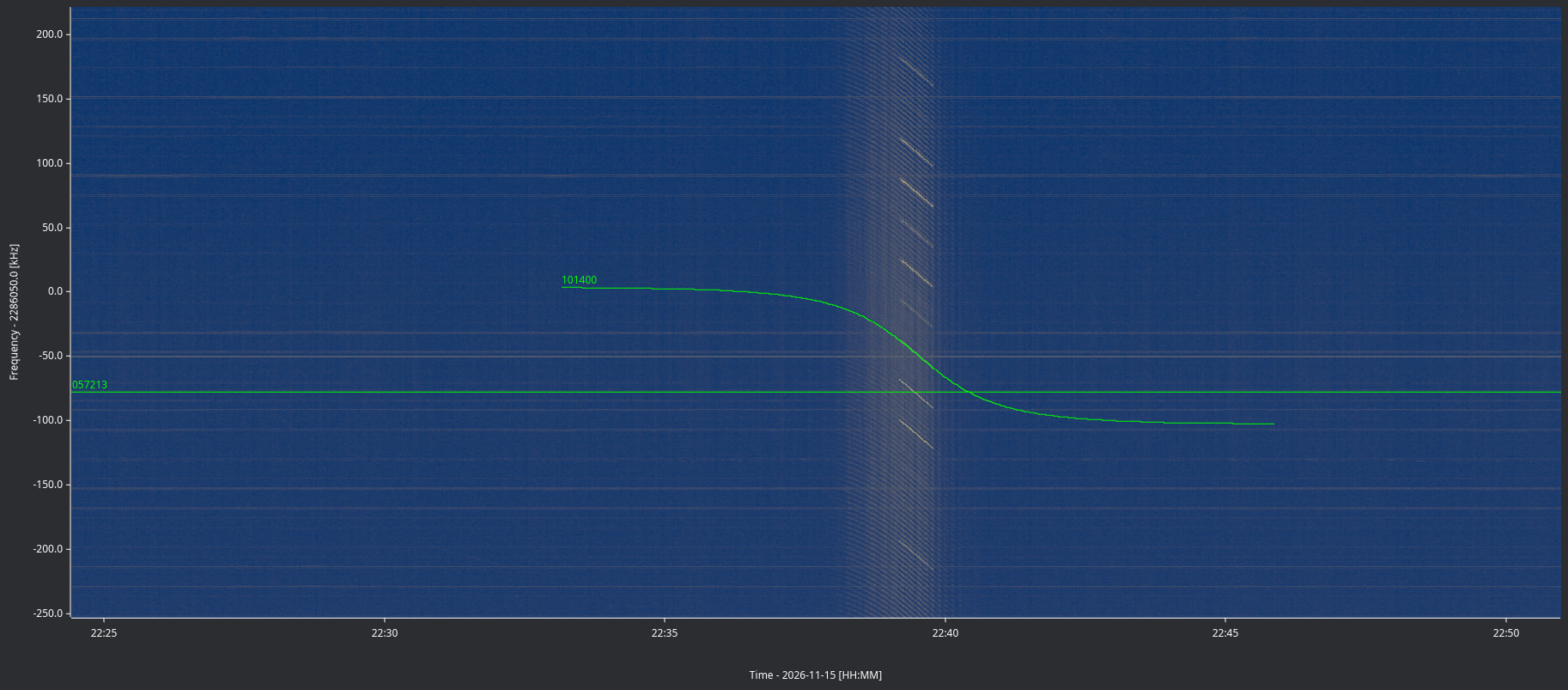
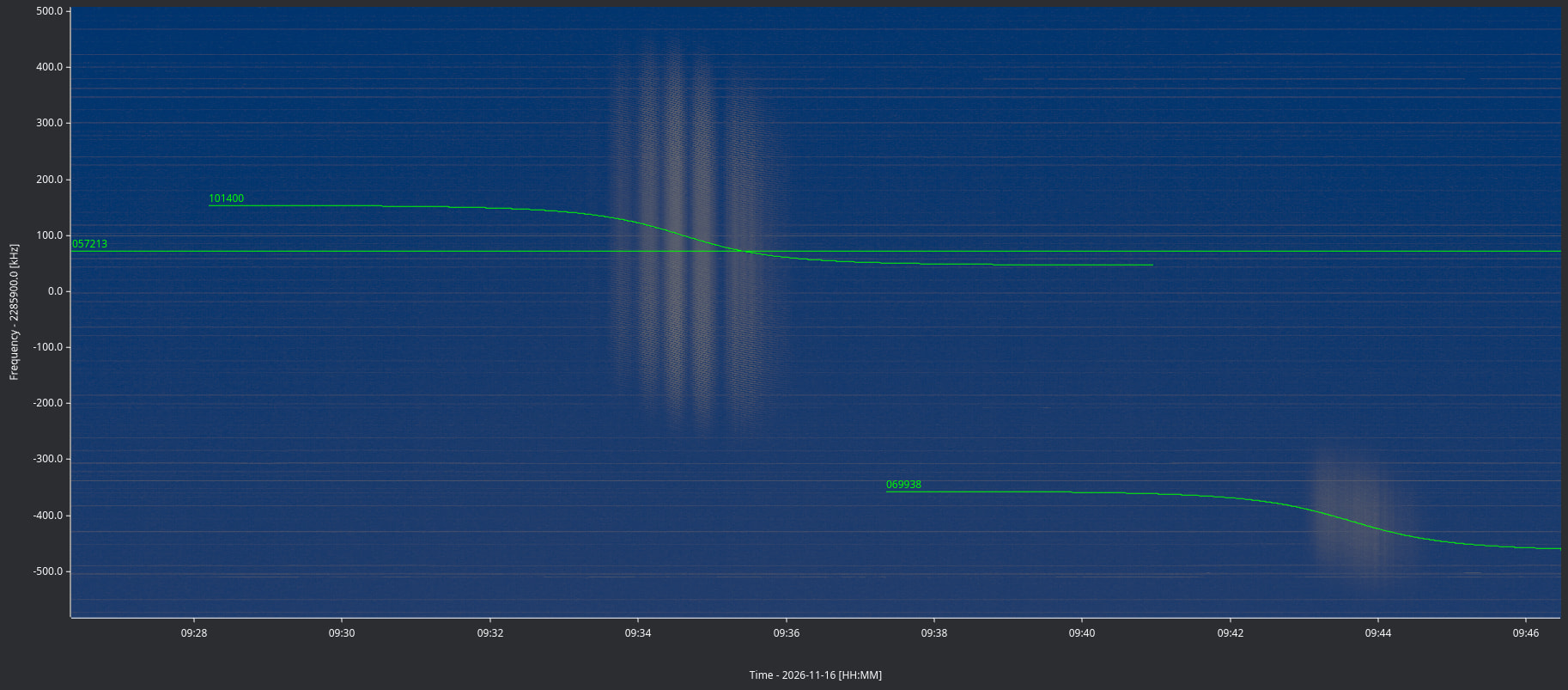
We might have 101400 Object N on 2286 MHz

3 Likes

And this morning pass once more

2 Likes

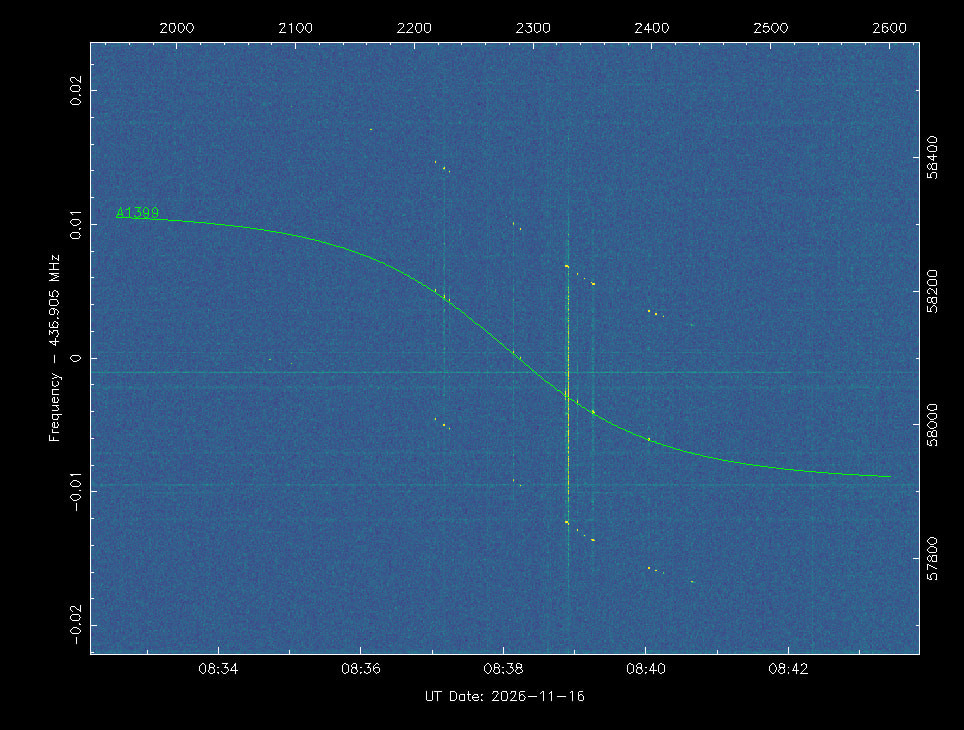
Another signal found on 436.905 following Norad ID A1399 (101399) Cospar ID 2026-257M.

The signals seems similar to the one on 435.905 MHz

Jan | PE0SAT

4 Likes

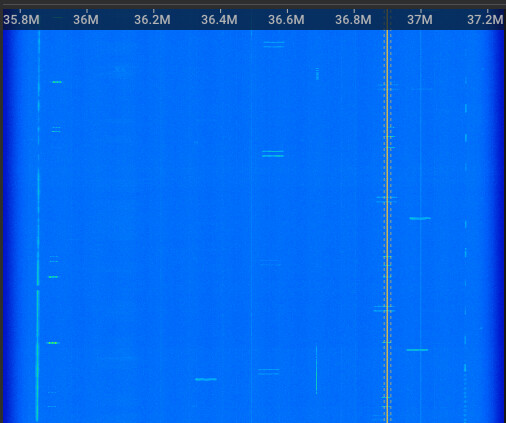
Recorded an IQ when both satellites where at an overhead pass, I have the impression that the satellite at 436.905 is also transmitting LoRA.

Input File     : 'iq_20261118103128_436500000_1500000.wav'
Channels       : 2
Sample Rate    : 1.5e+06
Precision      : 16-bit
Duration       : 00:07:55.00 = 712496128 samples ~ 35624.8 CDDA sectors
File Size      : 2.85G
Bit Rate       : 48.0M
Sample Encoding: 16-bit Signed Integer PCM

The file can be downloaded at the following location.

Because there are CSTP satellite name indication my guess they will use similar configuration and can be used for some positive identification.

Jan | PE0SAT