PHASMA-DIRAC:
On Friday night passes we sent a command for changing the RX of the satellite to a more narrow filter, to achieve a better communication. Unfortunately the filter didn’t work well and during the weekend we couldn’t achieve any communication via UHF, only beacon receptions.
We did this change by having in mind that the satellite, if something goes wrong, will reboot after 48h without communication (valid RX from satellite either at UHF or S-Band) (watchdog feature). However we reached this limit yesterday night but from the first morning pass today we realized that the expected reboot wasn’t triggered by the watchdog. We are currently investigating why this happened.
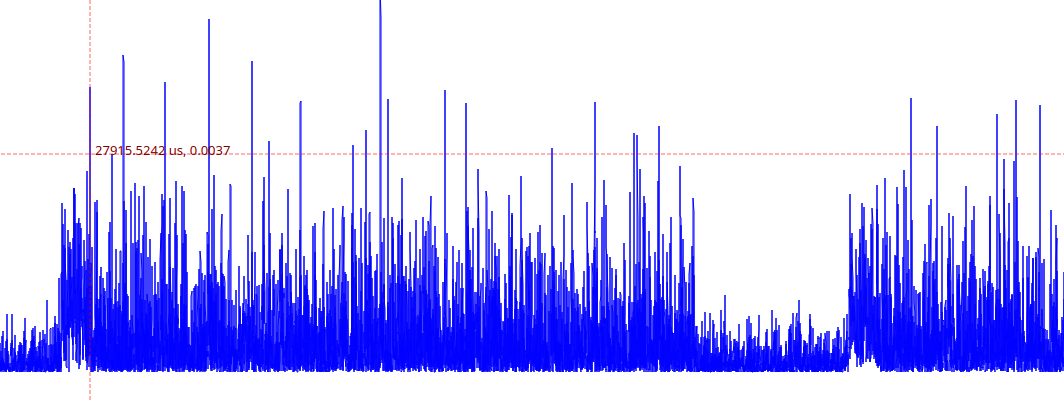
On the second morning pass, as yesterday night, we tried again to send through S-Band a command to undo the narrow filter on UHF. Yesterday we got from the telemetry that the satellites heard us but was unable to decode the signal in S-band, but on the morning pass we spotted some signals in the IQ we got that look like as answers to our command. We are in the process of analyzing the IQ and confirm or not if these were responses to the command.
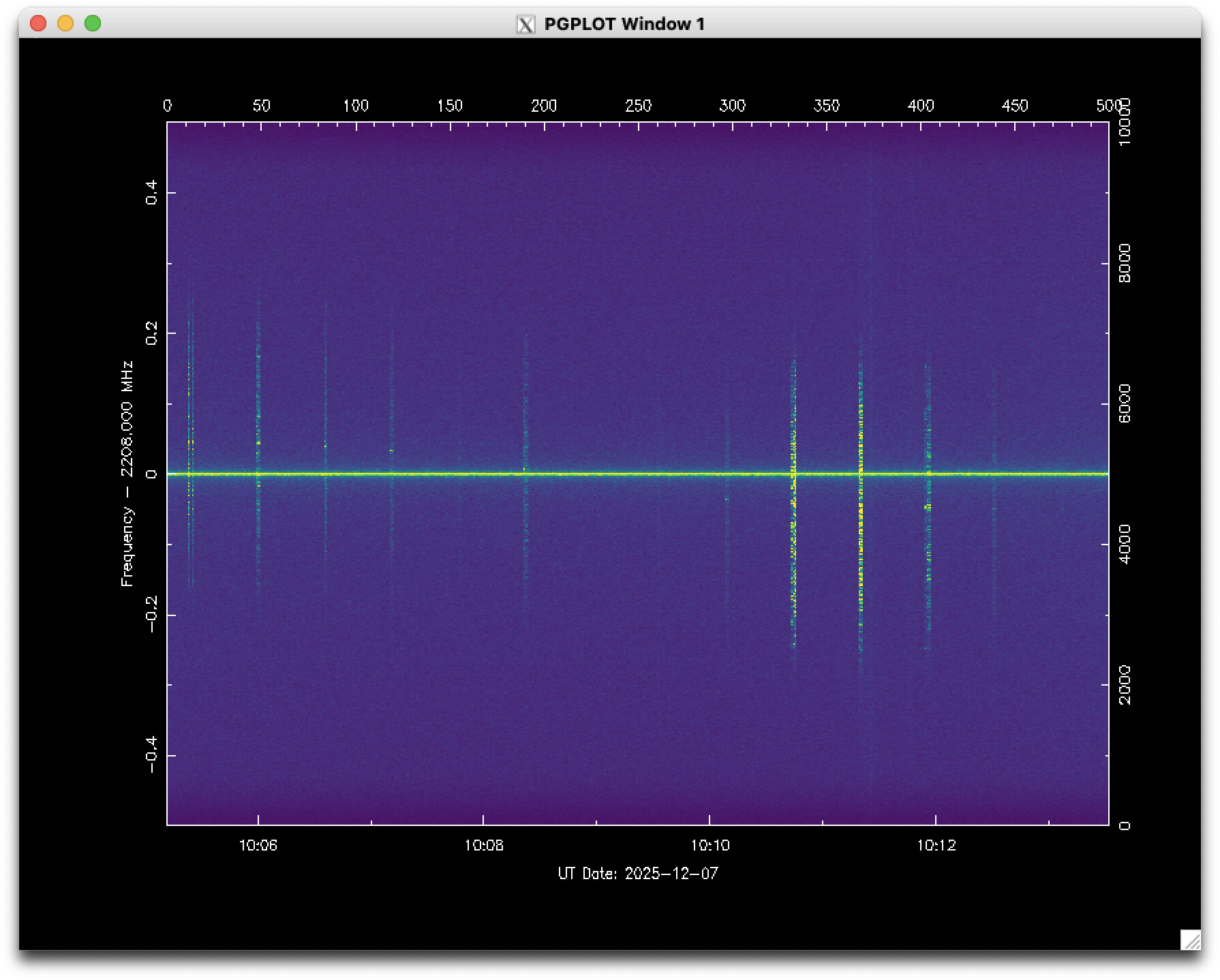
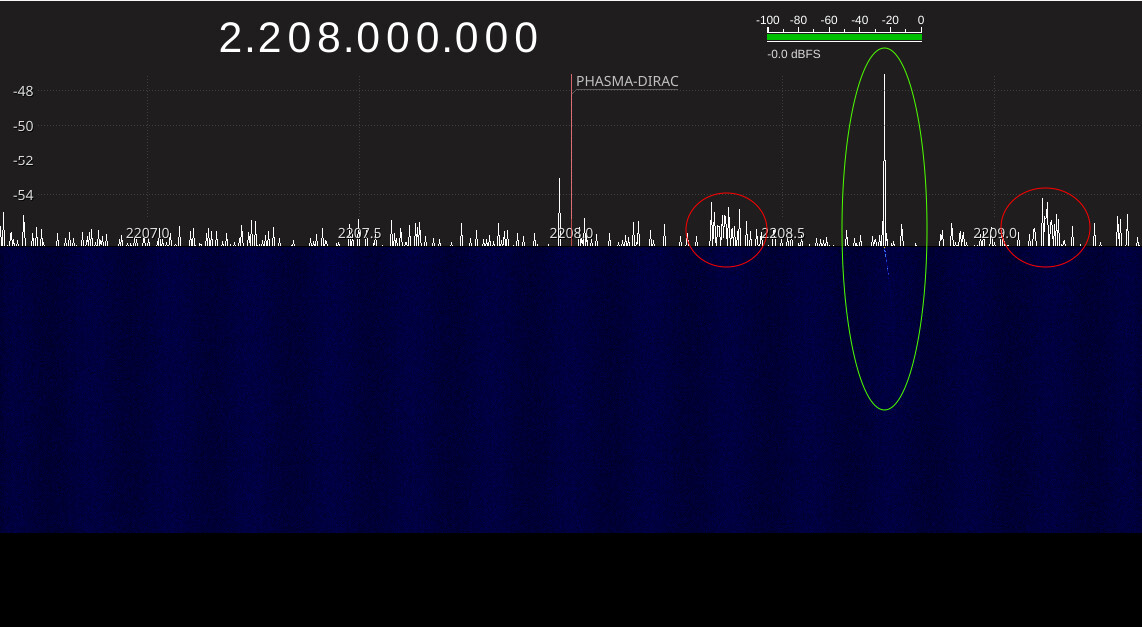
On other news it seems that we have a little bigger window in S-band for communication, this is verified from the morning pass which allowed as to get, but not decode, S-band beacons, for more than 2 min (in previous ones we had similar window for ~1min) and also an observation from the Dwingeloo Radiotelescoop, (thanks to @tammojan and the team!!!), in which it gave us the image below that is an indication of when the S-band antenna looking to us. Note that beacon is every ~35s.
EDIT: I forgot to add that we noticed a drift on the S-band frequency but as we still not having steady TLE we are not able to accurately calculate it. But will keep it in mind for the future communication attempts.
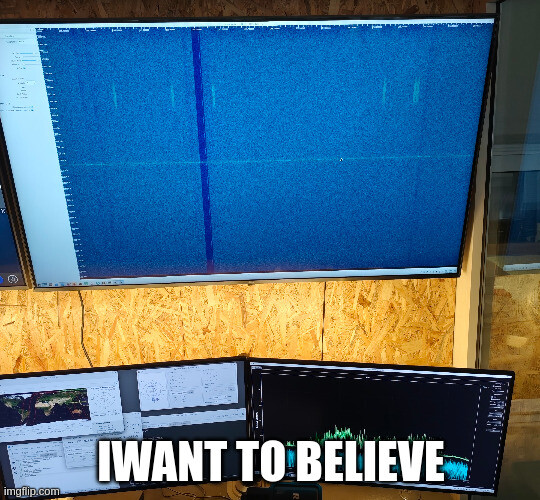
EDIT 2: I forgot also to mention the reception of the S-band beacons from @julianharbeck:
The satellite is still in a good condition based on the decoded periodic telemetry, both in power level and temperatures.
Next steps, to find out if the satellite heard us in S-band and if we can re-establish the UHF two-way communication.
TLE have been updated following objects from space-track.org analyst catalog.
PHASMA-LAMARR:
No updates, still nothing heard.
Next steps to confirm S-band two-way communication with PHASMA-DIRAC and then attempt it to PHASMA-LAMARR. Also make sure that the watchdog behaviour noticed on PHASMA-DIRAC doesn’t affect PHASMA-LAMARR, after we find out what caused it.
For TLE we are following objects from the space-track.org analyst catalog that are close to PHASMA-DIRAC as we still expect to be close to each other due to their similar mass.
Ground Segment:
Still we have an issue with hsgr station controller’s relays, we tried during the weekend to solve it but the solution didn’t work and we returned back to the semi-working relays. However the issue seems to get worse, so we are planning to work on it today to solve it.
There was also a re-calibration of the station’s rotator which probably is the reason we had better results on the S-band. However we are looking to improve this process and calibrate it even better.
Station at chania is working fine and decodes the periodic telemetry of PHASMA-DIRAC.
In SatNOGS side we continue to get good observations and use the to produce new TLE or compare the different TLE from space-track.org analyst list.
@fredy Let me know if I should observe some specific observations, otherwise I will try to do the high elevation passes. Due to the multi-mission and active tracking there is still some manual stuff to do, but at least I can operate it remotely now.
PHASMA-DIRAC:
We verified on the satellite side that S-band command was received and also that the narrow filter setting is reverted and now we have again re-established the two-way communication in UHF and make sure that S-band can receive us.
Thus, we focused in the last passes to get as much telemetry as possible as both the passes were low and we missed lately packets with EPS telemetry. After commands in UHF we got EPS telemetry, along with other telemetries. The status remains good both power and temperature wise.
From the telemetries and beacons we also verified that our attempts to reach PHASMA-LAMARR in S-band are heard by PHASMA-DIRAC as invalid frames, as expected.
Next steps, we are going to get more telemetry data in the next passes and start thinking our next moves.
TLE have been updated following objects from space-track.org analyst catalog.
PHASMA-LAMARR:
Given the two-way communication with PHASMA-DIRAC in S-band, we decided to attempt communication with PHASMA-LAMARR in S-band.
Yesterday’s pass, following an object near PHASMA-DIRAC wasn’t successful, however the commands were heard (as invalid) by PHASMA-DIRAC.
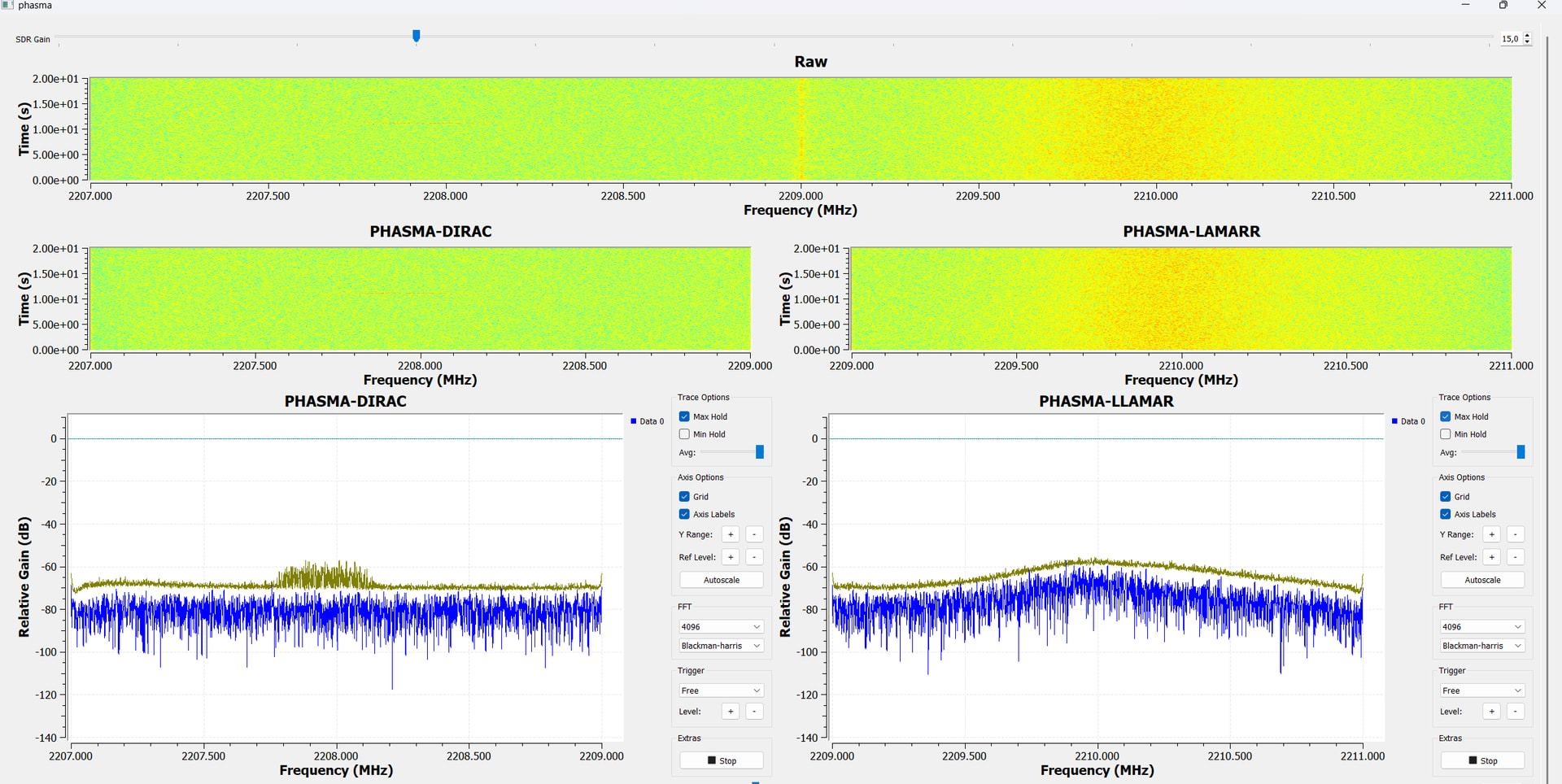
Morning’s pass, using another object, 3min away from the previous, that probably fitted better the distance between the two satellites, we managed to get some four beacons (with the format of the 1st, 2nd, 4th and 5th marks in the photo below) and twice something that looks like a response to commands (3rd mark in the photo below).
Unfortunately the low SNR didn’t allow us to decode the frames. The commands we sent were for antenna deployment and for enabling the payload to give us another way of communication with the satellite in UHF in case that payload antenna has been deployed. The responses happened in both cases for enabling payload command.
Given the above, our next steps and attempts will be to achieve communication in UHF through the payload (it doesn’t beacon but it receives and responses once enabled) and command through S-band the UHF antenna deployment. Depending on the results we will explore different paths to first get the satellite status, locate better which object is and establish two-way communication.
TLE have been updated following objects from space-track.org analyst catalog.
Ground Segment:
Given the results on the morning pass with PHASMA-LAMARR, we decided to postpone the relays maintenance and another attempt to calibrate the hsgr station to avoid any accident. Probably will be performed the next days.
Chania station keeps the two-way communication with PHASMA-DIRAC in UHF and is in a good status.
In SatNOGS side we continue to get good observations and use them to produce new TLE or compare the different TLE from space-track.org analyst list.
Finally we also improve our processes and we start automating operations tasks in order to continue them with simple supervision in the future.
PHASMA-DIRAC:
Given its good status, we have taken the focus from PHASMA-DIRAC, so for now we still keep watching it and get periodic telemetry from its beacons.
Next steps, we are going to get more telemetry data in the next passes and start thinking our next moves.
TLE have been updated following objects from space-track.org analyst catalog, we are now watching 3 objects with one of them almost being sure that is PHASMA-DIRAC.
PHASMA-LAMARR:
In yesterday’s passes, we managed to get again S-band signals and attempted to communicate with the satellite using the payload SatNOGS-COMMS, which was supposed to have been enabled in the previous pass.
With the new reception in S-band, we realized that what we thought as an answer probably is part of the beacon, so for now we think that payload probably wasn’t enabled. We also tried on the same pass to communicate with it but we didn’t get any response.
On the other hand, again during the same pass, we discovered that UHF beacon was on. There are a lot of scenarios on what happened but without decoded telemetry is difficult to verify any of them. The beacon as with PHASMA-DIRAC initially, is faint, so now we attempt to pass a command to increase the TX gain on the satellite side.
With the satellite beaconing we focused on getting telemetry in UHF, but unfortunately during a good pass in the morning, we didn’t manage to get something. Again there are a lot of scenarios, like rebooting, power issues etc, but we will keep trying to get some telemetry and find out its status.
Next steps, get telemetry and command the satellite to increase UHF TX power. We may also start tracking again the S-band in order to verify that the satellite is still transmitting.
With the reception in both our stations and Network we manage to have a clear picture about the candidate objects from the space-track.org analyst catalog. So, now we are almost sure about one of them and just in case we keep watching a couple of others that are close but for now it doesn’t seem to fit the signals. In other words from 113 objects, we have limit our targets to mainly one and maybe 2-3 others.
Ground Segment:
The relays maintenance and the calibration attempt is postponed again for tomorrow to keep sure we have a working setup and focus on the PHASMA-LAMARR operations.
Chania station is now also focused on communication with PHASMA-LAMARR.
In SatNOGS side we continue to get good observations and use them to produce new TLE or compare the different TLE from space-track.org analyst list.
PHASMA-DIRAC:
We got more telemetries (periodic and after command) from the satellite, still in good status.
Next steps, we continue getting more telemetry data in the next passes and start thinking our next moves.
TLE have been updated following object 88126 from space-track.org analyst catalog.
PHASMA-LAMARR:
In yesterday’s passes, in UHF we received more beacons from PHASMA LAMARR and we also see some that looks like responses to our commands.
Similarly in today’s passes, more beacons in UHF and some transmissions that look like responses to commands.
Unfortunately we are still not able to decode any of the beacons as they are still very faint.
Next steps, we continue to ask and get telemetry and command the satellite to increase UHF TX power in order to get something decoded and find out the satellite status.
TLE have been updated following object 88118 from space-track.org analyst catalog.
Ground Segment:
The relays maintenance and the calibration attempt for hsgr station is planned for today. Also we managed yesterday to establish two-way communication between hsgr station and PHASMA-DIRAC.
Chania station continues to be focused on communication with PHASMA-LAMARR and in a good condition.
In SatNOGS side we continue to get good observations and use them to produce new TLE or compare the different TLE from space-track.org analyst list. We also get a couple of decoded data for PHASMA-DIRAC.
PHASMA-DIRAC:
Continue wtih more telemetries (periodic and after command) from the satellite, still in good status.
Next steps, we continue getting more telemetry data in the next passes and start thinking our next moves, one of them we consider is to change the transmission modulation on UHF from FSK to MSK.
TLE have been updated following object 88126 from space-track.org analyst catalog, still seems the one that fits best.
PHASMA-LAMARR:
Yesterday’s passes didn’t have any results, however earlier today we managed to get periodic telemetry and some responses in our commands in S-Band. We managed to decoded 3 frames until now, one acknowledgment on the command for deploying panels, one health status and one radio status.
The boot counter and the uptime shows that the satellite has been rebooted several times, distributed since deployment (which is unknown if it is distributes) gives 3-4 reboots per day.
The temperatures are under zero, which could be one of the reasons of reboot, however we need more data to verify what we see and think.
Next steps, give that the power is at 7.8V after 8h since the last reboot, we assume that there is no power issue for now and we will attempt to set it as commissioned in order to avoid the 30min of silence after each reboot and also to raise duty cycle for reception and transmission in S-band and reception in UHF in order to have more opportunities for communication and increase the temperature.
TLE have been updated following object 88118 from space-track.org analyst catalog, still the object fits best.
Ground Segment:
We installed the bypass of the relays for hsgr station and performed calibration, however we need to re-check the calibration and improve it if needed. In other news, we got replies from PHASMA-LAMARR in S-Band and more in UHF from DIRAC.
Chania station continues to be focused on communication with PHASMA-LAMARR and in a good condition.
In SatNOGS side we continue to get good observations and use them to produce new TLE or compare the different TLE from space-track.org analyst list.
PHASMA-DIRAC:
Continue with getting more telemetries (periodic and after command) from the satellite and verify its good status.
Next steps, we continue getting more telemetry data in the next passes and start thinking our next moves, one of them we consider is to change the transmission modulation on UHF from FSK to MSK.
TLE have been updated following object 88126 from space-track.org analyst catalog, still seems the one that fits best.
PHASMA-LAMARR:
On the last passes we focused on getting new values for some settings and save them to stay persistent after reboot. In short we commanded SatNOGS COMMS to be commissioned, to change UHF and S-band tx gain and duty cycle. From the IQ data we got we can confirm that the S-band duty cycle is changed but we don’t have clear evidence if the other changes were done and if the new settings were saved.
While we tried from both UHF and S-Band to command the satellite, from the current data it seems that the commanding was successful through UHF.
In yesterdays pass the S-Band beacons were visible for at least 5min but unfortunately not decodable, however today’s pass is more promising, with ~6.5min visible S-band beacon and some strong signals. When analysis is done, if successful, frames will be uploaded to SatNOGS DB and will be visible in Grafana dashboard.
TLE have been updated following object 88118 from space-track.org analyst catalog, still the object fits best.
Ground Segment:
Both phasma stations looks good in condition. We also made a new attempt to calibrate hsgr station which seems to be successful, but we still monitoring its status.
In SatNOGS side we continue to get good observations and use them to produce new TLE or compare the different TLE from space-track.org analyst list.
Much to my surprise, I was able to see the S-Band downlink from PHASMA-DIRAC on the 1-meter dish tonight (14-Dec-2025)!! Even more amazing was that the data sidebands were JUST visible as well.