Regarding Observation 13948995 …
hi @f4tnk , how to produce waterfall with other sat track like that? very interesting.
Regarding Observation 13948995 …
hi @f4tnk , how to produce waterfall with other sat track like that? very interesting.
Hello Bali,
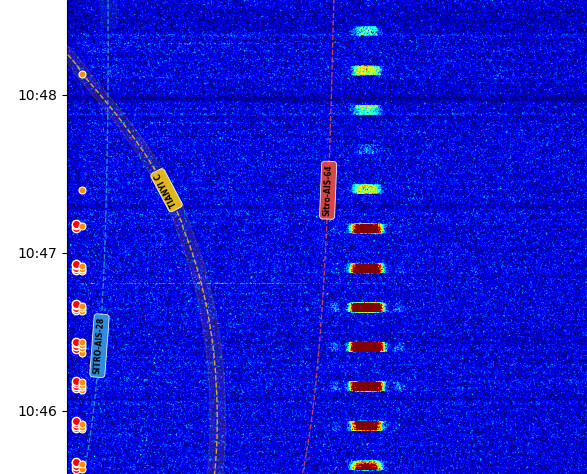
This waterfall is part of my experiments.
I changed the cmap=viridis from the satnogs-client waterfall.py to cmap=jet, along with a few adjustments ( Colormap reference — Matplotlib 3.10.9 documentation ). It’s an interesting topic related to data science. Viridis remains fundamentally more suitable because it’s more linear and has a better boundary for visualizing and understanding the data.
Then, on the left side, the red dots are the frames decoded by satnogs flowgraph, and the orange ones are the frames decoded by gr-satellites. This is very useful for debugging and correlating frame decoding with the signal.
Finally, there’s a collision calculation between the observation and other satellites that are simultaneously passing over a bandwidth of approximately 40 kHz on the observation frequency, and whose signal could be present in the waterfall. This can also be useful for the SSA if a signal is present without an identified collision. It also provides ideas for new satellites to track, etc. There is initial integration of data from SpaceTrack and the ITU, but it’s not finished, as I don’t currently have an account with the International Telecommunication Union.
Collision data is also included in the observatory’s metadata:
collisions: [
“Sitro-AIS-64|98439|-2.5kHz|11°|GMSK USP/2400|10:38-10:40|SatNOGS DB”,
“Sphinx/Frazier|63232|-25.0kHz|13°|GFSK/38400|10:42-10:48|SatNOGS DB”,
“TIANYI C|64050|-25.0kHz|54°|FSK/9600|10:43-10:48|SatNOGS DB”,
“PW-6U|98513|-25.0kHz|76°|FM|10:38-10:48|SatNOGS DB”,
“LEMUR 2 AMANDA-SVANTE|48269|-25.0kHz|72°|FM|10:38-10:47|SatNOGS DB”,
“SITRO-AIS-28|59071|-32.5kHz|74°|GMSK USP/2400|10:48-10:48|SatNOGS DB”
]
All of this is just the product of my imagination and research on the subject.
There you go, you know almost everything lol 
super! love it feature