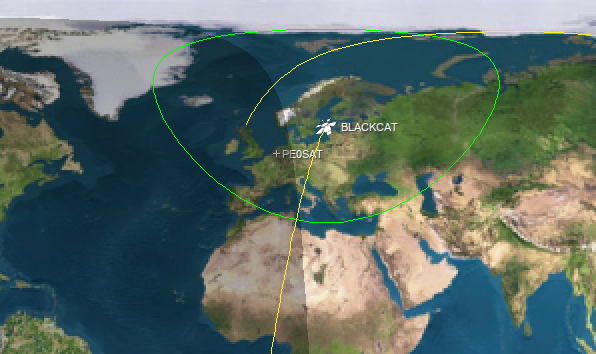
As of January the BlackCAT CubeSat out of penn state has been orbiting and going through instrument commisioning. BlackCAT uses a coded aperture telescope to locate high redshift gamma ray bursts and to survey catalogued X-ray sources.
At the start of the mission we intended to send rapid alerts of transiet events via the Iridium network, but due to an assembly error by our bus provider we need an alternate solution. The solution they provided was to use the SatNOGs network to faciliatate rapid alerts. Basically our satellite will send a constant beacon that will contain the last known detected transient event. Our bus provider claims that reliable contacts can be made with a groundstation consisting of a single QFH antenna, having run the numbers I’m a little sceptical. As I understand it, we’d have to schedule multiple passes per day on the network to make this work. Does that seem feasible with the network?
Having followed this wiki: Satellite Operator Guide - SatNOGS Wiki . I’m a bit hungl up on the next steps. I’ve decided that we are for the moment use the iq_reciever flowgraph, so that we can demod everything locall. I’ve also started a rudimentary grafana dashboard. How do I go from where I’m at to actually receiving the IQ data?
For those interested in tracking it, here’s its information:
Norad ID: 67369
I have created some observation in the network I will see if signals are received on 401.050 MHz over Europe.
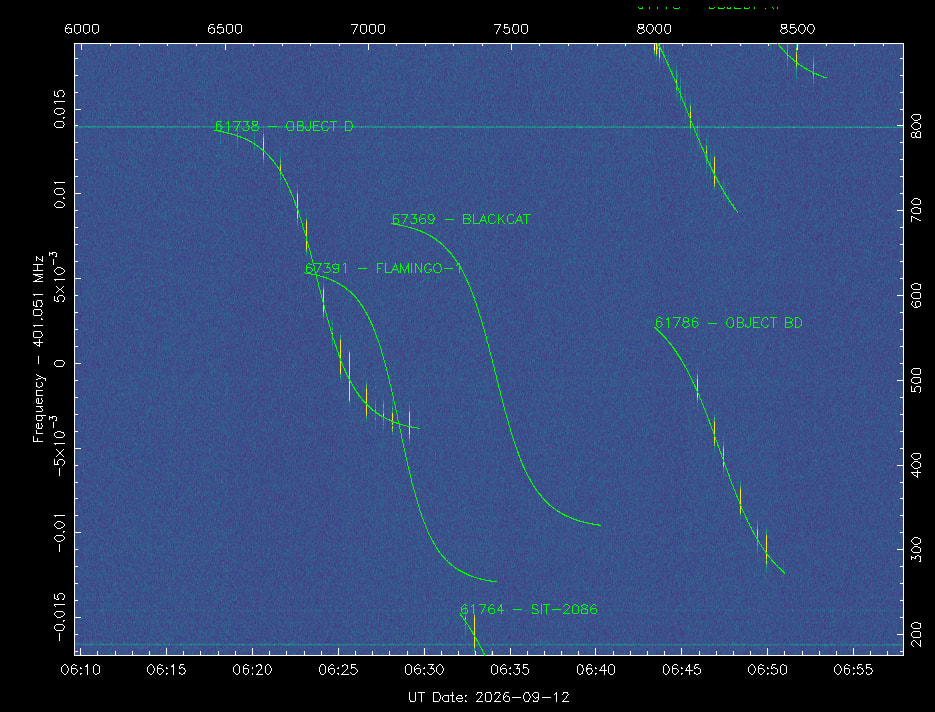
Querying the SatNOGS network I couldn’t find any observations with signals in the Waterfall.
Are we sure about the active frequency, TLE id and that it is sending beacons in a known time schedule ?
This would be the first observation on the network.I’m not sure if I’ve gone through all the steps to ensure that it is fully added. I was able to receive it about two weeks ago with a fat dipole over a ground plane and a 30dB LNA
As you can see there are no signals for object 67369, but I do see signals for 61738 and 61786 both look like 2k4 signals, these seem to be SITRO-AIS satellites using GMSK 2k4 USP framing.
Here a SITRO-AIS-15 example received and decoded by the SatNOGS network:
So back to my initial question, are we sure about object ID, active frequency and beacon schedule ?
Basically any information that helps in identifying the BlackCAT signal could help in receiving usefull data for your team.
Apologies for the late reply, this is my day job so aside from emergencies I’m not regularly checking things on the weekend.
According to our bus integrator, our frequency is 401.05 MHz and up to the best of my knowledge 67369 is the norad ID. This was determined somewhere in late february and backed up by contacts made by our bus integrator. Our beacon period should be around 10 seconds. It is possible there has been an upset over the evening. I will have to check with our software team.
Can the operator of a satellite schedule multiple passes per day on the network using networked ground stations that are not their own, or is scheduling passes on each station owner?
If you can schedule passes on networked ground stations, how does one go from having built a dashboard to actually scheduling passes and receiving data?
Only if he has an online and available station in Network, you can check more details for scheduling and other permissions in Operation - SatNOGS Wiki. Alternatively you can make a public request here in the forum and station owners may schedule the satellite in their stations.
Not sure what you mean by “from dashboards to scheduling & receiving”, do you mean how you get data in a dashboard? If that’s the question, then this is the current chain we use in SatNOGS:
Observations are scheduled in Network
Stations perform them and return the results of the observations, if there is a demodulator/decoder that support satellite’s transmissions and the station receives a good (in SNR terms) signal then they return also frames with data.
These frames are sent to DB. DB gathers frames from 3rd party observers too.
If there is a decoder (usually through a katai struct that describes the frame format, more in satnogs-decoders) you get the data decoded and sent to grafana (actually in the database that grafana uses)
With a dashboard in grafana you can show the decoded data visualized.
Thank you so much for clarifying! I’ve been banging my head against the wall, when all I needed was a wiki.
Looking at the scheduler page, it says I do not have permission to schedule a pass. I assume this is becauce I have not contributed a ground station yet?
No worries, current documentation is not in its best form and usually asking in the forum is quicker.
I’m going to schedule tomorrow a couple of observations for BlackCAT based on 67369 object for the next two days.
if you are interested in some specific passes let me know.
I’ll try to keep scheduling BlackCAT for the next couple of weeks, but unfortunately I will not be able to check them, so if you see anything interesting on any of them please update us.
So the reason why you couldn’t see it turns out to be that our transmissions are geofenced to Lithuania, USA, Denmark, Ireland, Spain, and Italy. Obviously radio waves don’t care about country borders, but that might explain things.