Implementing the SatNOGS-COMMS Board Design

Hi there!

I am working on a CubeSat project for which I am trying to adapt the SatNOGS-COMMS Board to use on.

I am following the schematics from the gitlab repo here to understand the working of the board, and there were a few things I didn’t quite understand, and I was hoping to get the answers to my queries here on the forum.

1.) In S-band TX path, U604, the attenuator PAT0816-C-10DB, is required to safeguard the RF mixer from high incoming power, as mentioned in the system design document of this project here
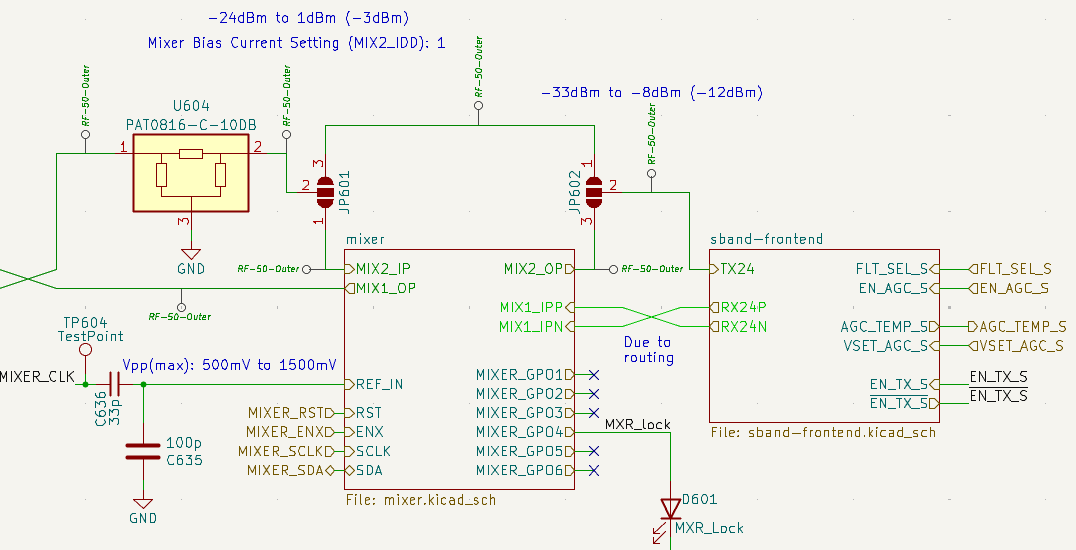
So why should the path bypassing the mixer also include the attenuator? Also, how to take care of impedance matching once soldering is introduced on the RF path?

2.) In S-band TX path, 2 stage amplification has been implemented.

U903, the amplifier SKY66312-11 and U908, the LPF LFCG-2250+ both are unsuitable for the band of operation of SatNOGS-COMMS. Wouldn’t this change the TX frequency to those out of its band of operation? Also, wouldn’t having 2 stage amplification, along with duplicated BPF increase insertion losses?

3.) In S-band RX, can I switch the HPF before LNA to an LPF (similar to S-band RX), to get high frequency noises removed before amplification? Is there some trade-off there I am missing?

4.) In UHF RX, unlike S-band RX, transformers have been used as baluns. Is there some frequency-specific reasoning behind this choice? Is that the similar case for having lumped element filters in UHF TX, unlike S-band RX?

It will be great if someone can help
Thanks. :smiley:

Hello!

Thanks for reaching out. As I understand you are likely interested in the amateur S-Band, ie 2400-2450MHz. The default configuration on S-Band assumes an operation at ~2050MHz RX and ~2250MHz Tx. Therefore, have a look at this issue, which describes the changes required to operate at the amateur s-band.

1 ) You also have to protect the U914 QPA0363A amplifier, which has an absolute maximum input power of -5dBm.
2a) Described on the issue. If you need further details on the RX operation of amateur S-Band please tell us.
2b) Filtering before amplification helps amplifiers stay at their linear region, by filtering undesired frequencies such as mixer harmonics, or interference.
3 ) The reason for the high pass filter, is to be able achieve operation at many bands above 1GHz. Theoretically, you could use another filter, if that filter satisfies your needs.
4 ) In the past, the AT86RF215 UHF used to be connected via differential lines through a differential RF switch. The RF-Switch was replaced with a single line one and therefore baluns were required. Also, I’ve seen RF IC manufacturers usually recommend using baluns. The lumped elements are used for 50Ω matching, since the UHF power amplifier is not inherently matched at such and thus a matching circuit is required.

2 Likes

Hi there! Thanks for your quick response to solve my queries
I still have a few things that are unclear to me

2.) The conversation you pointed out specifies that U903 should be left as it is, doesn’t this still leave out the possibility of having major parts of bands of operation of SatNOGS-COMMS board? The datasheet has only mentioned the working of U903 in 2300-2400 MHz band. And I am still not sure I understand the decision of having 2 stage amplification, despite it introducing more insertion losses

4.) The S band path has used baluns ICs, not transformers, which is not true for UHF band. So, am I rightfully confused about this difference or is 'balun IC’s just a specialized term for transformers used for this purpose? Also, do the lumped elements also function as filters? If not, then before amplification in UHF TX there should be filters just like the S band TX.

Also, regarding the feeding of antenna, I couldn’t figure out the following
5.) From what I understand, an antenna like dipole would need differential feeding. The antenna feeding is unbalanced, and outer coax layer is grounded through the SMA connector. Does that mean we can’t use this feeding for a UHF dipole antenna?

Please let me know what things I am missing here
Thanks in advance. :smiley:
Naigam

Hello,

2 ) Yes, probably you would need a power amplifier that is advertised to operate at ~2.45GHz. This specific power amplifier has been operated at 2.2 to 2.45GHz successfully and that is why it is stated that you don’t need to change it. But of course if a better option exists then you should go with that. Insertion losses are compensated by the amplification stages. Also, keep in mind that the RF-Mixer introduces an attenuation of, typically, 8dB which should be compensated by an additional amplification (U914 QPA0363A). In the UHF there is no RF-Mixer, therefore no additional losses are introduced and no other amplification is required.

4 ) Yes balun is a type of transformer. These lumped components are chosen to match the inner impedance of the device to the outer one, ie 50Ω. I don’t know if they also function as kind of filter, since it’s an LC circuit. The reason of the introduction of a filter directly in front of the S-Band transceiver is primarily to filter the RF-mixer artifacts which can degrade its performance. Since no RF-Mixer is used in UHF, no such filtering is really required.

5 ) You can use a dipole antenna, but a balun should be placed prior to the connection to the SatNOGS COMMS board. For example, in PHASMA mission, we used a small PCB with a balun which transforms the differential lines of the two “antenna monopoles” into a single line.

Have a nice day!