Any further sightings since my abbreviated RX this morning?
And… nothing seen 1600utc over the Eastern U.S. on 435.900.
They might be done w/ UHF until the next deployment unless some problem develops w/ one of the sats. Any reports appreciated.
3 Likes
Names updated now that they’re in Celestrak:
SPACEMOBILE OBJECT A
1 A0240U 26179A   26217.38767162  .00000419  00000-0  40463-4 0  9994
2 A0240  52.9936 327.7666 0005362  13.7124 346.4012 15.12901527    17
SPACEMOBILE OBJECT B
1 A0241U 26179B   26218.31229244  .00000936  00000-0  68823-4 0  9997
2 A0241  52.9981 323.5552 0005509 356.9145   3.1811 15.13289398   159
SPACEMOBILE OBJECT C
1 A0242U 26179C   26217.38723793  .00003463  00000-0  13943-3 0  9992
2 A0242  53.5193 326.9903 0125261 239.1535 119.7095 15.20881274    14
2 Likes
Excellent - thanks!
So at least one of them is still using the UHF downlink.
The higher of my two passes is either real late tonight or real early tomorrow, depending on how you want to look at it. But I’ll do my best to see if any of them are still transmitting over - or just offshore of the U.S.
Not a thing on any of the 70cm freqs allocated to AST on the 0730utc pass over the Eastern U.S.
Towards the end, the new sats even crossed the coastline & then international waters, but still nothing.
1 Like
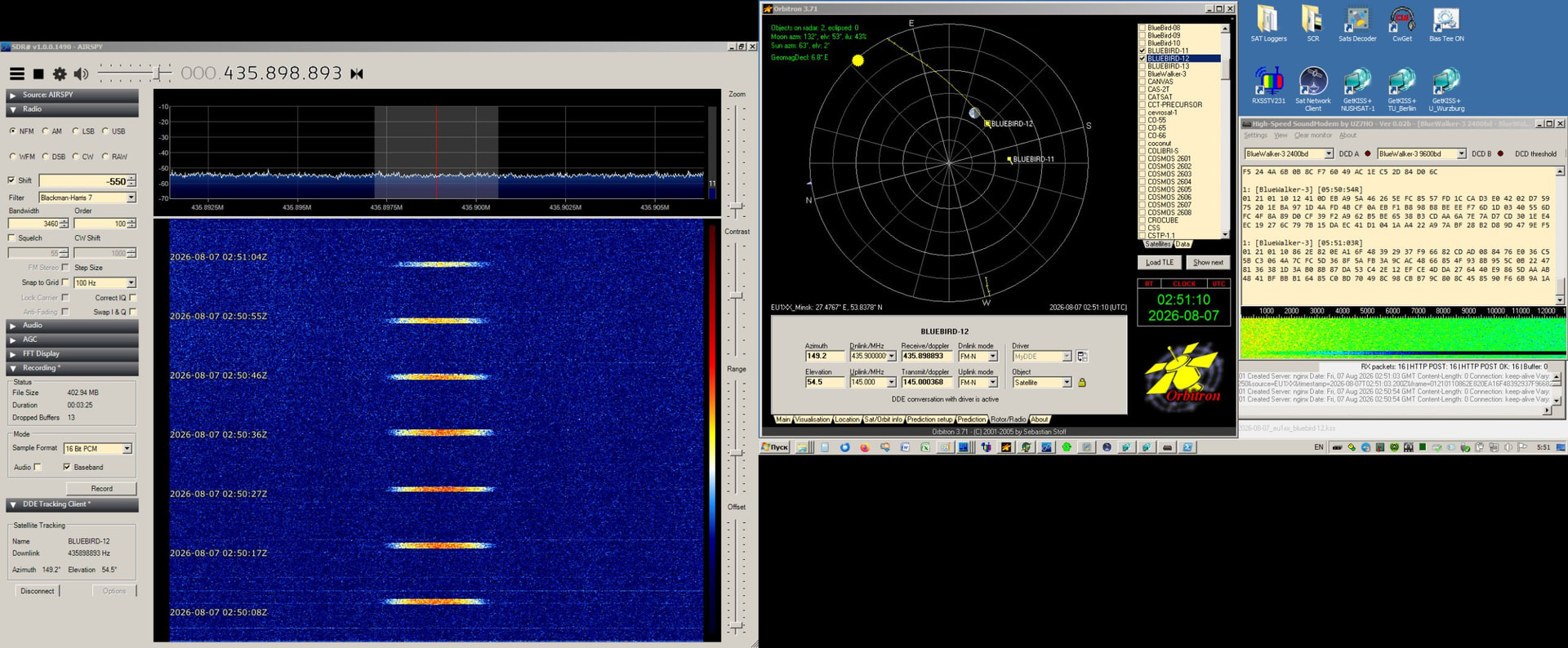
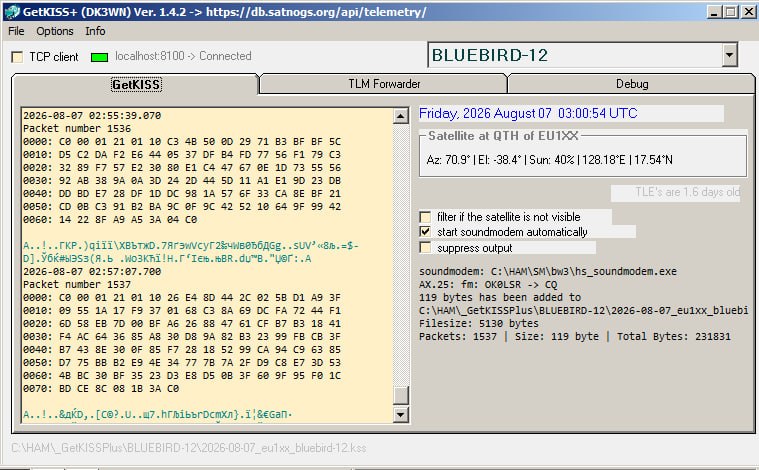
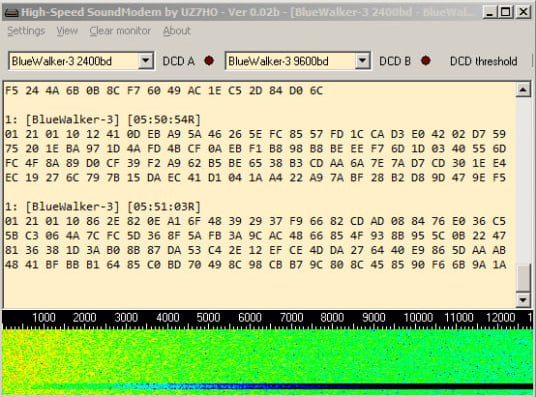
I’m seeing fm:OK0LSR → CQ on the screenshot, is that real or an artifact from another satellite?
OK0LSR is the amateur radio callsign for LASARsat, a Czech student-led nanosatellite launched on December 21, 2024.
Nothing heard on 435.900 MHz during the recent pass over the ground station in Bulgaria. 74 degrees high elevation pass at my QTH in Greece.
1 Like
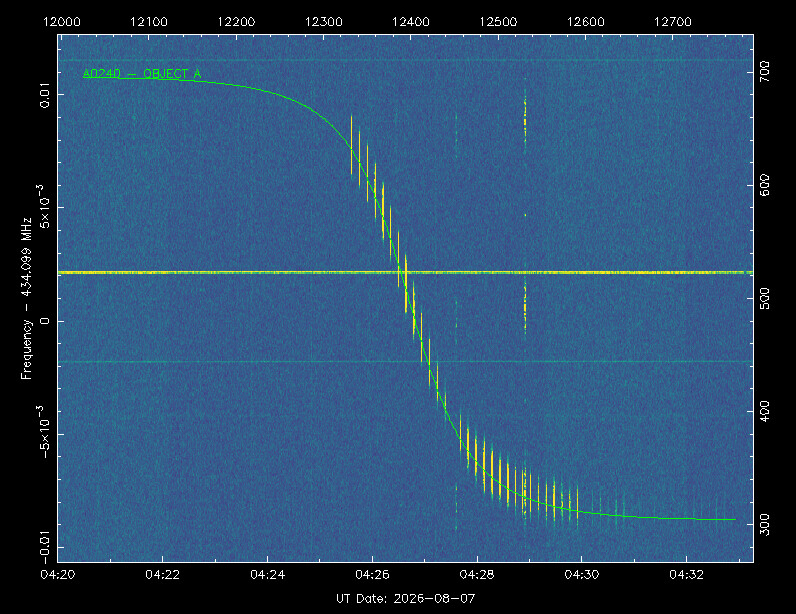
Checking the passes from this morning and signals are received on both 434.100 and 435.900 MHz.
These aren’t active every pass but alternately.
(I only monitor 434 - 438 MHz, so not other previous used frequencies, maybe other can check those)
Looking at the GP data, these are now all comparable and not longer show an Apogee x Perigee anomaly.
434.100 MHz
435.900 MHz
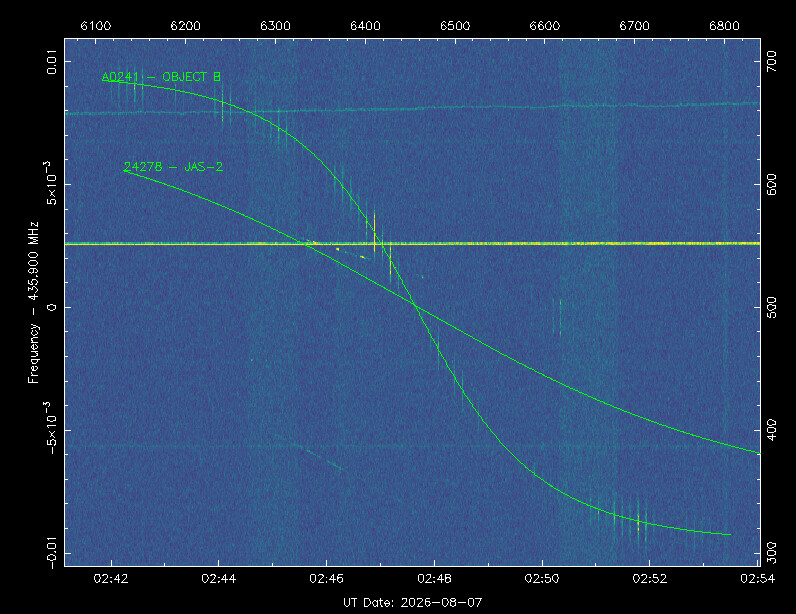
None of my attempts to decode the frames were successful based on the information from the previous launches.
Example:
name: BLUEBIRD-11
norad: 98251
data:
  &tlm Telemetry:
    unknown
transmitters:
  2k4 FSK downlink:
    frequency: 435.900e+6
    modulation: FSK
    baudrate: 2400
    deviation: 600
    framing: Light-1
    data:
    - *tlm
Jan | PE0SAT
4 Likes
TLE from https://www.space-track.org/ changed to use temporary NORAD ID from DB until we release the support alpha-5 TLE in DB and Network.
BLUEBIRD-11
1 A0240U 26179A   26218.64274344  .00000454  00000-0  42287-4 0  9994
2 A0240  52.9983 322.0568 0005119 345.9465  14.1382 15.13013622   207
BLUEBIRD-12
1 A0241U 26179B   26218.64260137  .00000469  00000-0  42962-4 0  9996
2 A0241  52.9975 322.0527 0005554 353.1869   6.9046 15.13182797   202
BLUEBIRD-13
1 A0242U 26179C   26218.64251177  .00000364  00000-0  37054-4 0  9991
2 A0242  52.9998 322.0550 0005443 357.5559   2.5404 15.13288669   200
BLUEBIRD-11
1 98251U 26179A   26218.64274344  .00000454  00000-0  42287-4 0  9993
2 98251  52.9983 322.0568 0005119 345.9465  14.1382 15.13013622   206
BLUEBIRD-12
1 98250U 26179B   26218.64260137  .00000469  00000-0  42962-4 0  9993
2 98250  52.9975 322.0527 0005554 353.1869   6.9046 15.13182797   209
BLUEBIRD-13
1 98249U 26179C   26218.64251177  .00000364  00000-0  37054-4 0  9995
2 98249  52.9998 322.0550 0005443 357.5559   2.5404 15.13288669   204
4 Likes
This is a feature of the GetKISS+ program from DK3WN. It displays the AX.25 frame header until the next one header is received. Since BlueBird does not have an AX.25 header you see the header from my previous observation.
2 Likes
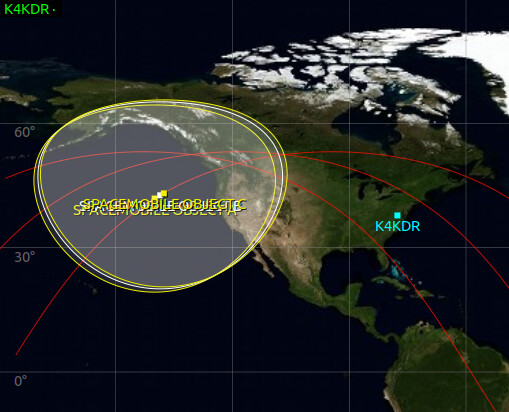
And now the latest TLE update has corrected the one object’s “different” orbit. The 3 sats now show as a tight group.
SPACEMOBILE OBJECT A
1 A0240U 26179A   26218.64274344  .00000454  00000-0  42287-4 0  9994
2 A0240  52.9983 322.0568 0005119 345.9465  14.1382 15.13013622   207
SPACEMOBILE OBJECT B
1 A0241U 26179B   26218.64260137  .00000469  00000-0  42962-4 0  9996
2 A0241  52.9975 322.0527 0005554 353.1869   6.9046 15.13182797   202
SPACEMOBILE OBJECT C
1 A0242U 26179C   26218.64251177  .00000364  00000-0  37054-4 0  9991
2 A0242  52.9998 322.0550 0005443 357.5559   2.5404 15.13288669   200
4 Likes
Thanks for the update, so we do know it should be possible to decode the signals.
Jan | PE0SAT
2 Likes
@K4KDR using the audio from this observation I was able to decode frames with the gr-satellites Yaml.
gr_satellites BLUEBIRD-11.yml --wavfile 14724669.ogg --samp_rate 48e3
name: BLUEBIRD-11
norad: 98251
data:
  &tlm Telemetry:
    unknown
transmitters:
  2k4 FSK downlink:
    frequency: 435.900e+6
    modulation: FSK
    baudrate: 2400
    deviation: 600
    framing: Light-1
    data:
    - *tlm
***** VERBOSE PDU DEBUG PRINT ******
((transmitter . 2k4 FSK downlink))
pdu length =        116 bytes
pdu vector contents =
0000: 01 21 01 1a f0 b0 1b a3 8d 2b f9 fa 1e 66 79 2e
0010: 3e 3e 4f e0 11 bf 69 12 93 fb 3c f9 fb b4 83 29
0020: 9d ea e1 af 01 16 a7 98 26 2f 26 49 69 f2 50 a2
0030: d4 05 eb ef 88 f4 e2 79 ac 93 1e ef 86 9a 8a 4c
0040: 1a c5 70 80 fb df e1 9e f7 e2 9f 63 de 7a d0 c9
0050: 48 d3 f0 de 1e 42 ee 6c 12 45 49 0d f2 73 6f 75
0060: 4c 3d 85 a7 95 8b 6f e5 33 39 48 ef e6 da 86 1a
0070: 08 26 02 4b
************************************
***** VERBOSE PDU DEBUG PRINT ******
((transmitter . 2k4 FSK downlink))
pdu length =        116 bytes
pdu vector contents =
0000: 01 21 01 1a b1 9c ee 54 17 b8 a1 61 5b e2 ef 89
0010: bd 54 91 1a 46 ef 53 32 6d c5 81 c1 92 67 92 7e
0020: 63 6f 03 05 89 33 1b 8a 65 48 87 63 12 b5 81 62
0030: e8 c9 99 39 de 2f 8b ab 47 4b b4 d1 ed 29 32 bc
0040: 8b 40 ec 4d 19 cb 94 62 3f c2 d1 eb 1f 6e 6e f2
0050: a5 88 f4 4a f5 fc fa 82 6b 6c d5 22 b9 5c 25 87
0060: 7c 6b 4d e3 a1 f2 55 d0 d4 e3 46 d8 74 f0 7f 24
0070: a0 c7 06 7b
************************************
Jan | PE0SAT
5 Likes
That’s great!
Unfortunately, I haven’t been able to access any of the SatNogs pages for 2 or 3 days now.
Let me share the audio file Scott https://pe0sat.vgnet.nl/download/BLUEBIRD/14724669.ogg
Jan | PE0SAT
3 Likes
Thanks very much! Man… it’s been a while since I’ve seen 240 decodes from a single pass.
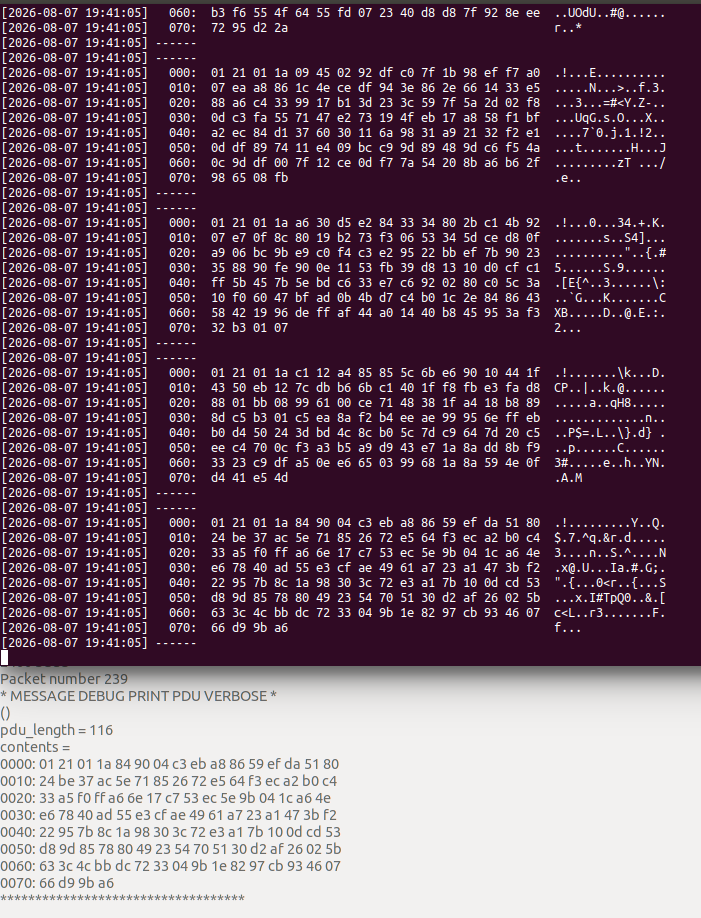
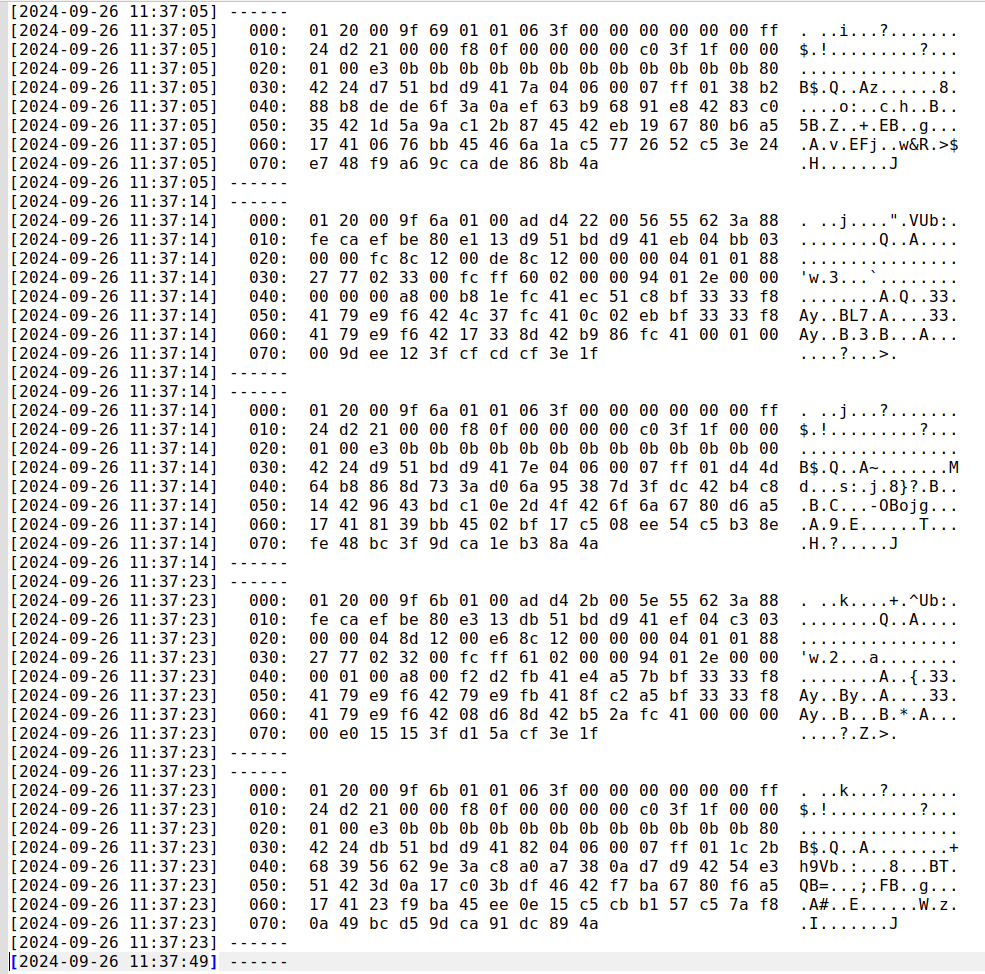
… for comparison, here are some frames from BlueBird-5 in 2024:
5 Likes
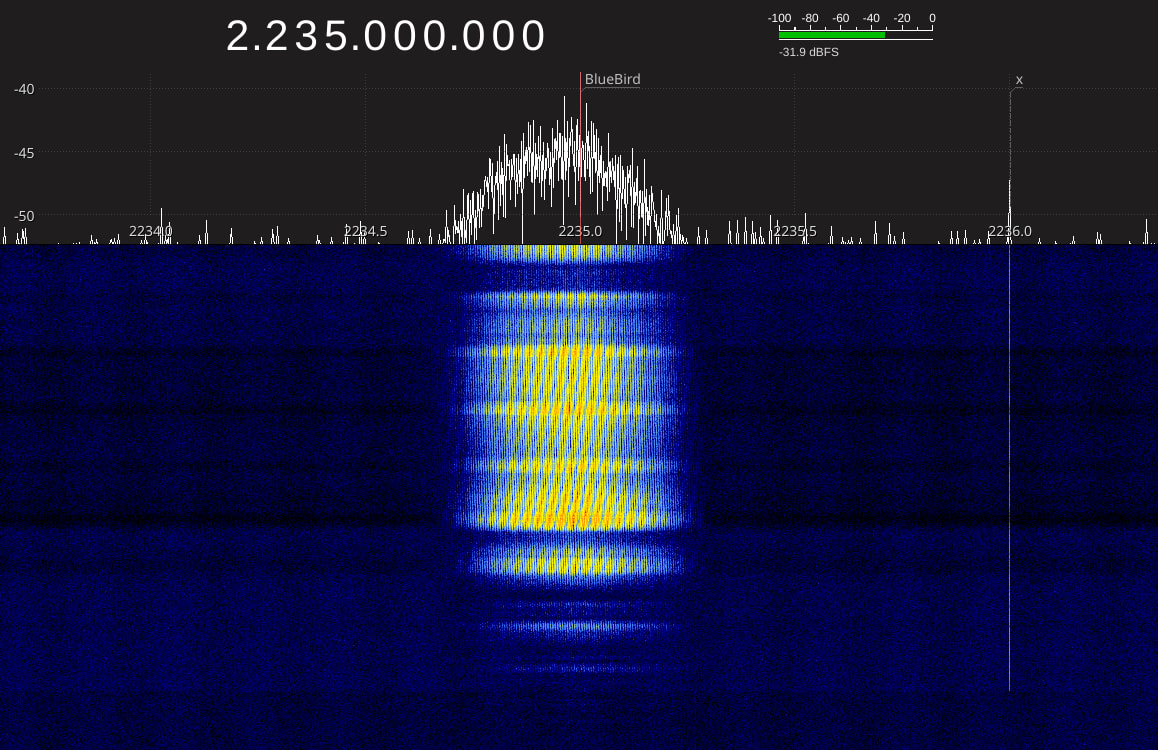
No additional UHF downlinks seen from the 3 new sats tonight in U.S. airspace, but one of them did have an active S-Band downlink on 2235 MHz.
Parsed out some raw hex frames (‘1A CF FC 1D’ ASM) thanks to SatDump.
5 Likes