In my strf obs, ran at 24 MSPS, a signal appeared on the 42900 TX frequency, minus 24 MHz.
It was 13 kHz rms off from Optsat 3000 but with tle date 26243
With Claude AI I asked to generate a fresh TLE for optsat 3000 with the datapoints from my observations and the existing TLE information.
The output:
Optsat 3000
1 42900U 17044A   26295.41666667  .00005100  00000-0  22571-3 0  9993
2 42900  97.3766 356.2649 0005206 311.5631 136.5385 15.22230424    09
Fit to your pass: with this TLE your carrier.dat fits at 51 Hz RMS with dt = 0 s. The f0 comes out at 2284.9998 MHz. The old TLE (26243) gave 169 Hz, and only after shifting it 64 s.
How I made it:
- I fitted two corrections to the old TLE against your 214 Doppler points:
- mean anomaly −4.074°, which is the satellite running 64.3 s late;
- RAAN −0.011°, which is almost nothing.
- I ran the corrected orbit through SGP4 over ±12 h around the new epoch. Then I fitted new mean elements at 26295.417 to those positions; they match within 5 m.
- I kept B* and ndot/2 from the old TLE.
- Mean motion moved from 15.21699 to 15.22230. That’s the decay SGP4 already applies over the 51 days since the old epoch, not something I added.
Limits:
- One pass of Doppler pins down timing along the track well (to a second or two) but doesn’t tell us much else.
- Inclination, eccentricity, argument of perigee and the decay rate all come from the old TLE.
- The timing should hold for a few days. After that the error grows with however much the real decay differs from the old ndot/B*.
- A second pass, preferably a few days later, would let me fit the mean motion as well and make it last longer.
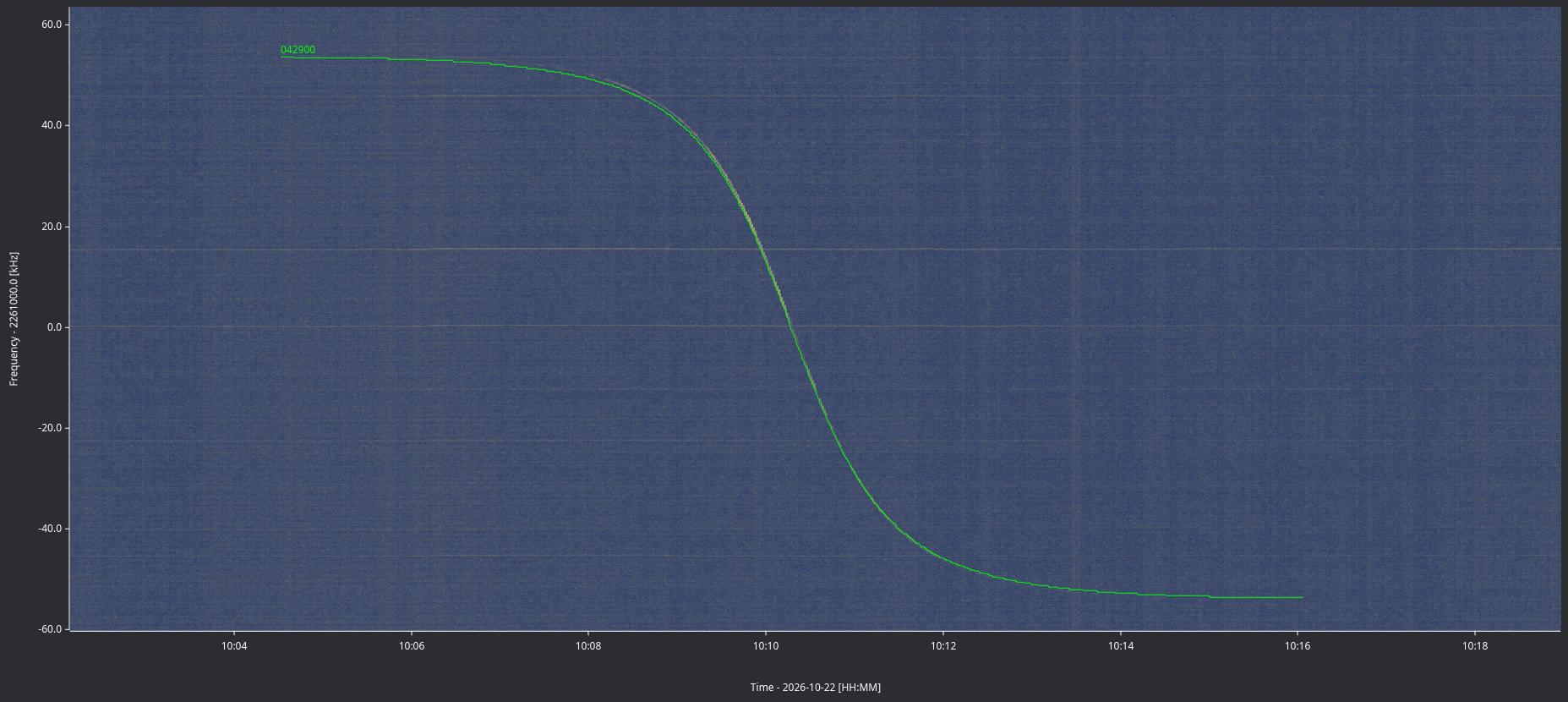
pass fits, ignore frequency please 