Hi all,
I build the Orbital Congestion Simulator, an open-source web app that propagates the full public catalog (Approximately 28,000 objects) with SGP4 in the browser: https://orbital-congestion.vercel.app
Since tracking depends on how fresh a TLE is, I wanted to know how quickly an older TLE drifts away from a newer one for the same object. I’m sharing the results and the scripts in case they’re useful here, and I’d welcome corrections on the method.
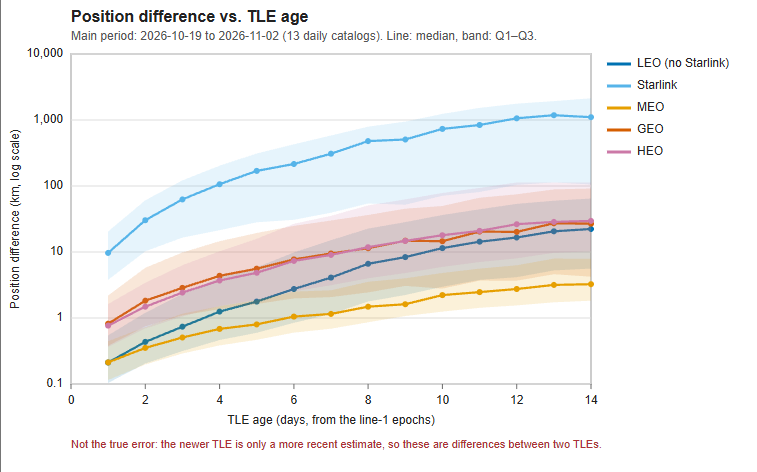
Important: this is not the true error. I compare an older TLE with a newer TLE of the same object. The newer TLE is only a more recent estimate, not the true position, so these numbers are differences between two TLEs.
Method
- Data: daily snapshots of the public CelesTrak catalog, archived as gzip 3LE files in a GitHub release.
- For each object, every pair of different TLEs (older, newer) is compared. The older TLE is propagated with SGP4 (satellite.js 7.1.0) to the newer TLE’s epoch and compared with the newer TLE’s position at its own epoch.
- Age = difference between the two line-1 epochs, grouped into whole days.
- The difference is also split into along-track, radial and cross-track components (in the newer orbit’s frame).
- Main result: the median per orbit layer and age. Pairs above Q3 + 3·IQR (Tukey) are counted and listed separately (often manoeuvres or re-entries), not removed.
- Main period: 13 daily catalogs, 19 Oct – 2 Nov 2026, 28,378 objects, 1,771,754 pairs. An earlier period (47 catalogs, Jul – Oct 2026, smaller catalog) is reported separately and shows the same pattern.
Results (median difference, km)
| Layer | 1 day | 3 days | 7 days | 14 days |
|---|---|---|---|---|
| LEO (without Starlink) | 0.21 | 0.74 | 4.1 | 22 |
| Starlink | 9.7 | 63 | 309 | 1,103 |
| MEO | 0.21 | 0.51 | 1.2 | 3.3 |
| GEO | 0.82 | 2.9 | 9.5 | 27 |
| HEO | 0.77 | 2.4 | 9.0 | 30 |
What stood out to me:
- The growth speeds up with age: for LEO without Starlink, about 0.2 km after 1 day, 4 km after a week and 22 km after two weeks.
- Almost all of it is along-track. For LEO at 7 days, the median along-track part is 4.05 km, against 0.37 km radial and 0.19 km cross-track. That looks like timing (drag) rather than orbit shape, so a stale TLE mostly makes a pass arrive early or late.
- Starlink is in a different class: 45–75× larger than other LEO objects at the same age, probably because of frequent manoeuvres. A one-day-old Starlink TLE already differs by about 10 km.
- MEO is the most stable layer.
- The tails are long: about 9% of pairs in each cell are above the Tukey limit.
SGP4 check
Before measuring, I checked the propagation against the Vallado et al. (2006) verification set (AIAA 2006-6753): 33 test cases, 666 points. All 33 agree within 1 mm in AFSPC mode; in improved mode, 32 of 33 do, and the one difference is the expected opsmode difference.
Limitations
- Differences between TLEs, not true errors (see abov
- Only one snapshot per day, so updates within a day are not seen and ages fall in 1-day steps.
- The main period is only about two weeks long.
- Manoeuvres are not detected individually; they show up in the outliers.
Code and data
- Method, results and charts:
https://github.com/muhammet842/orbital-congestion-simc8319ffe860cbcf08c28d8fb7fb498e7/research/tle-age - SGP4 verification:
https://github.com/muhammet842/orbital-congestion-simc8319ffe860cbcf08c28d8fb7fb498e7/research/sgp4-verify - TLE archive: Release TLE archive · muhammet842/orbital-congestion-simulator-premium · GitHub
Everything can be rerun with npm run research:tle-age; nothing is random, so the same archive gives the same numbers.
I used an AI coding assistant while building the scripts; how it was used is described in https://github.com/muhammet842/orbital-congestion-sims/AI_USAGE.md. The method, the checks and theconclusions above are my own responsibility, and I’d be glad to hear where they could be improved.
Thanks!