New Satellite, I don't have more data

2026-11-04 21:42:17Z (18:42:17 LT) 401,558 MHz Frame: 119 bytes
ASCII:
… .h./<…L…e.CY
K{.KC.uL.U..v..YK…k..@…S
jM.T..Z$..8...4a.*O{h.eS6.s 4ZDpC.vx_...IZ...N..t#.=…
…=t..

HEX:
000 82 A2 B9 00 EB 90 20 9E
008 68 00 2F 3C 8B AF C8 7F
010 F8 F7 C6 4C 93 97 B7 A6
018 65 0D 43 59 4B 7B 87 4B
020 43 A0 75 4C C3 55 87 CC
028 76 2E EB 59 4B 9C D0 B2
030 6B EE 03 40 F3 A5 D7 53
038 6A 4D B0 54 E7 E2 5A 24
040 9A AC 38 60 18 A0 C9 34
048 61 02 2A 4F 7B 68 AD 65
050 53 36 DF 73 34 5A 44 70
058 43 F5 76 78 5F 9F 87 D4
060 49 5A 9B 84 BB 4E 60 84
068 FE 74 23 C8 3D F9 0C C6
070 98 EB B0 3D 74 E6 DA

META:
Bytes: 119
CFO: 278,8 Hz
SNR: 9,5 dB
CRC: OK
Corrections: 16
Erasures: 0

Modulation: FSK
Framing: AX100ASM
Baud rate: 19200
Deviation, Hz: 4800

LW2DYB/GS

1 Like

Hi, I dropped this and New satellite maybe in Claude, who is “fairly certain it’s the same transmitter”

  • same frequency (401.558 MHz), same AX100 ASM framing, same 4800 Hz deviation, about 19k2;
  • CSP header 82 A2 9C 00: the same source 1, destination 10 and port 10, with only the ephemeral source port different;
  • the payload also starts with EB 90;
  • and that frame contained readable text: “TY-47, UTC 179071642”.

Is it possible to record this signal as IQ data to check on the doppler curve so we can match it to a satellite ?

Thanks,

Ben

1 Like

You could check if the passes match 65488 Object A

I have identified that one in 2 passes from last night. Was recording strf to catch some local data transmitter but this was in my frequency range.

Claude did some math:

So I tested it with your fitted TLE of 65488, for LW2DYB’s reception time (4 Nov, 21:42:17 UTC):

65488 was over northern Argentina at that moment (subsatellite point 21.5° S, 65.9° W), so in view for him.
The Doppler shift there: depending on where in Argentina he is, +7.5 to +8.4 kHz. Around Buenos Aires, Córdoba or Mar del Plata, the frequency he’d see is 401.5575–401.5584 MHz.
What he reported: 401.558 MHz, with only 279 Hz of correction (CFO) in his decoder.

That matches within a few hundred hertz. His 401.558 is simply 65488’s 401.550 MHz seen while it was still approaching.

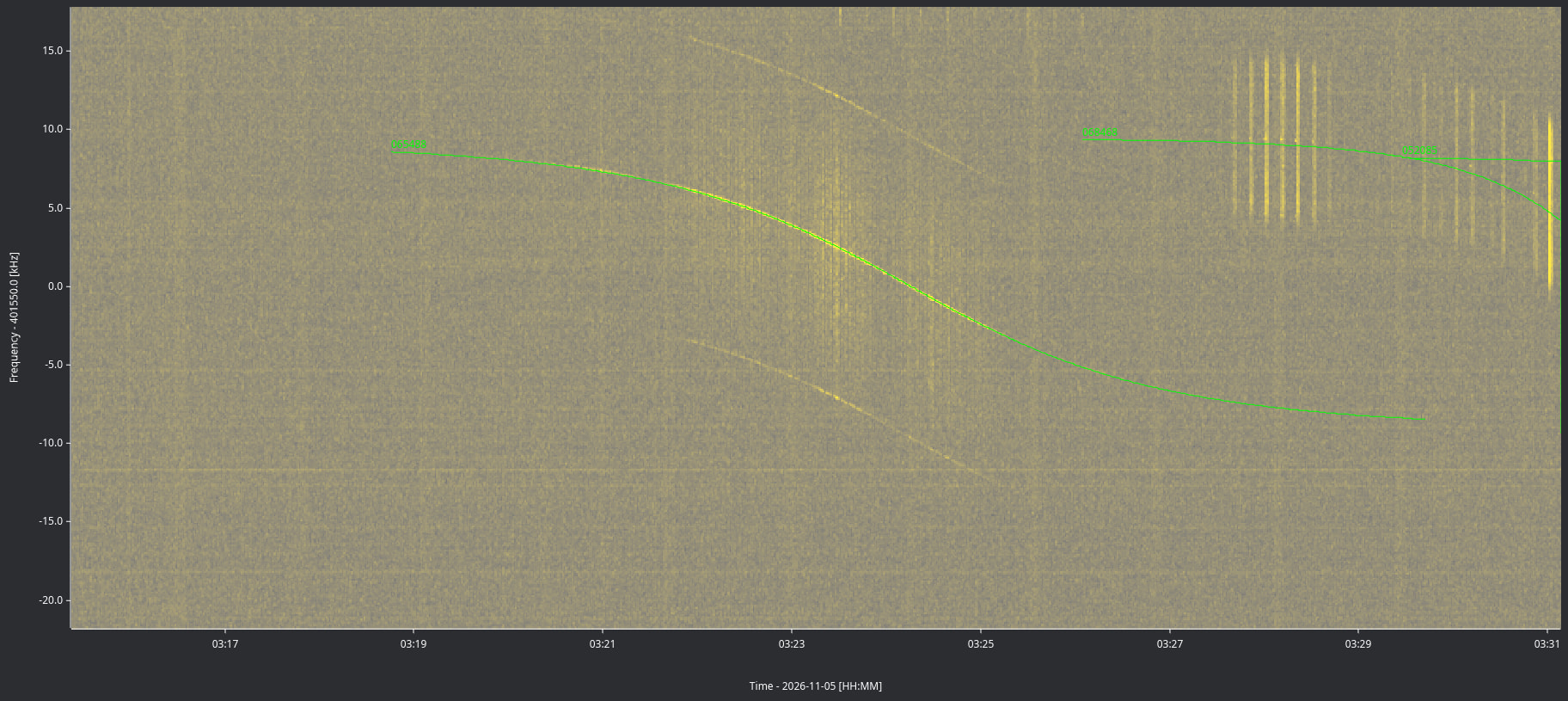
Your new zoom (relative to 401.555 MHz) supports it too:

The fitted 065488 curve now runs right over the middle trace.
The two sidebands sit at about ±9 kHz, more than my rough ±7 from the first screenshot. That fits 19k2: an alternating bit pattern (preamble or idle) at 19,200 baud produces sidebands at ±9.6 kHz. At 9k6 they’d be at ±4.8 kHz, as you said.
Around 03:23–03:25 there are wide, faint bursts on the middle trace: packets.
1 Like