Hi Everyone,
For the past few days I have been tracking Kita-36 and Kita-53 on 400.500 MHz. I have observed that both Kita satellites transmit short bursts of 40 kbaud 2-FSK, about 80 to 120 ms each. Not 30 kbaud as currently listed in the SatNogs database.
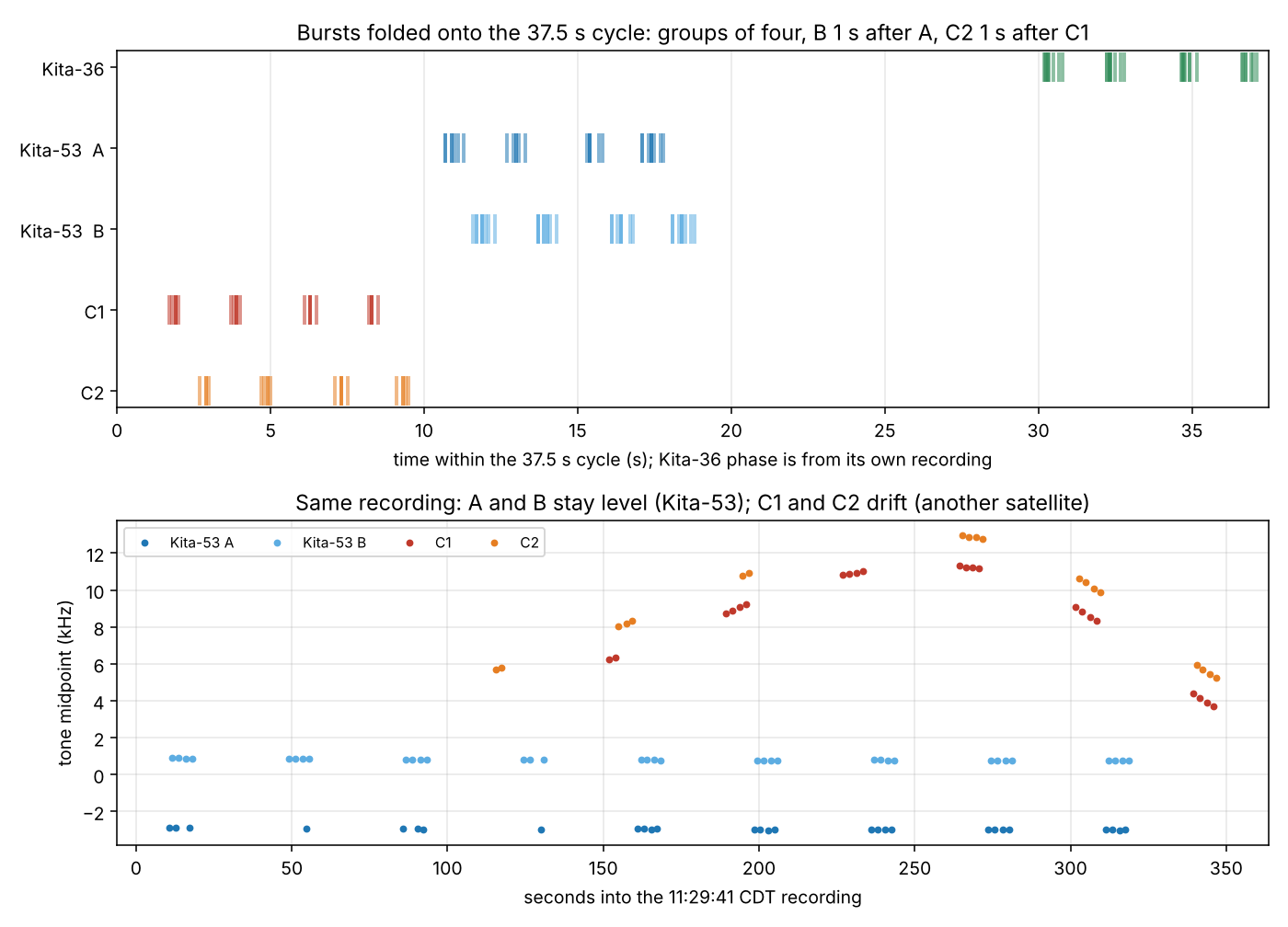
For each satellite, the two FSK tones sit 40 kHz apart, and every frame starts with the sync word C8 27 04 followed by a length byte. Each satellite also sends a group of four frames about 2 s apart, with lengths 0x76, 0x77, 0x84 (or 0x85/0x86) and 0x5a. The group repeats every 37.5 s, and the payload looks random. Kita-36 sends one burst at a time.
Interestingly, Kita-53 sends them in pairs: two transmitters about 3.76 kHz apart, which I call A and B, where B follows A by 1 s with the same frame type. Both stayed flat under the Kita-53 Doppler correction, so these signals come from Kita-53’s position. A matches the format of the single Kita-36 signal.
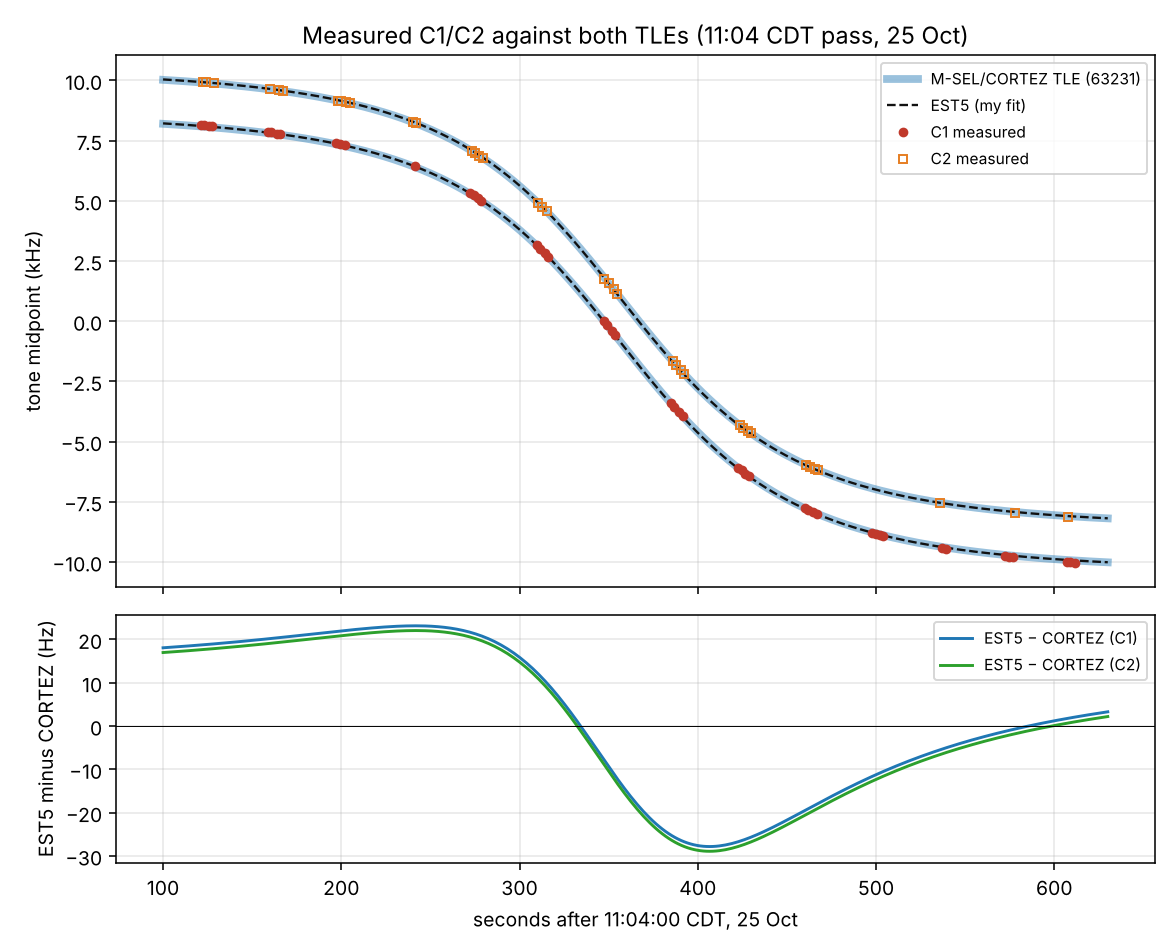
Quite unexpectedly, a new set of signals I am calling “C1/C2” turned up in the same Kita-53 recording I have been studying. These two extra signal sources that did not stay flat under the doppler correction. Their frequency drifted differently from Kita-53’s, so they are not on Kita-53. However, and to my surprise, they use the same radio and use the same sync word. These are 0x84 frames are 348 bytes, where the Kita ones are 270. An image to illustrate is below. At present, the origin is unknown, although I have ruled out Ghost-3.
For anyone interested, here is provisional tle for “C1C2” derived from several observations. Apologies if these need to be re-aligned.
C1C2-EST3
1 99999U 26999ZZ 26297.68936343 .00000000 00000-0 10000-3 0 9992
2 99999 97.7400 189.6340 0008000 0.0000 24.0880 15.28000000 01
Lastly, with the help of the Claude LLM, here is a custom decoder which may be used. It is set up for a 100K sps IQ input. Just remove the .zip.
N6RFM_kita53_decoder.grc.zip (9.9 KB)
More information about Kita-36 and 53 is here
What we already know - it’s a very crowded sky up there!
Good hunting all.
Bob
N6RFM