KSLV-2 Launch Planned : 2026-10-07 03:25 UTC

Hello all, Yonghoon Chung here from Yonsei, working with @dooyoung on BEE-1012, UEL-Y-Sys, and SD-1 SAT. Thank you for the fast response — @bali’s SatYAML files are exactly right, and all three satellites were indeed in observation 15144789.

The beacon format of the three satellites is published here, with Kaitai Struct decoders for SatNOGS and sample frames:

In short:

  • All three: 436.500 MHz, GFSK 4800 bd, AX100 ASM+Golay. A frame is a 4-byte CSP header in network byte order, the beacon body, and a 4-byte CSP CRC-32 when the CSP CRC flag is set.
  • Tell them apart by the ASCII identifier right after the CSP header: BEE1012 (frame 218 B), UELYSYS (219 B), SD1\0 (95 B, no CRC trailer).
  • The three .ksy files parse all 31 frames of observation 15144789 and match our ground station’s parser.

All three satellites are healthy and two-way communication works.

Yonghoon Chung — Astrodynamics and Control Laboratory, Yonsei University

3 Likes

Finally SLEDGE is observed by SatNOGS, even before our official ground station observes.
Thank you for community’s support for SLEDGE.

2 Likes

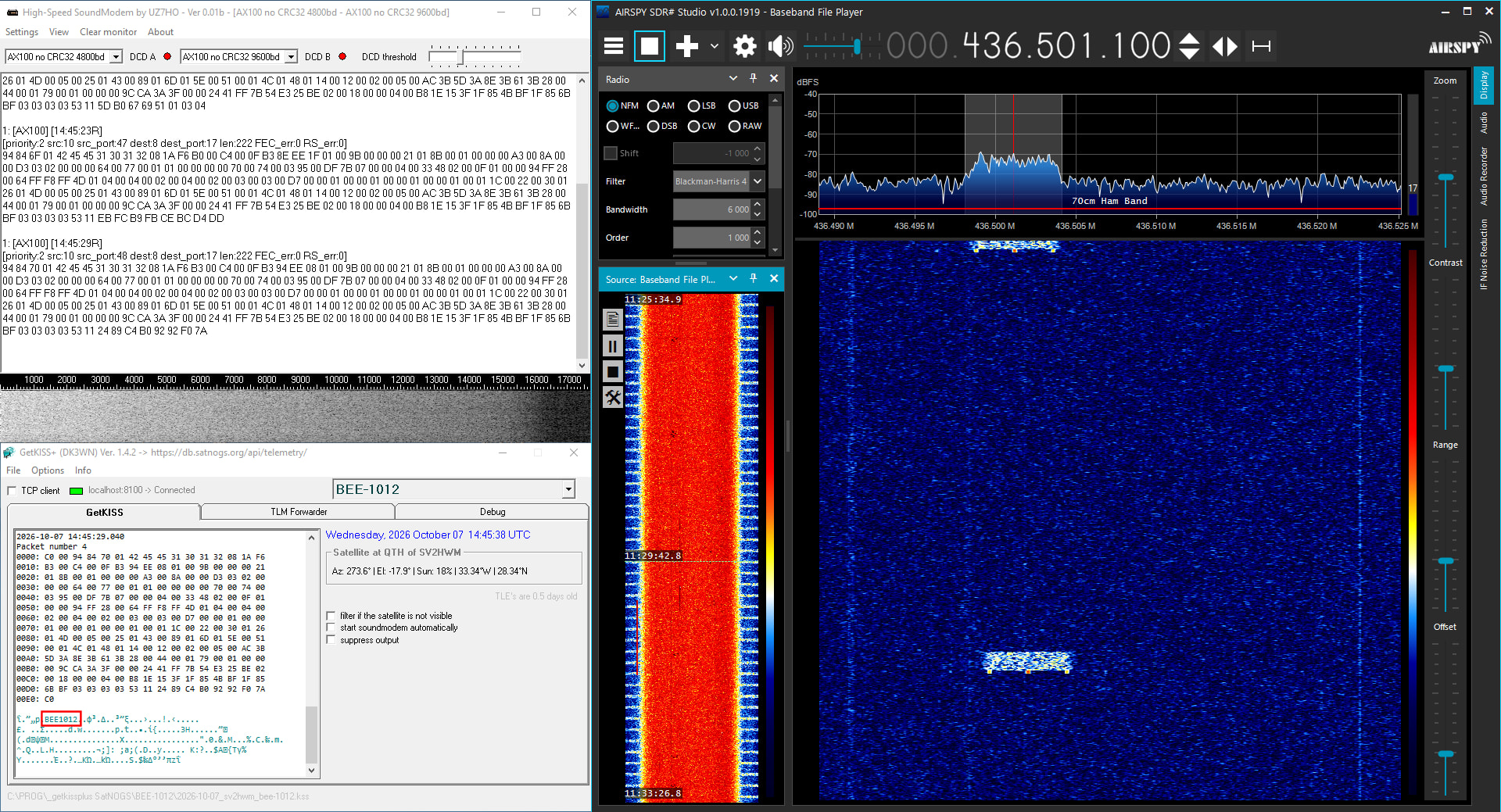
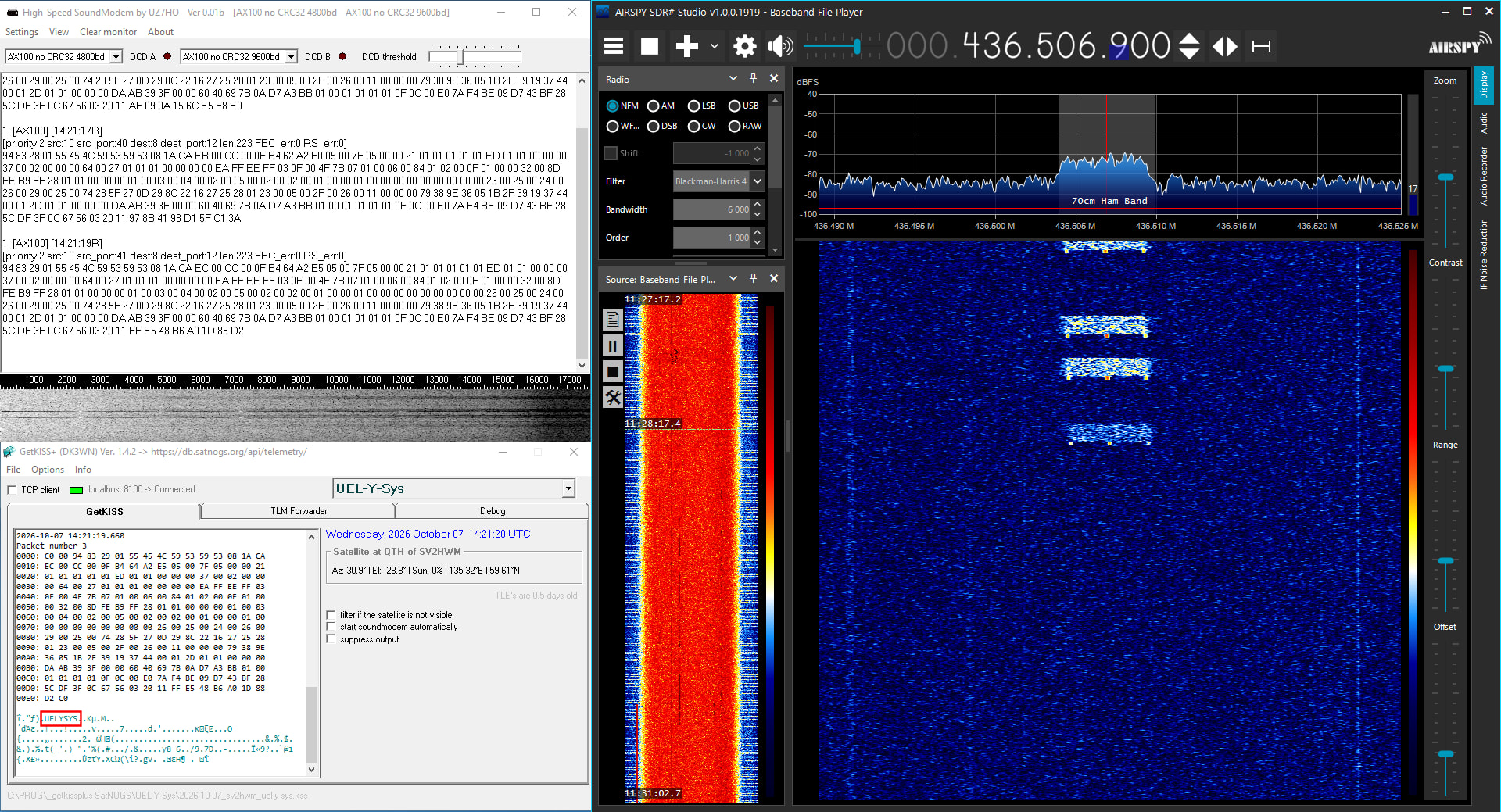
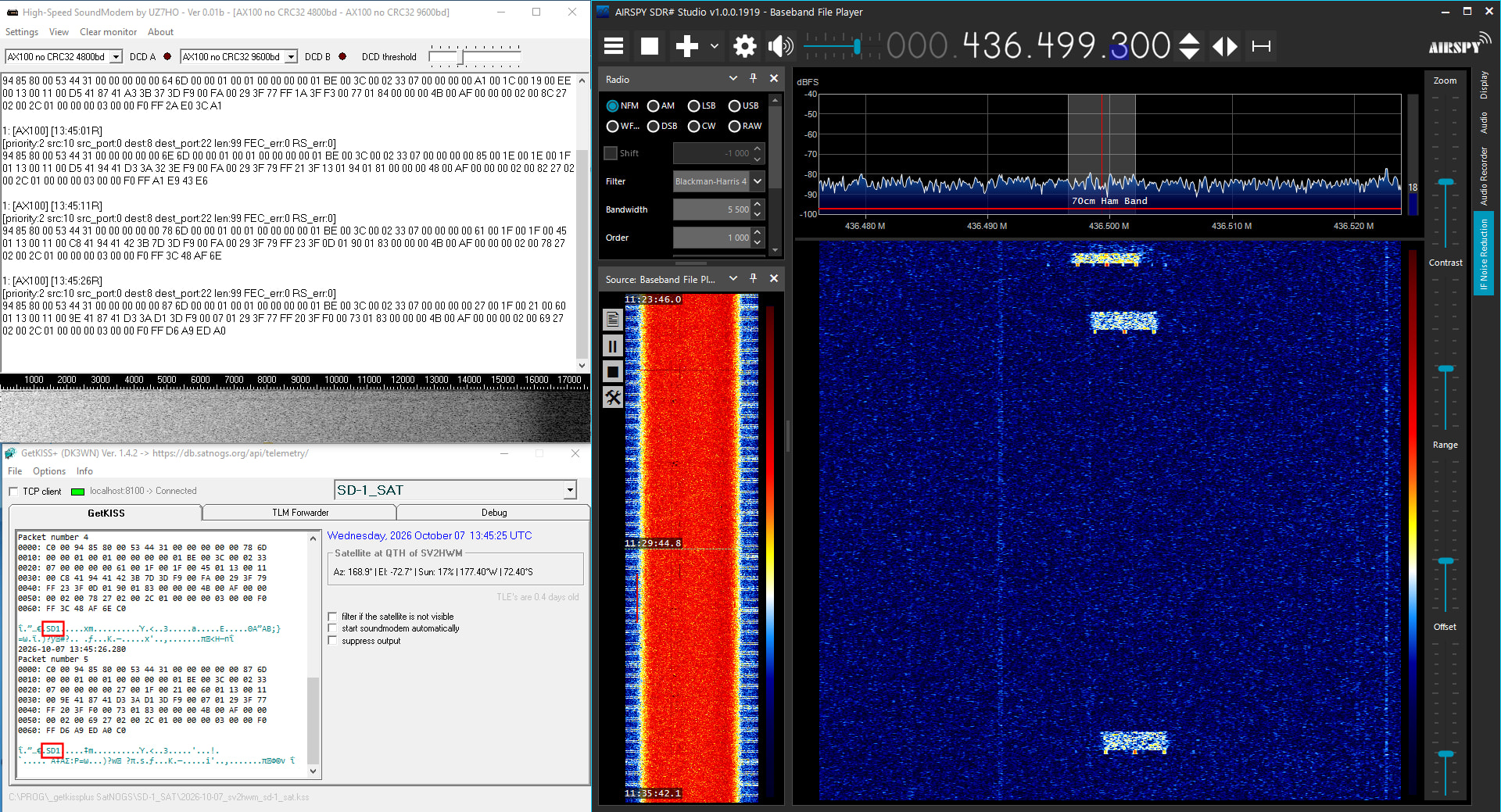
11:25-11:35 UTC – Replay of recorded IQ with turnstile antenna in Greece

SD-1 SAT


BEE-1012

UEL-Y-Sys

3 Likes

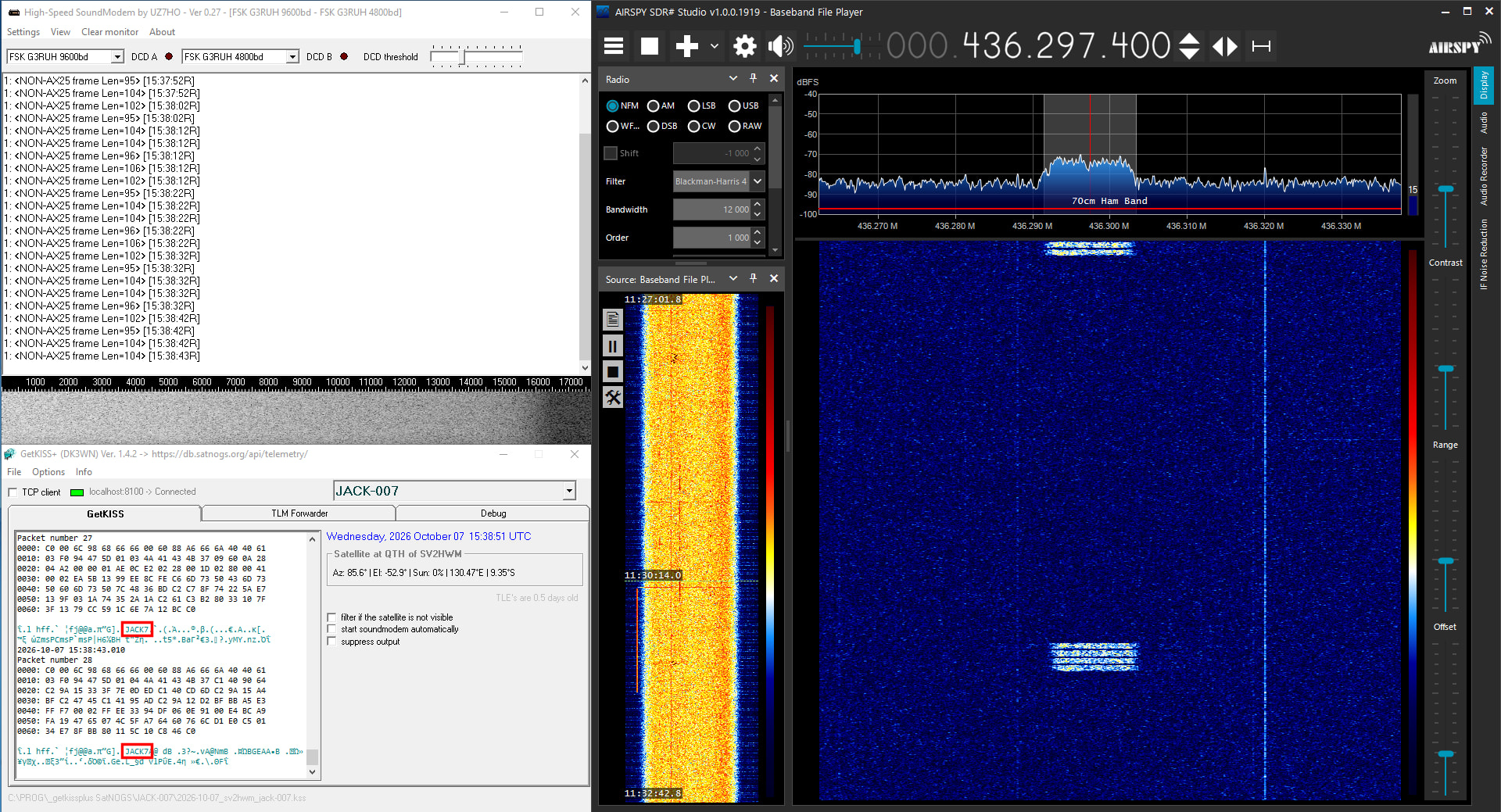
11:25-11:35 UTC JACK-007 Replay of recorded IQ in Greece.

5 Likes

Even though only 28° max elevation, managed a few 19k2 decodes from SLEDGE today.

4 Likes

Nice catch! Let’s add it in DB, I guess at 436.3 MHz. FSK 4k8.

TLE based on previously calculated ones for JACK-007:

JACK-007
1 98193U          26280.14444444  .00000000  00000-0  50000-4 0    09
2 98193  97.6704  19.7088 0003597   0.0000 134.9051 14.98187870    08
2 Likes

Thank you! Yes it’s on 436.300 MHz but the mode is FSK G3RUH Non-AX.25 @ 9k6 bd.

Oh I was looking the wrong field in the screenshot :smiley:

Noted, I’m going to change it in DB and update Network future observations.

Thanks!

It’s actually AX.25, but with one little mistake.

The destination callsign 6L433 is wrongfully padded with 0x00 instead of 0x40 (as the source callsign correctly is).

4 Likes

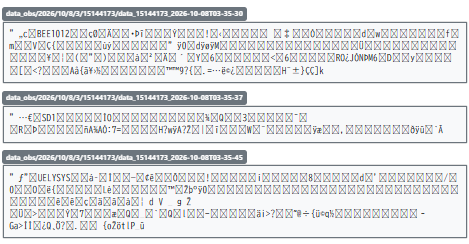
In an observation of SD-1_SAT scheduled by Fredy at my ground station (5049), the downlink signals from three satellites—SD-1_SAT, UEL-Y-Sys, and BEE-1012—were overlapping, as they were transmitting on the same frequency while following nearly identical orbits.
Interestingly, I was able to successfully decode packets from all three satellites during the same observation and identify each satellite by its unique ASCII identifier in the beacon data (SD1, UELYSYS, and BEE1012).
Despite the overlapping signals, it was great to receive and identify telemetry from all three satellites in a single observation!

In any case, congratulations to all the mission teams on the successful launch! :tada::satellite::satellite::satellite:
SatNOGS Network - Observation 15144173

Best regards,
Kazuki NISHIOKA, JF6FYI

3 Likes

Can someone update TLE of SLEDGE?

SLEDGE
1 98241U          26280.15383156  .00000000  00000-0  22504-3 0 10004
2 98241  97.6615  16.3360 0011381  84.5637 100.4510 14.98183333    00

We could get some signal with doppler error. We’ve updated TLE according to compensate the doppler error.

2 Likes

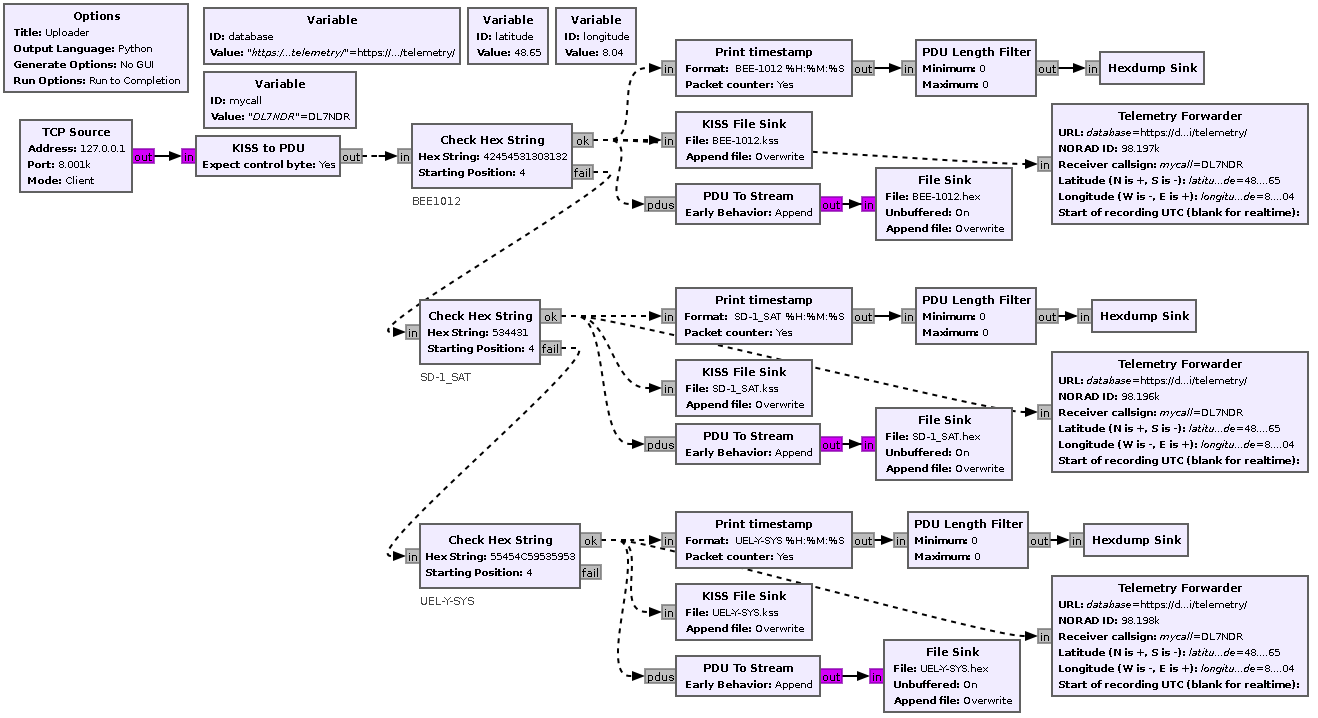
I’m using the following GNU Radio flowgraph with block Check Hex String to upload received data from BEE-1012, SD-1_SAT and UEL-Y-SYS automatically to the correct SatNOGS database (satellite ID).

Uploader.zip.zip (1.6 KB)

5 Likes

Dear @dl7ndr,

This is an excellent flowgraph!
Thank you very much for sharing it with us.
I’ll definitely make use of it for my manual satellite reception sessions.

Best regards,
Kazuki NISHIOKA, JF6FYI

1 Like

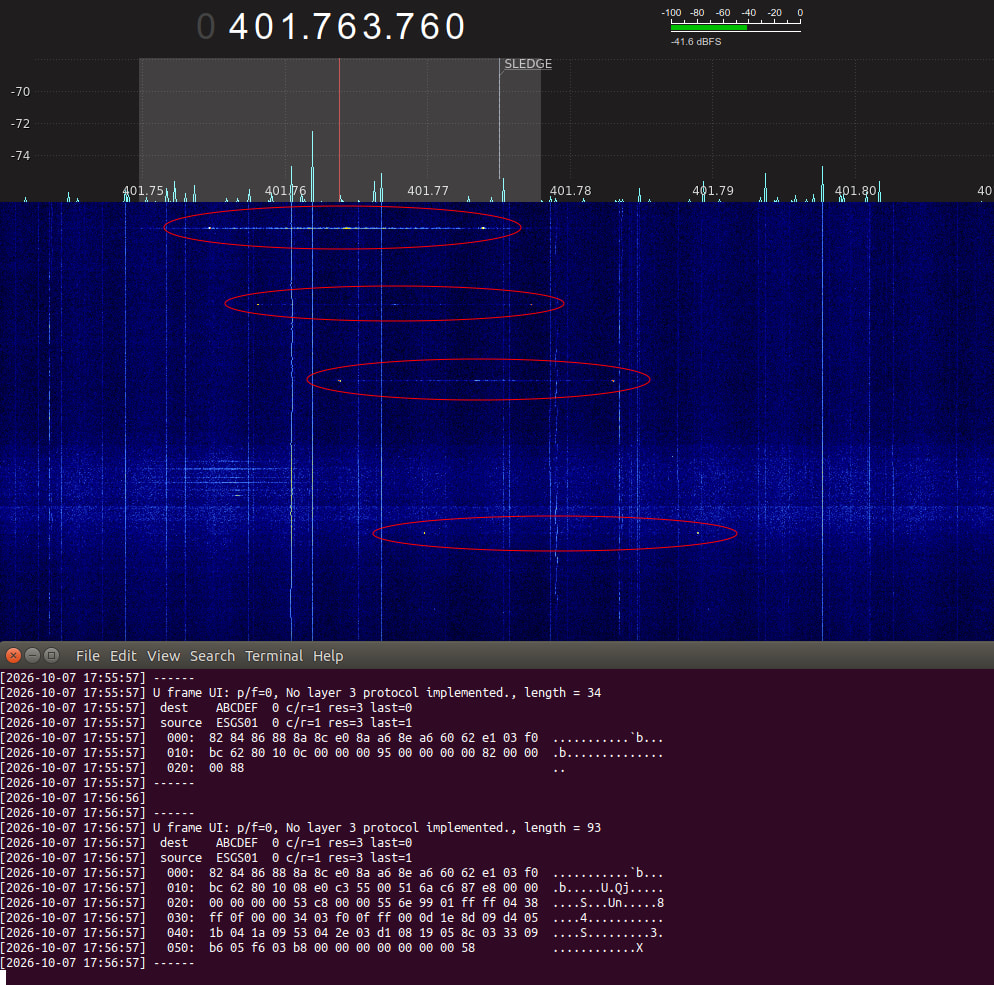
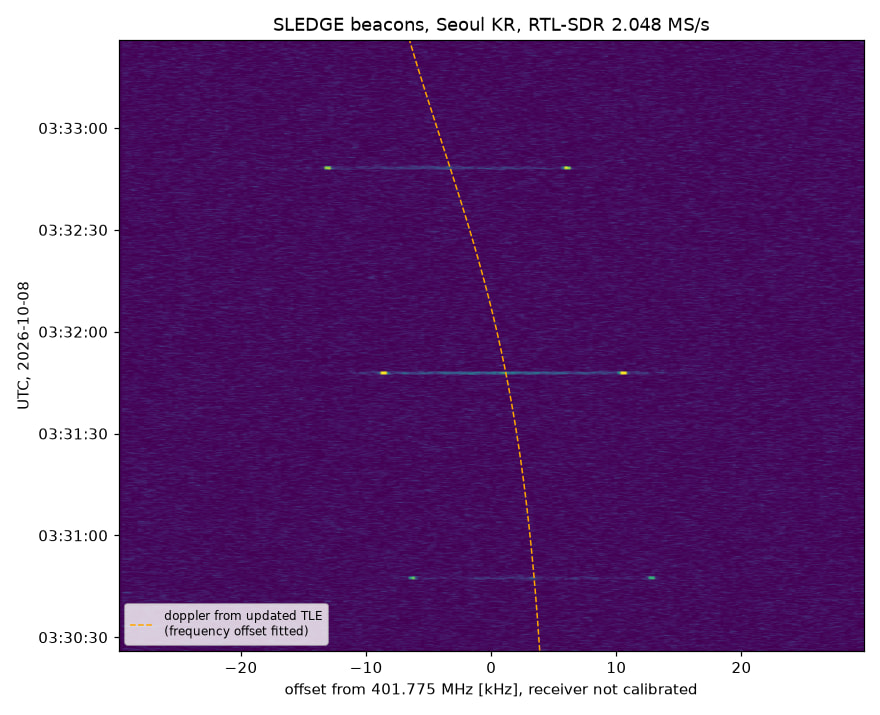
Reception report for SLEDGE from Seoul, KR, pass of 2026-10-08 around 03:33 UTC.

We received three beacons, at 03:30:47, 03:31:47 and 03:32:47 UTC. No single frame passed the CRC, but combining the frames within a burst recovered the AX.25 address field, ESGS01 → ABCDEF. This matches the PDU you posted earlier.

Your updated TLE matches our observation to within a few seconds. In the attached waterfall, the doppler curve from your updated TLE runs through all three bursts. We shifted it in frequency to fit, because our receiver is not calibrated. +1 for updating it.

4 Likes

Hi all,

Here’s a provisional TLE for GBSAT, generated from an initial state vector:

GBSAT
1 98243U          26280.15382832  .00000000  00000-0  22504-3 0  9992
2 98243  97.6615  16.3360 0011374  84.5968 100.3914 14.97736437    06

This TLE is based on the initial state vector and has not yet been validated against actual observations.

If you receive GBSAT’s signal, please share the SatNOGS observation link here. Any reception data or feedback would be greatly appreciated.

Thanks again for your continued support in tracking GBSAT!

73!

1 Like

Good morning,

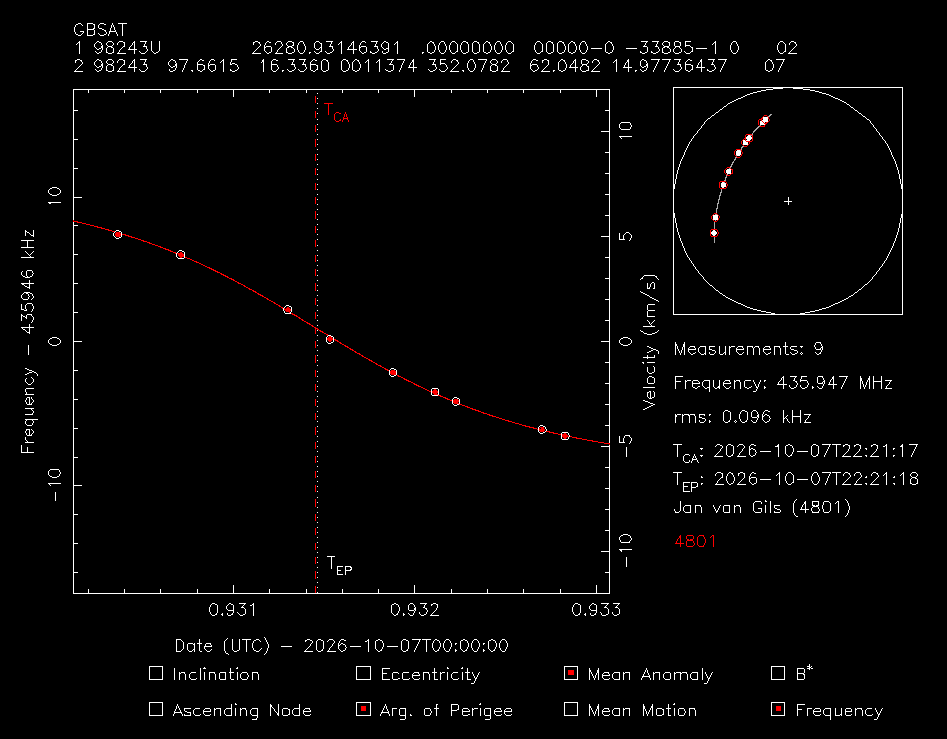
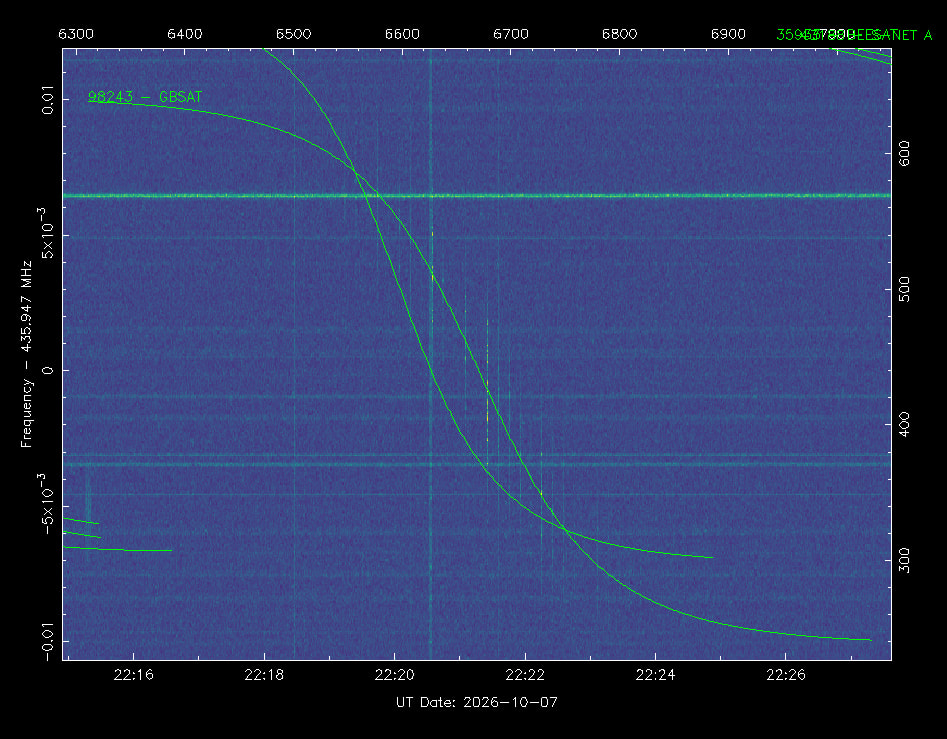
Is used your initial state vector TLE as a source and matched and corrected them with a STRF Doppler reception from last night. That gave me the following set:

It would be ideal if I had more data points, but it’s a start.

GBSAT
1 98243U          26280.93146391  .00000000  00000-0 -33885-1 0    02
2 98243  97.6615  16.3360 0011374 352.0782  62.0482 14.97736437    07
# 20261007.93-20261007.93, 9 measurements, 0.096 kHz rms

And here you can also see that a lack of coordination regarding frequency usage creates a high risk of mutual interference.

Jan | PE0SAT

4 Likes

감사합니다.

Thank you for sharing raw information, it will help a lot for operating our ground station.

2 Likes

I was also studying how to refine TLEs using STRF, so thank you very much for doing the refinement for us! We’ll try using this updated TLE for our upcoming passes!

To everyone who has requested a QSL card, I’m sorry for the delay. Our satellite is currently in emergency operations, so issuing the QSL cards may be delayed by 1–2 days. We’ll send them out one by one as soon as possible!

Once again, thank you so much to everyone in the community for your continued help and support!

73!

6 Likes

ello everyone,

I am Junhyeon Kim, a master’s student on the CPSAT team at Chosun University.

Thank you all for observing CPSAT and sharing your recordings. @EU1SAT, thank you for your reception report. @dl7ndr, we successfully parsed both the EPS1 and BAT frames you shared—thank you!

Doppler-fitted TLE for CPSAT (98194)

We fitted this set to the carrier frequency our laboratory ground station measured in its IQ recordings. Please use it for scheduling until a catalogue orbit is available:

CPSAT
1 98194U          26280.15371675  .00000000  00000-0  50000-4 0    17
2 98194  97.6611  16.3380 0011340  86.3337  98.0211 14.97366155    01
  • Fit: residual carrier in 0.5 s slices (SNR ≥ 15 dB) from four passes, 7 Oct 05:01, 14:10 and 15:45 UTC and 8 Oct 03:28 UTC. We fitted mean anomaly, mean motion and RAAN jointly, with a carrier offset per pass.
  • Check on a pass not used in the fit (8 Oct 05:03–05:13 UTC): the Doppler residual is 2.4 Hz RMS (max 6.3 Hz), with a timing offset of −0.28 s. Our earlier set gave 146 Hz RMS and about −20 s on the same pass.
  • The set now in SatNOGS DB (Satellite Team, mean motion 14.95702602 rev/day) does not match the same measurements well: its timing error grew from about +4 s to about +92 s between our first and last fitted passes, and was about +97 s on the check pass.
  • Request: could the SatNOGS team please update the CPSAT (98194) TLE in SatNOGS DB to the set above, so that scheduled observations start on time? We will post a new fit if the orbit drifts or a catalogue TLE appears.
  • Carrier: after removing Doppler, the CPSAT carrier sits about +220 to +270 Hz above 437.265 MHz in all five passes. This includes our receiver’s reference error, which we have not calibrated separately.

Receptions so far

Our laboratory ground station received five passes:

Pass start (UTC) KST Max El Beacons decoded
7 Oct 05:00 14:00 12.7° 12
7 Oct 14:10 23:10 17.9° 18
7 Oct 15:45 8 Oct 00:45 28.4° 14
8 Oct 03:27 12:27 46.2° 18
8 Oct 05:03 14:03 11.6° 13

Through the SatNOGS network we have 96 decoded CPSAT beacon records from 13 stations and 3 SIDS observers (7 Oct 06:08 – 8 Oct 02:14 UTC). Thank you to DK0SB, UX5UL, DEOS_RALF, DUS-NORD, MXL CSRB, KU4YJ, WH6GVF, JH4XSY, VU2JEK, VK2RZ, KD5QZG, Not Quite ESL, EU1XX, DL7NDR and SV2HWM. Some of these beacons were decoded from the uploaded audio of observations that have no frames in SatNOGS DB. Not all offline recoveries have been submitted to SatNOGS DB.

We have decoded beacon data from all ten modes, including ADCS.

Beacon format, HEX/WAV samples, and candidate decoder

@dl7ndr, thank you for offering to submit our decoder in post 41. Yes, please go ahead with the CPSAT decoder MR. We can provide additional received beacon frames and reference values for review.

SatNOGS Dashboard: we would also like to open a CPSAT dashboard on the SatNOGS Dashboard (dashboard.satnogs.org). We have already adapted our Grafana dashboard to the SatNOGS data source using the candidate decoder’s fields. Following the Satellite Operator Guide, we are requesting editor permissions through a satnogs-ops issue and will build the dashboard ourselves once the decoder is merged. We are happy to share the dashboard JSON for review. Please let us know if anything else is needed.

Reception timing and data notes

Of the 96 SatNOGS records:

Time basis Records
Source-reported reception timestamp 52
Estimated from recorded audio 34
Observation interval only; packet time unresolved 10

Audio estimates still carry uncertainty in the absolute recording start time. Where the packet time is unresolved, we keep only the observation interval and exclude the record from time-series plots. The same beacon received by several stations is counted once per station.

Daniel’s EPS1 and BAT frames match his SatNOGS DB uploads byte-for-byte, with reported reception times of 7 October, 13:02:58 and 13:03:18 UTC, respectively.

Earlier TLEs (for reference)

Our laboratory’s first recording (7 Oct 04:51:50–05:12:30 UTC) used this preliminary team-generated set. It was superseded by the Doppler-fitted set above:

CPSAT
1 98194U          26280.15371675  .00000000  00000-0  50000-4 0    17
2 98194  97.6611  16.3349 0011340  86.3337  98.0580 14.97711285    03

CHOSUN SSIL and JUN SatNOGS: the metadata of SatNOGS observations 15143288 (CHOSUN) and 15143357 (JUN) records this earlier SatNOGS Team set:

CPSAT
1 98194U          26280.14444444  .00000000  00000-0  50000-4 0    00
2 98194  97.6704  10.0320 0003597   0.0000 145.0950 14.98187870    03

No valid beacon frame has been recovered from those two observations.

Best regards,
Junhyeon Kim
CPSAT Team, Chosun University
9 Likes